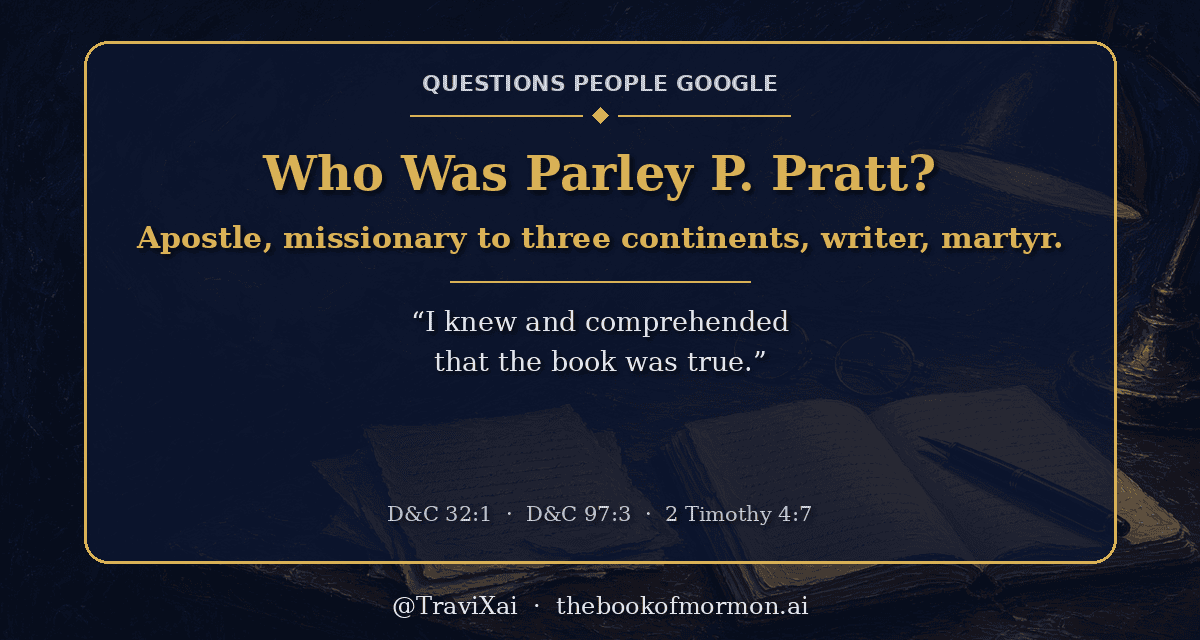

He read the Book of Mormon in a day, preached on three continents, wrote “The Morning Breaks”, and was murdered in Arkansas. Here is the whole life, including the hard parts.
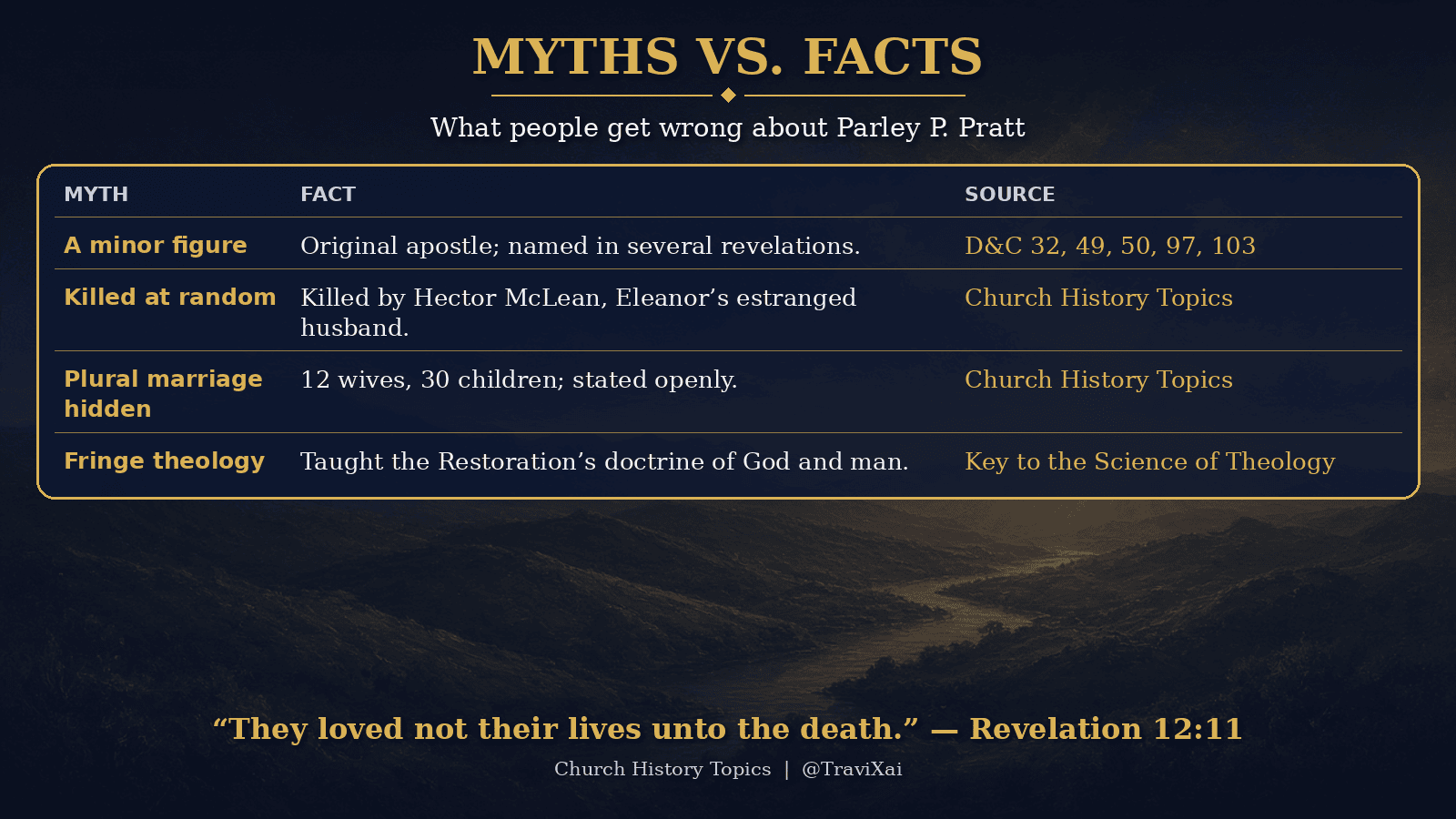
The question often assumes Parley P. Pratt was a minor figure, or that his death in Arkansas was a scandal he brought on himself. Neither holds up. Parley P. Pratt (1807–1857) was converted by the Book of Mormon in 1830, called by name in D&C 32, and chosen as one of the original Twelve Apostles in 1835. He helped convert Sidney Rigdon and John Taylor, served in England and Chile, wrote A Voice of Warning and hymns like “The Morning Breaks,” and was murdered in 1857 by Hector McLean, the estranged husband of his wife Eleanor.
Who he wasThe apostle who never stopped preaching
Parley Parker Pratt (1807–1857) was one of the original twelve apostles called in 1835, a missionary on three continents, the author of the most popular Latter-day Saint missionary book of the 19th century, and the writer of hymns Latter-day Saints still sing, including “The Morning Breaks,” the hymn that opens the 1985 hymnbook. He was murdered in Arkansas in 1857. His own summary, written to a boyhood friend four years before he died: “I have been a farmer, a servant, a fisher, a digger, a beggar, a preacher, an author, an editor, a senator, a merchant, an elder, and an Apostle of Jesus Christ.”
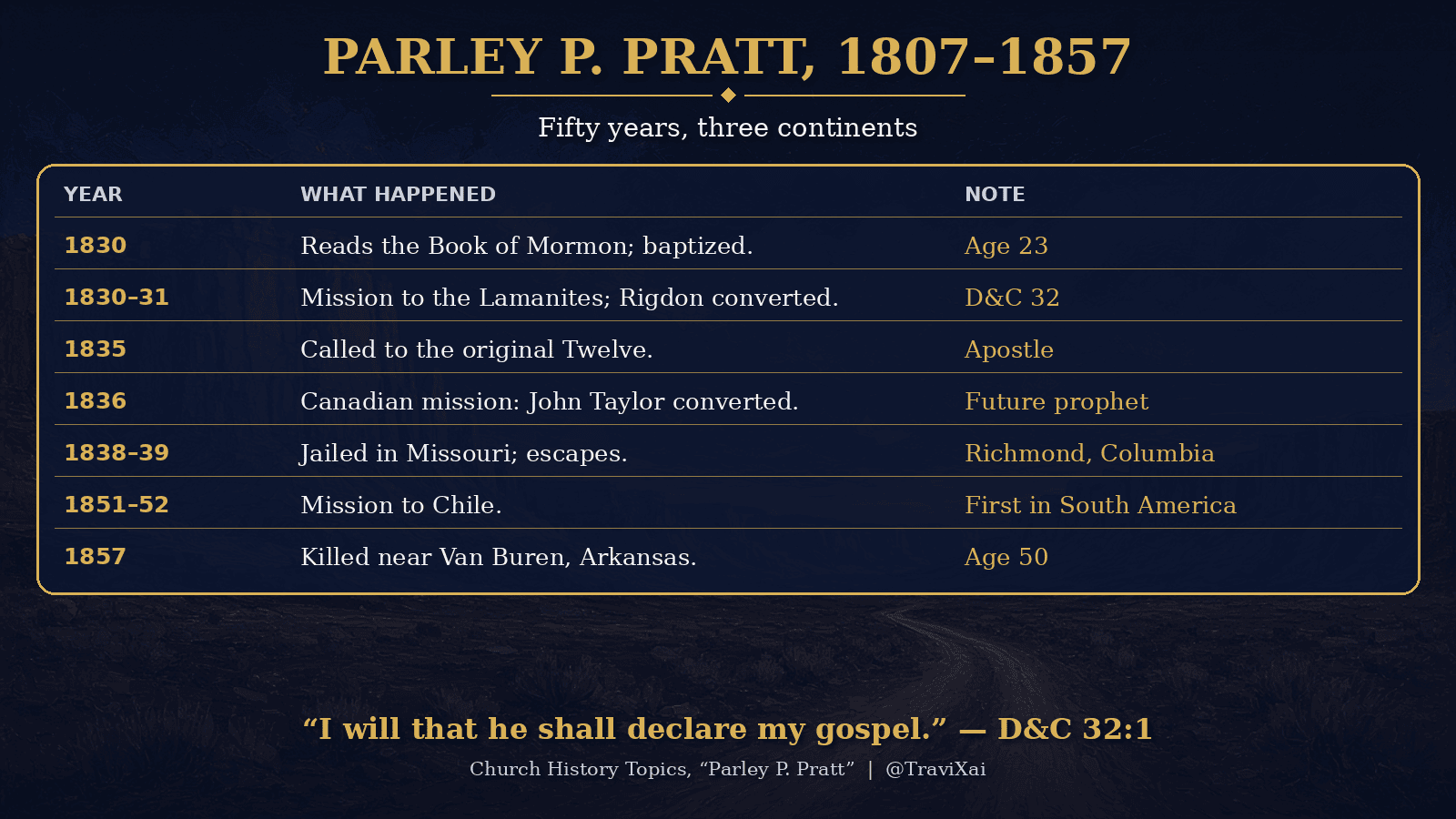
In 1830, at 23, he was living in Ohio, where Sidney Rigdon had been his pastor, when he felt prompted to go back to New York to preach. There he came across a copy of the Book of Mormon: “I read all day; eating was a burden, I had no desire for food; sleep was a burden when the night came, for I preferred reading to sleep.” His conclusion: “I knew and comprehended that the book was true.” He found Joseph Smith’s family and was soon baptized.
MissionaryFrom Kirtland to Chile
Almost at once the Lord called him by name: “concerning my servant Parley P. Pratt, behold, I say unto him that as I live I will that he shall declare my gospel and learn of me, and be meek and lowly of heart. And that which I have appointed unto him is that he shall go with my servants, Oliver Cowdery and Peter Whitmer, Jun., into the wilderness among the Lamanites” (D&C 32:1–2). On the way west they stopped near Kirtland to see his old pastor, Sidney Rigdon. More than 100 people in and around Kirtland joined the Church, including Sidney and Phebe Rigdon. That stop is a large part of why Kirtland became the Church’s next gathering place.
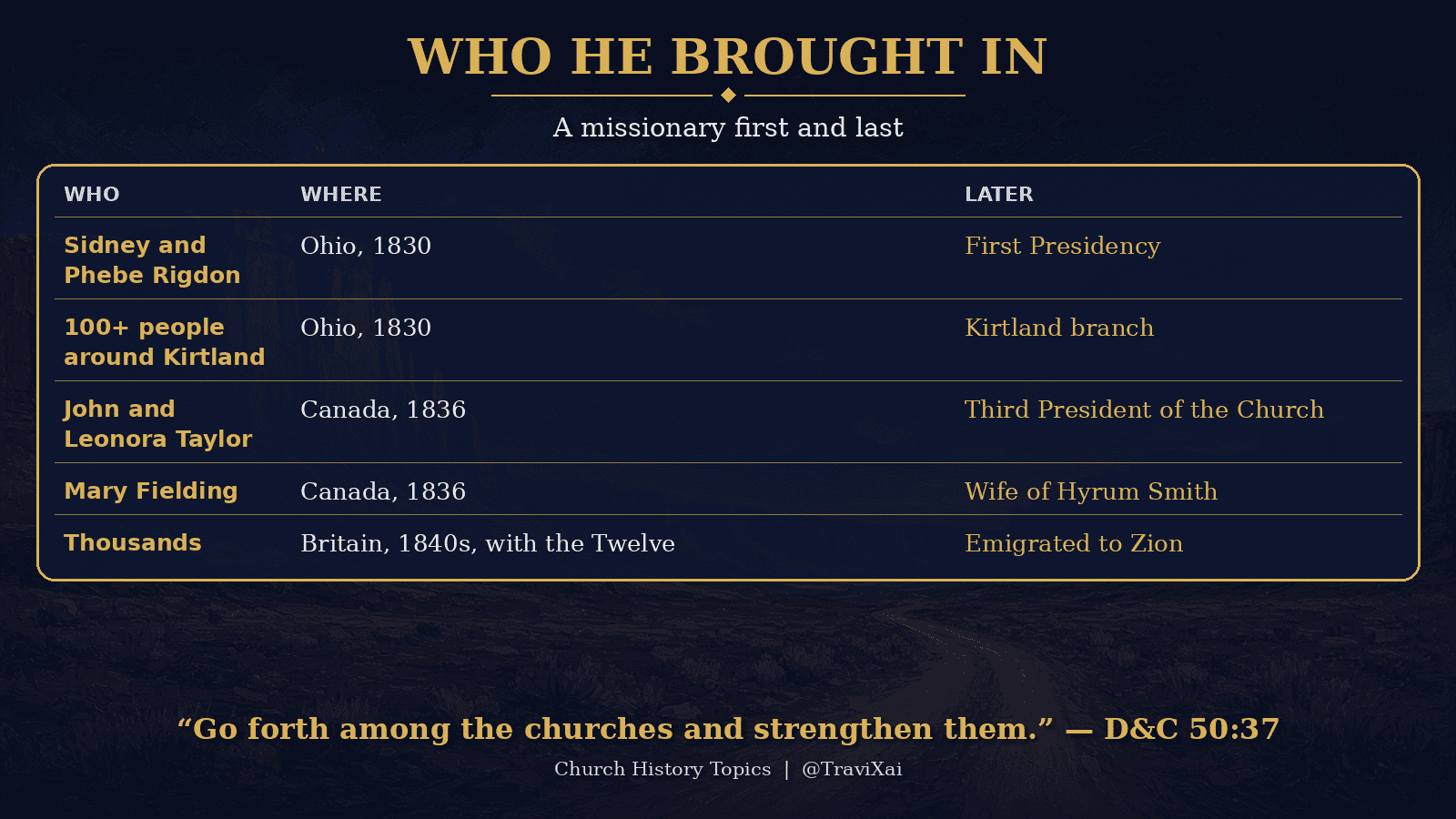
In 1836 a mission to Canada brought in John Taylor, later the third President of the Church, and his wife Leonora, as well as Mary Fielding, who married Hyrum Smith and became the mother and grandmother of Church Presidents. From 1839 to 1842 he served with the Twelve in England, where thousands joined the Church. In the early 1850s he supervised the Pacific missions and went to Chile with his wife Phebe and Rufus Allen, the first Latter-day Saint missionaries in South America. He studied Spanish there and wrote to Brigham Young suggesting every apostle learn other languages so the gospel could reach the world. The Church in South America today has millions of members. He saw it first. See What Is the Gathering of Israel?.
Writer and theologianA Voice of Warning and the Key
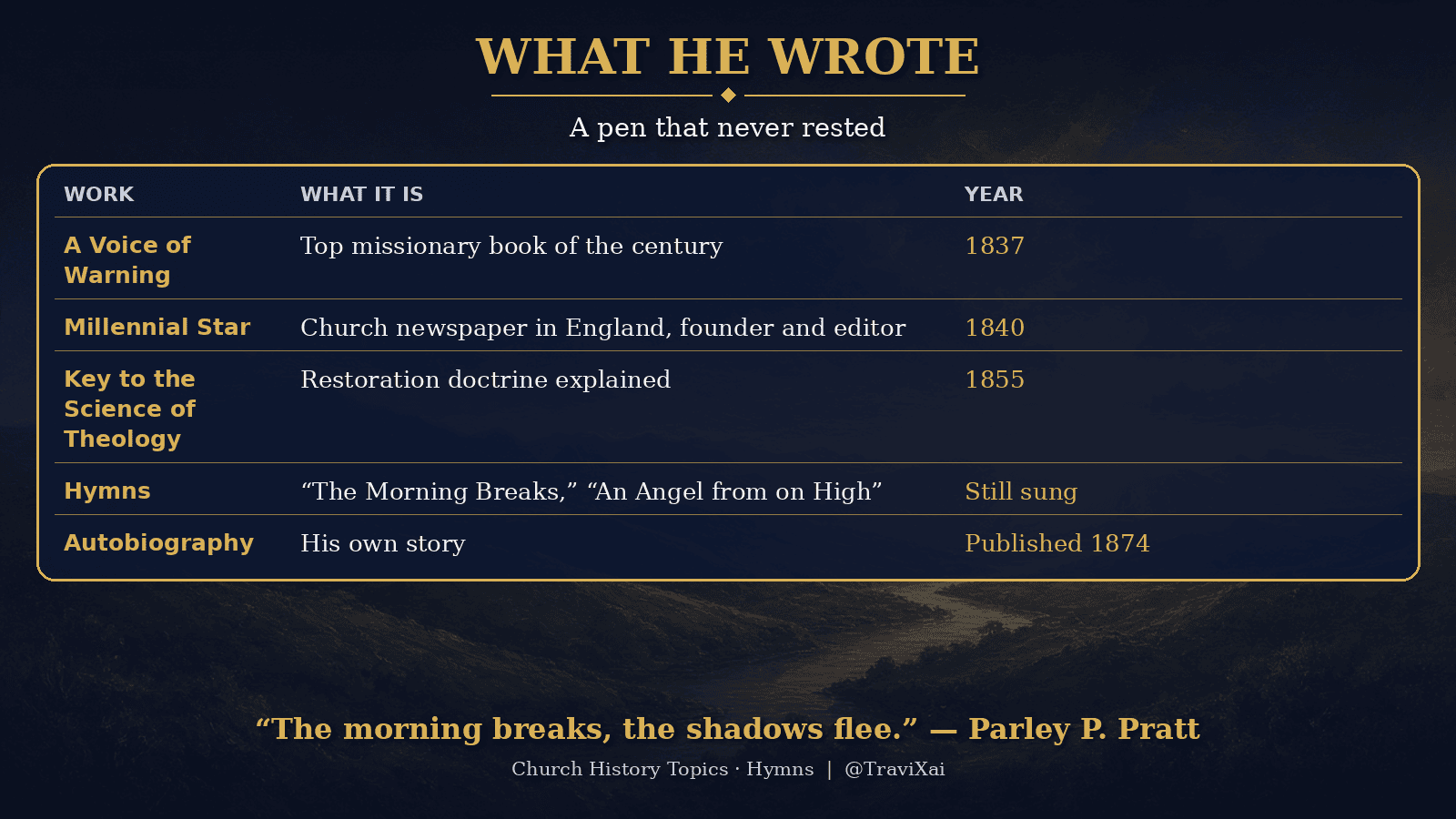
Parley wrote constantly. A Voice of Warning (1837) was one of the most popular missionary books of the 19th century. In England he founded and edited the Latter-day Saints’ Millennial Star. In 1855 he published Key to the Science of Theology, a systematic explanation of Restoration doctrine. His hymns are still in the hymnbook: “The Morning Breaks,” “An Angel from on High” and “Come, O Thou King of Kings.”
The Key is unapologetic about what the Restoration teaches regarding God and man: “Gods, angels and men, are all of one species, one race, one great family widely diffused among the planetary systems, as colonies, kingdoms, nations, &c.” In the same chapter he is just as clear about rank: “there is one Supreme Head, who is over all, and through all, and in all His sons.” That is the doctrine exactly: we are His offspring, of His kind, capable of eternal progression across worlds without number, and He is always our Father and always above us. Parley also learned from Joseph Smith, in his words, “that the wife of my bosom might be secured to me for time and all eternity.” See What Is Eternal Marriage?.
TrialsPrison, plural marriage and a hard family story
Parley lived the persecution. When the Saints were expelled from Missouri in 1838–39, he was arrested for his part in a battle with Missourians (the skirmish at Crooked River) and spent months in jail in Richmond and Columbia before escaping and rejoining the Saints in Illinois. See Why Was Joseph Smith in Liberty Jail? and What Happened at Haun’s Mill?. In 1847 he and John Taylor led a large company to the Salt Lake Valley.
His family life is part of the record, and the Church tells it plainly. His first wife, Thankful Halsey, died in 1837 giving birth to their first child. He then married Mary Ann Frost Stearns, a widow, who served with him in England. They accepted plural marriage together after returning in the early 1840s. He married his first plural wife in 1843, eventually married 12 women and was the father of 30 children. His wives described a generally harmonious household. See Does the LDS Church Still Practice Polygamy?.
His deathArkansas, May 1857
His last wife, Eleanor Jane McComb, had joined the Church in California. By her account her husband, Hector McLean, was an abusive alcoholic who sent their children to her parents in New Orleans after she was baptized. She left him and moved to Salt Lake City. At a time when divorces were hard to obtain, she considered the marriage over though they were never legally divorced, and in November 1855 she married Parley. When she tried to retrieve her children, her father alerted McLean. McLean had Parley arrested in Arkansas in May 1857; a federal judge released him, and McLean followed Parley and killed him near Van Buren, Arkansas.
That is the honest version. Critics sometimes tell it as if Parley simply stole another man’s wife and got what was coming. That skips the abuse Eleanor described, the separated children and the fact that a judge released Parley before McLean murdered him. Saints sometimes tell it as a pure martyrdom with no context. The full story is a man killed for a marriage that came out of his faith, and the Saints mourned him as a martyr. News of his death reached Utah that summer amid rising tension with outsiders; historians count it among the grievances in the air before Mountain Meadows, which explains the mood and excuses nothing. See What Was the Mountain Meadows Massacre?.
The BibleA finished course
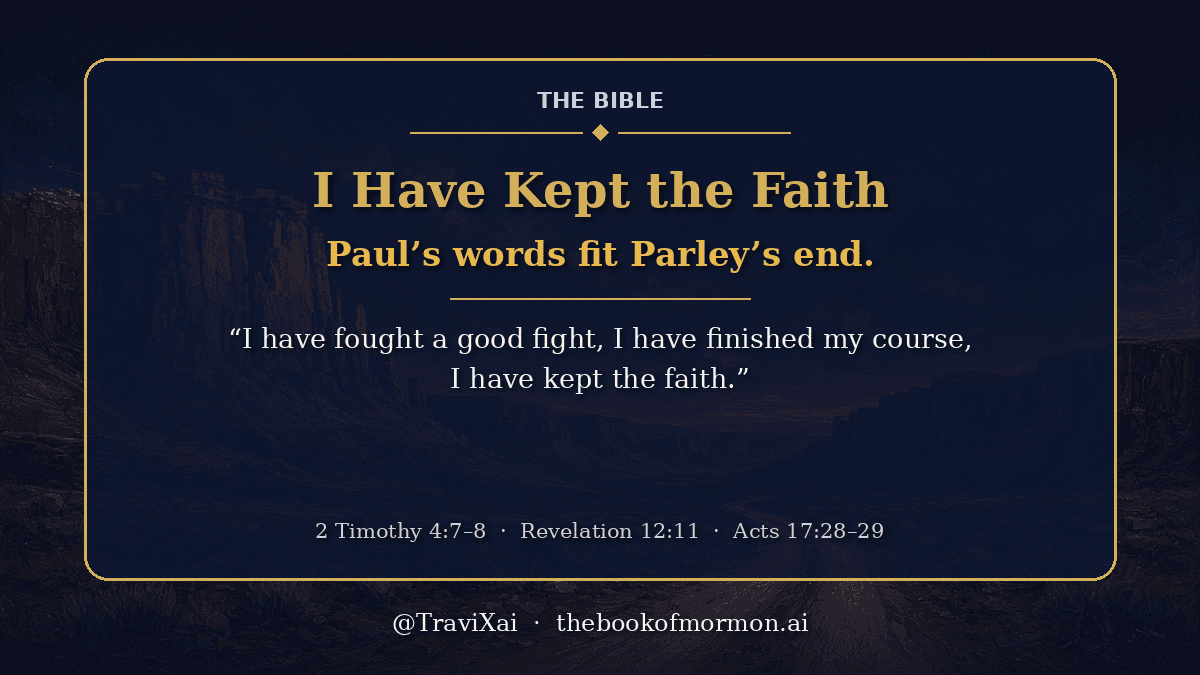
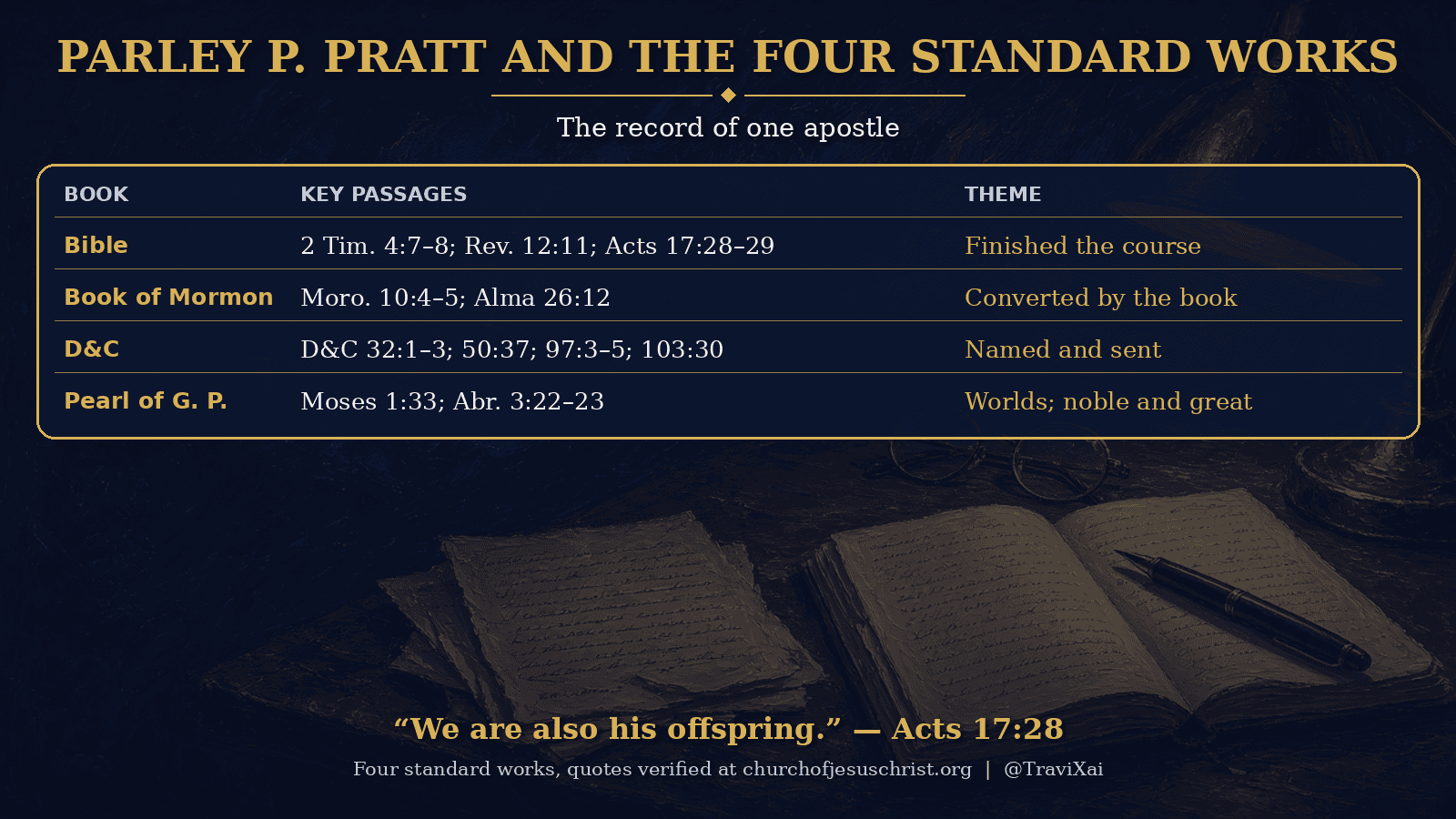
Paul’s words at the end of his life fit Parley’s: “I have fought a good fight, I have finished my course, I have kept the faith: Henceforth there is laid up for me a crown of righteousness, which the Lord, the righteous judge, shall give me at that day” (2 Timothy 4:7–8). John’s description of the martyrs fits too: “they overcame him by the blood of the Lamb, and by the word of their testimony; and they loved not their lives unto the death” (Revelation 12:11).
And Parley’s theology starts where Paul’s sermon on Mars Hill starts: “For in him we live, and move, and have our being; as certain also of your own poets have said, For we are also his offspring. Forasmuch then as we are the offspring of God, we ought not to think that the Godhead is like unto gold, or silver, or stone” (Acts 17:28–29). Offspring are of the same kind as their Father. That is all “one species, one race, one great family” means.
The Book of MormonThe book that would not let him sleep
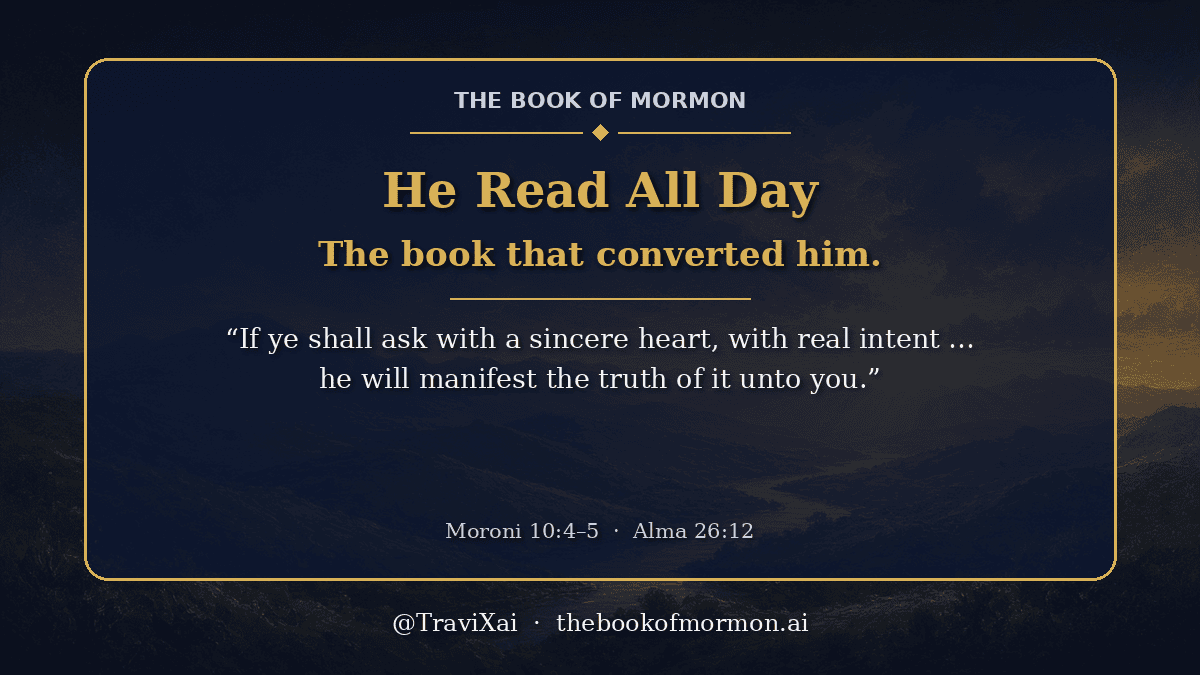
Parley did what Moroni asked readers to do: “ask God, the Eternal Father, in the name of Christ, if these things are not true; and if ye shall ask with a sincere heart, with real intent, having faith in Christ, he will manifest the truth of it unto you, by the power of the Holy Ghost. And by the power of the Holy Ghost ye may know the truth of all things” (Moroni 10:4–5). He read, he asked, he knew, and he spent the next 27 years preaching it. His attitude was Ammon’s: “I know that I am nothing; as to my strength I am weak; therefore I will not boast of myself, but I will boast of my God, for in his strength I can do all things” (Alma 26:12). See Is the Book of Mormon True?.
The Doctrine and CovenantsNamed in four revelations
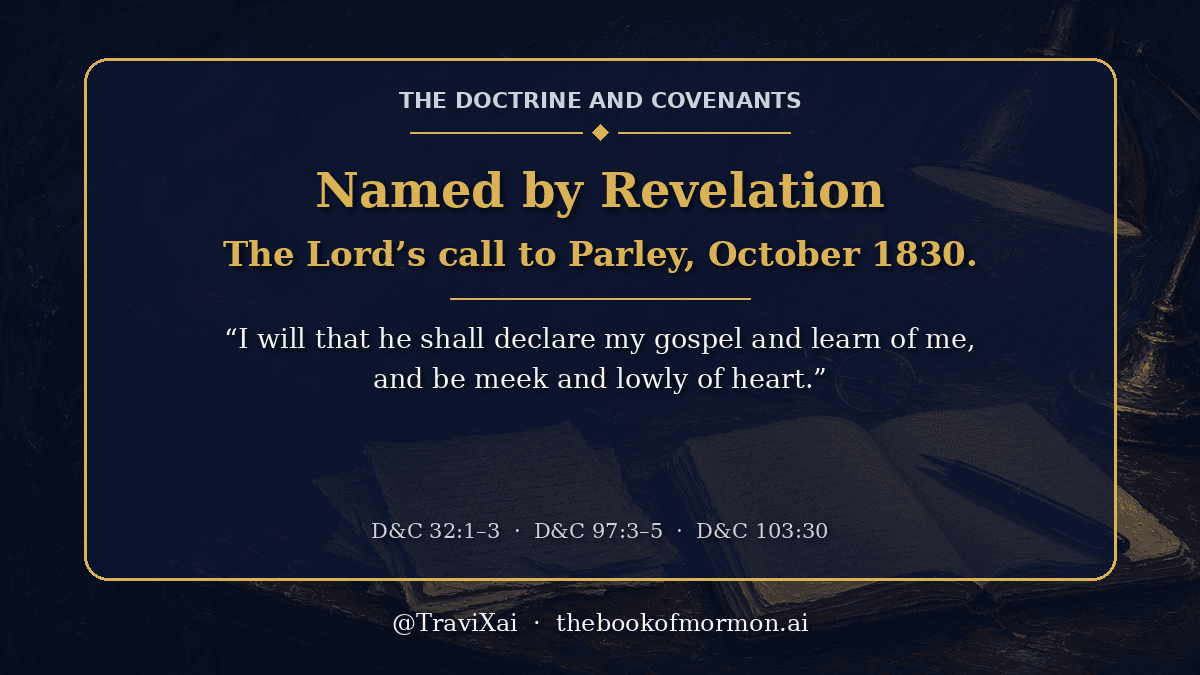
Parley is named in several sections, including D&C 49, which sent him to the Shakers. D&C 32 sent him to the Lamanites with the promise “I myself will go with them and be in their midst; and I am their advocate with the Father, and nothing shall prevail against them” (D&C 32:3). D&C 50 sent him to “go forth among the churches and strengthen them by the word of exhortation” (D&C 50:37). In D&C 97 the Lord said He was pleased with the school in Zion “and also with my servant Parley P. Pratt, for he abideth in me,” and promised to bless him “in expounding all scriptures and mysteries” (D&C 97:3–5). And D&C 103 sent him to recruit for Zion’s Camp (D&C 103:30). See What Was Zion’s Camp?.
The Pearl of Great PriceWorlds without number
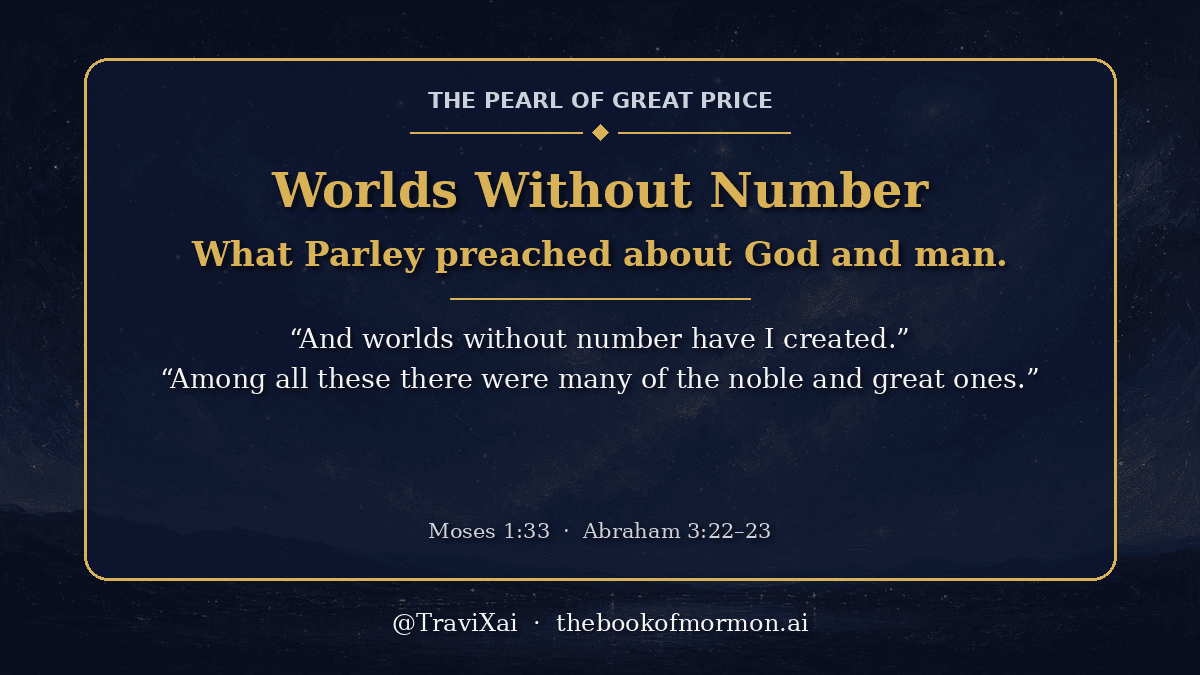
The doctrine Parley spent his pen on comes straight from the Pearl of Great Price. To Moses: “worlds without number have I created; and I also created them for mine own purpose; and by the Son I created them, which is mine Only Begotten” (Moses 1:33). To Abraham: “the Lord had shown unto me, Abraham, the intelligences that were organized before the world was; and among all these there were many of the noble and great ones … and he said unto me: Abraham, thou art one of them; thou wast chosen before thou wast born” (Abraham 3:22–23). Parley’s “planetary systems” and “series of progressive being” are those verses taken seriously. See What Is the Book of Abraham?.
Check the premiseThe presuppositions baked into the question
Before this question can be answered fairly, the person asking has to justify a few assumptions packed inside it:
- That Parley P. Pratt was a minor early convert. He was one of the original Twelve Apostles, named in several revelations, and brought in Sidney Rigdon, John Taylor and Mary Fielding.
- That his death proves he was a home-wrecker. By Eleanor’s account her husband was abusive and had sent her children away; a federal judge released Parley before Hector McLean followed and murdered him.
- That the Church hides his plural marriages. The Church’s own history states he married 12 women and had 30 children.
- That his theology was a fringe invention. His “one great family” teaching restates Acts 17:28–29, Moses 1:33 and Abraham 3:22–23, and he kept the Father as “one Supreme Head, who is over all.”
FAQQuick answers
Who was Parley P. Pratt?
One of the original twelve apostles of the restored Church (1835), a missionary on three continents, an author and hymn writer, killed in Arkansas in 1857.
How was Parley P. Pratt converted?
In 1830 he read the Book of Mormon, later writing, “I knew and comprehended that the book was true,” and was soon baptized.
What did Parley P. Pratt write?
A Voice of Warning (1837), Key to the Science of Theology (1855), the Millennial Star, an autobiography, and hymns like “The Morning Breaks.”
Who did Parley P. Pratt convert?
Sidney and Phebe Rigdon, more than 100 people around Kirtland, John and Leonora Taylor, and Mary Fielding, among many others.
How did Parley P. Pratt die?
He was murdered near Van Buren, Arkansas, in May 1857 by Hector McLean, the estranged husband of his wife Eleanor.
Was Parley P. Pratt the first missionary in South America?
Yes. He, his wife Phebe and Rufus Allen went to Chile in the early 1850s, the first Latter-day Saint missionaries in South America.
How many wives did Parley P. Pratt have?
According to the Church’s history, he married 12 women during his life and was the father of 30 children.
What hymns did Parley P. Pratt write?
Among others, “The Morning Breaks,” “An Angel from on High” and “Come, O Thou King of Kings,” still in the hymnbook.
SummaryKey takeaways
- Converted by the Book of Mormon in 1830; named in D&C 32, 50, 97 and 103.
- One of the original Twelve Apostles, called in 1835.
- Helped convert Sidney Rigdon, John Taylor and Mary Fielding; first missionary in South America.
- Wrote A Voice of Warning, Key to the Science of Theology and “The Morning Breaks.”
- Murdered in Arkansas in 1857 by Hector McLean.
Sing “The Morning Breaks” this Sunday and think of him. For quick, sourced answers, open Galatians18, and follow me on X at @TraviXai.
Sources
- King James Bible (churchofjesuschrist.org): Acts 17:28–29 · 2 Timothy 4:7–8 · Revelation 12:11
- Book of Mormon: Alma 26:12 · Moroni 10:4–5
- Doctrine and Covenants: D&C 32:1–3 · D&C 50:37 · D&C 97:3–5 · D&C 103:30
- Pearl of Great Price: Moses 1:33 · Abraham 3:22–23
- Church History Topics, “Parley P. Pratt” · The Autobiography of Parley P. Pratt · Parley P. Pratt, Key to the Science of Theology (1855), ch. 5
- Terryl L. Givens and Matthew J. Grow, Parley P. Pratt: The Apostle Paul of Mormonism (Oxford University Press, 2011)
- Featured image and in-article graphic: original graphics by thebookofmormon.ai (painterly backgrounds; no photographs or likenesses of real people).