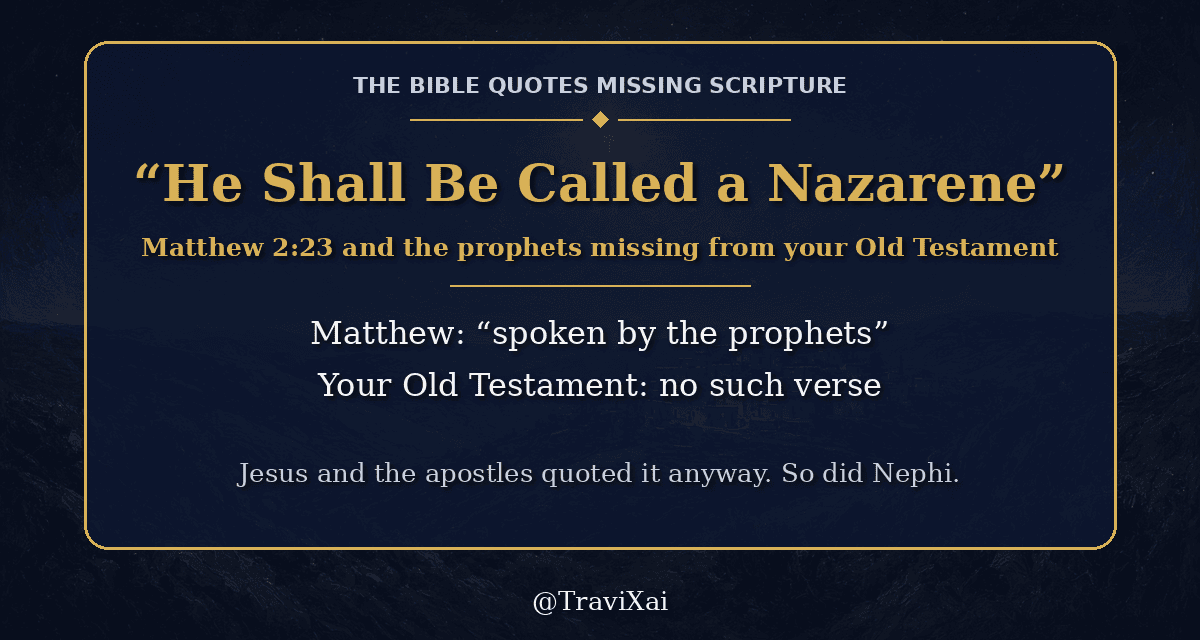

Matthew quotes “the prophets” saying “He shall be called a Nazarene.” No Old Testament prophet says it. Jesus, James, and Paul quote lines we can’t find either. So why is Zenos a fraud?
Home › Answering Critics › Start here: Are Latter-day Saints Christian? · Is the Bible All of God’s Words?
No Old Testament verse says “He shall be called a Nazarene.” Matthew 2:23 says it was “spoken by the prophets” anyway. Jesus, James, and Paul also quote words as scripture that aren’t in our Old Testament. Chrysostom’s answer in the 300s: “many of the prophetic writings have been lost.” The Book of Mormon says the same thing, and names some of those prophets.
“Zenos isn’t in the Bible. Joseph Smith made him up.” I hear it all the time. Ok, fair enough. A prophet nobody can find in the Old Testament is suspicious…. Let’s run that test on Matthew.
Then on Jesus. Then on James and Paul. Because the New Testament keeps quoting scripture we don’t have, and it does it with a straight face: “as it is written,” “the scripture saith,” “spoken by the prophets.” I love the Bible. I’m not here to tear it down. I’m here to show you the critic’s rule fails on the Bible first.
Check the assumptions first
The “Zenos is fake” argument leans on assumptions the New Testament doesn’t share:
- That every true prophet is in our Old Testament. Matthew cites “the prophets” for words none of our prophets say.
- That “it is written” always points to a verse we have. Jesus says “as the scripture hath said,” and commentators still can’t find the verse.
- That God was done talking when the record was collected. John says the books about Jesus alone would fill the world (John 21:25).
- That one standard works for both books. Matthew gets “lost books.” Nephi gets “made up.”
Exhibit AMatthew: “spoken by the prophets”
Joseph, Mary, and the young child come back from Egypt and settle in Galilee. Then Matthew adds this:
And he came and dwelt in a city called Nazareth: that it might be fulfilled which was spoken by the prophets, He shall be called a Nazarene.
Matthew 2:23 (KJV)
Look for it. You won’t find it. Not in Isaiah, not in Jeremiah, not anywhere. The Expositor’s Greek Testament puts it flatly: “In no one place can any such statement be found.”
The best guess is a wordplay. Isaiah says “a Branch shall grow out of his roots” (Isaiah 11:1), and the Hebrew for branch is netzer. Fair possibility. Some reach for Samson the “Nazarite” (Judges 13:5), but a Nazarite is a vow, not a hometown. And Matthew didn’t say “a pun on Isaiah.” He said “the prophets,” PLURAL, and gave the words.
So what did the early church say? John Chrysostom, the most famous preacher of the 300s, asked the question himself:
And what manner of prophet said this? Be not curious, nor overbusy. For many of the prophetic writings have been lost; and this one may see from the history of the Chronicles.
John Chrysostom, Homily 9 on Matthew
He goes on: “some they suffered to perish, others they themselves burnt up and cut to pieces.” Later Greek commentator Euthymius Zigabenus followed him: “many prophetic books were lost” (Bible Hub commentaries). Meyer lists Chrysostom and Theophylact among those who read Matthew 2:23 as “a quotation from a lost prophetical book.” Meyer himself disagreed. Fine. But an “orthodox” saint said it plainly. Nobody called him a fraud.
Exhibit BJesus does it too
Matthew could be the odd one out. He isn’t. Jesus does it.
“As the scripture hath said”
He that believeth on me, as the scripture hath said, out of his belly shall flow rivers of living water.
John 7:38 (KJV)
Which scripture? Barnes admits “no such expression as follows is to be found literally in the Old Testament.” Ellicott says the words “are not found in any part of the Canonical Scriptures of the Old Testament, and yet Christ Himself utters them with the formula of quotation.” The Cambridge Bible points to verses like Isaiah 58:11, then admits “none of them contain the very remarkable expression” Jesus quoted (commentaries on John 7:38).
“Said the wisdom of God”
Therefore also said the wisdom of God, I will send them prophets and apostles, and some of them they shall slay and persecute:
Luke 11:49 (KJV)
That sounds like a citation. Meyer says it is, and that “no such passage occurs in it,” meaning the Old Testament. Ellicott notes some scholars guessed at a lost book called “The Wisdom of God,” but “there is no trace of the existence of a book with that name” (commentaries on Luke 11:49). Either way, we don’t have it.
“Thus it is written”
And said unto them, Thus it is written, and thus it behoved Christ to suffer, and to rise from the dead the third day:
Luke 24:46 (KJV)
Where is it written that Christ rises the third day? The usual answer is Hosea 6:2: “in the third day he will raise us up.” Read it. That’s Israel talking about us. Jonah is a sign Jesus pointed to (Matthew 12:40), not a written prophecy. Jesus said “it is written.” Show me the page.
“He saw it”
“Your father Abraham rejoiced to see my day: and he saw it, and was glad” (John 8:56). When? Genesis never tells us. The closest is a place name, “In the mount of the Lord it shall be seen” (Genesis 22:14). Jesus knew something about Abraham that our Genesis doesn’t record.
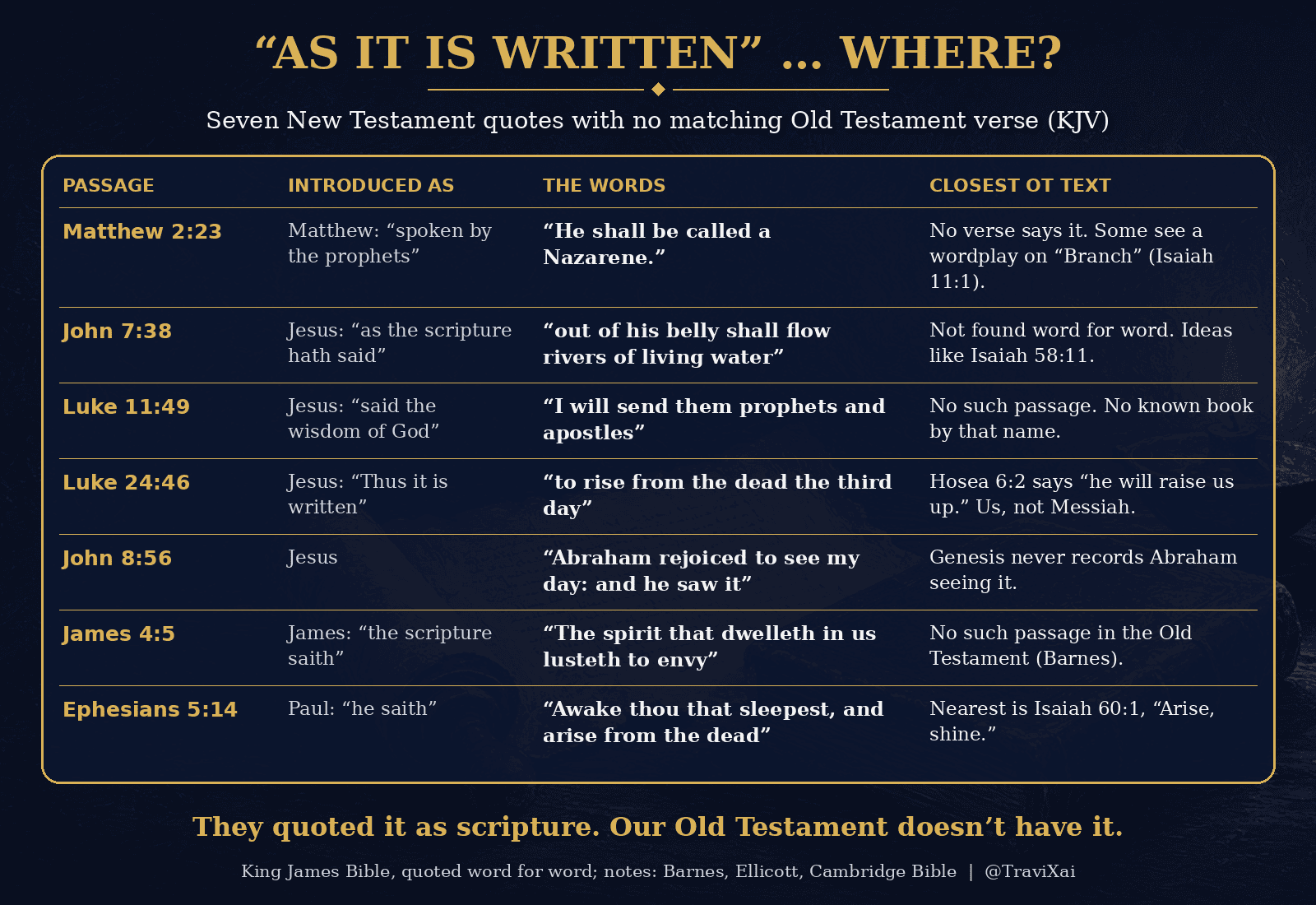
Exhibit CThe apostles do the same
James: “the scripture saith”
Do ye think that the scripture saith in vain, The spirit that dwelleth in us lusteth to envy?
James 4:5 (KJV)
Barnes: “Few passages of the New Testament have given expositors more perplexity than this.” Why? Because “no such passage as that which seems here to be quoted is found in the Old Testament” (Barnes on James 4:5). His fixes: maybe a gloss, maybe an apocryphal book, maybe “the general spirit” of the Old Testament. James said “the scripture.” He meant a scripture.
Paul: “he saith”
Wherefore he saith, Awake thou that sleepest, and arise from the dead, and Christ shall give thee light.
Ephesians 5:14 (KJV)
The Pulpit Commentary: “But no such words occur in the Old Testament.” Barnes: “It is agreed on all hands that it is not found, in so many words, in the Old Testament” (commentaries on Ephesians 5:14). The nearest is Isaiah 60:1, “Arise, shine; for thy light is come.” Close. Not it.
Add Jude quoting Enoch’s prophecy (I covered that in Jude 1:14 and Enoch), and the books the Old Testament itself names and we no longer have (Jasher, Nathan, Gad, and the rest). This isn’t one stray verse. It’s a pattern.
The standardNow do Zenos
Now the New Testament’s big claim. Jesus taught “beginning at Moses and all the prophets” (Luke 24:27). Peter said “all the prophets from Samuel and those that follow after” foretold these days (Acts 3:24), and “To him give all the prophets witness” (Acts 10:43). ALL the prophets. Then read the Old Testament and count how many name a suffering, rising Messiah. I walked through that gap in The Old Testament Was Christian. So Who Took Christ Out?.
The Book of Mormon fills that gap with names. Nephi quotes prophets from the brass plates, a record from Jerusalem around 600 B.C.:
…to be lifted up, according to the words of Zenock, and to be crucified, according to the words of Neum, and to be buried in a sepulchre, according to the words of Zenos…
1 Nephi 19:10
And look how they died. “The prophet Zenos did testify boldly; for the which he was slain” (Helaman 8:19). Zenock “testified of the Son of God, and because the people would not understand his words they stoned him to death” (Alma 33:17). That’s exactly what Jesus said about the missing prophets in Luke 11: “some of them they shall slay and persecute.” Stephen said the same: “Which of the prophets have not your fathers persecuted?” (Acts 7:52)
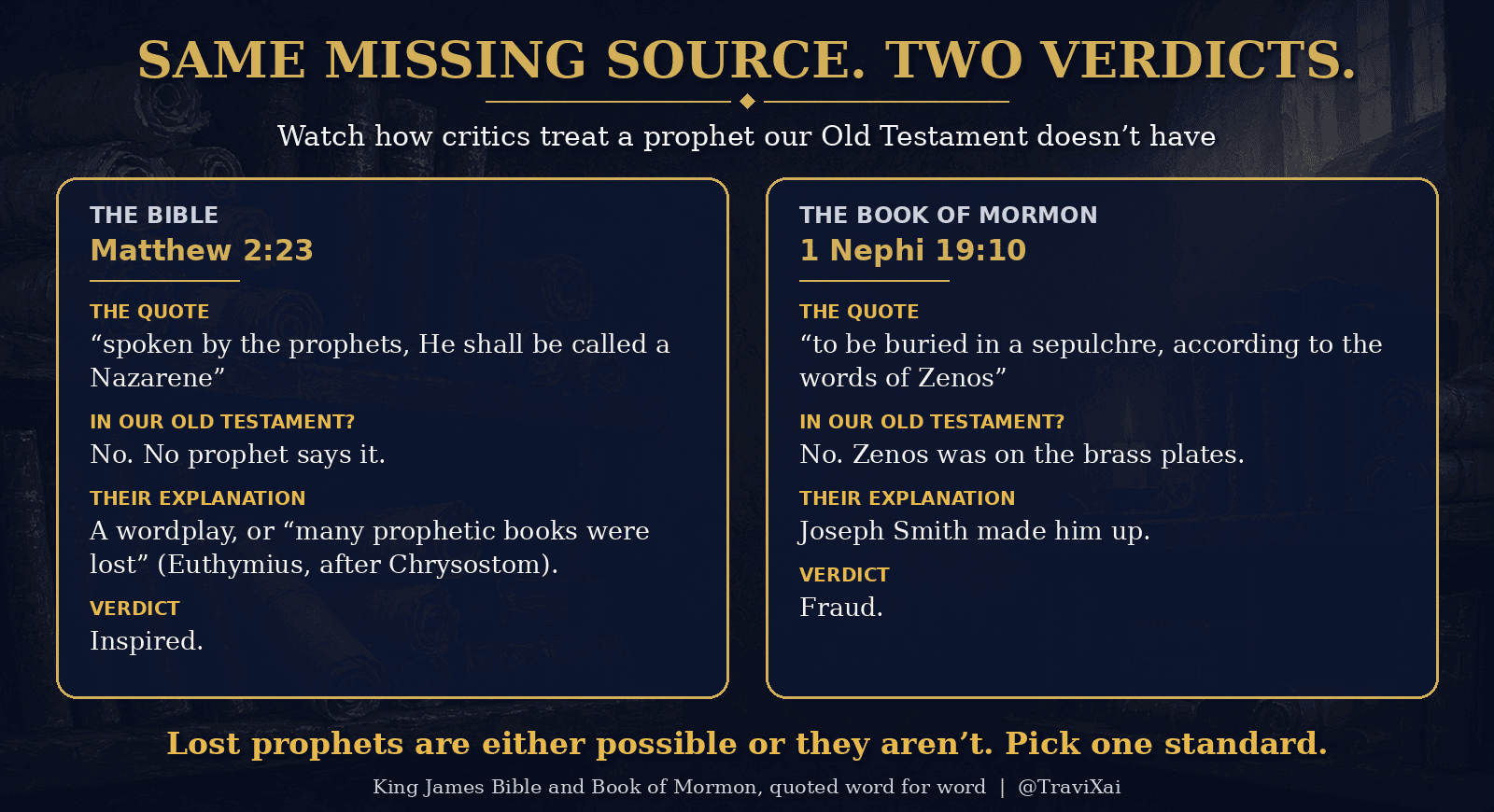
So here’s the score. Matthew quotes unnamed prophets we don’t have: inspired. Chrysostom says the books were lost: saint. Nephi quotes NAMED prophets we don’t have, who preached Christ and were killed for it: fraud. Yeah, ok!
If lost prophets can’t be real, Matthew 2:23 goes first.
The answerJesus checks the record
Here’s the part critics never see coming. The Book of Mormon doesn’t just claim missing scripture. It shows Jesus checking a record for it.
After His resurrection, Jesus visits the Nephites, asks for their records, and says: “Behold, other scriptures I would that ye should write, that ye have not” (3 Nephi 23:6). He asks about Samuel the Lamanite’s prophecy that saints would rise. They say it was fulfilled. Then:
How be it that ye have not written this thing, that many saints did arise and appear unto many and did minister unto them?
3 Nephi 23:11
A missing fulfillment, caught by the Lord and written in. That’s the opposite of “every word was preserved.” Nephi saw the Bible’s side of it too: “many plain and precious things taken away from the book” (1 Nephi 13:28). And the fix God promised: later records would “establish the truth of the first” and “make known the plain and precious things which have been taken away” (1 Nephi 13:40).
Not a rival to the Bible. A witness next to it. Matthew said “the prophets.” The Book of Mormon says, here are some of them. For why the canon was never closed in the first place, read The Canon Was Never Meant to Close.
What all four standard works say about missing scripture
The Bible
And there are also many other things which Jesus did, the which, if they should be written every one, I suppose that even the world itself could not contain the books that should be written. Amen.
John 21:25
The Book of Mormon
Wherefore, because that ye have a Bible ye need not suppose that it contains all my words; neither need ye suppose that I have not caused more to be written.
2 Nephi 29:10
The Doctrine and Covenants
These things were all written in the book of Enoch, and are to be testified of in due time.
D&C 107:57
The Pearl of Great Price
And in a day when the children of men shall esteem my words as naught and take many of them from the book which thou shalt write, behold, I will raise up another like unto thee; and they shall be had again among the children of men—among as many as shall believe.
Moses 1:41
SummaryKey takeaways
- Matthew 2:23 quotes “the prophets”: “He shall be called a Nazarene.” No Old Testament verse says it.
- Jesus quotes words as scripture we can’t find: John 7:38, Luke 11:49, and the third-day prophecy in Luke 24:46. John 8:56 knows something Genesis never records.
- James 4:5 and Ephesians 5:14 do it too. Protestant commentators like Barnes and Ellicott admit it.
- Chrysostom’s answer for Matthew 2:23: “many of the prophetic writings have been lost.”
- The Book of Mormon names lost prophets, Zenos and Zenock, who preached Christ and were killed. Same missing source. Pick one standard.
He shall be called a Nazarene: quick answers
Where does the Old Testament say “He shall be called a Nazarene”?
Nowhere, word for word. Matthew 2:23 says it was “spoken by the prophets.” Many connect it to the “Branch” (Hebrew netzer) of Isaiah 11:1. Chrysostom said “many of the prophetic writings have been lost.”
Does Jesus quote scripture that isn’t in the Old Testament?
John 7:38 (“as the scripture hath said, out of his belly shall flow rivers of living water”) and Luke 11:49 (“said the wisdom of God”) cite words no Old Testament verse contains, as Barnes, Ellicott, and Meyer note.
What scripture is James 4:5 quoting?
No one knows. Barnes says “no such passage as that which seems here to be quoted is found in the Old Testament.”
Where is Ephesians 5:14 from?
Not from the Old Testament word for word. The nearest is Isaiah 60:1, “Arise, shine; for thy light is come.” Some think Paul quoted an early hymn or a source we no longer have.
Who were Zenos and Zenock?
Israelite prophets quoted in the Book of Mormon from the brass plates. They testified of Christ (1 Nephi 19:10; Alma 33), and both were killed (Helaman 8:19; Alma 33:17).
What are the “plain and precious things” in 1 Nephi 13?
Nephi saw that “many plain and precious things” would be “taken away from the book” (1 Nephi 13:28), and that later records would restore them (1 Nephi 13:40).
Where can I read more about lost books of the Bible?
Next time someone says Zenos is made up because he isn’t in the Bible, ask them which prophet said “He shall be called a Nazarene.” For quick, sourced answers on continuing revelation and an open canon, “you can’t add to the Bible”, and the Great Apostasy, open Galatians18. And for more like this every day, follow me on X at @TraviXai.
Sources
- Bible (KJV, churchofjesuschrist.org): Matthew 2:23 · John 7:37–39 · Luke 11:49–51 · Luke 24:25–27, 44–46 · John 8:56–58 · James 4:5 · Ephesians 5:14 · Acts 3:24 · Acts 10:43 · Acts 7:52 · Matthew 12:40 · John 21:25 · Isaiah 11:1 · Isaiah 58:11 · Isaiah 60:1 · Hosea 6:2 · Judges 13:5 · Genesis 22:14
- John Chrysostom, Homily 9 on Matthew (Nicene and Post-Nicene Fathers, New Advent)
- Matthew 2:23 commentaries (Benson, Meyer, Expositor’s Greek Testament): Bible Hub
- John 7:38 commentaries (Barnes, Ellicott, Cambridge Bible): Bible Hub
- Luke 11:49 commentaries (Ellicott, Meyer): Bible Hub
- James 4:5 commentaries (Barnes): Bible Hub
- Ephesians 5:14 commentaries (Barnes, Pulpit Commentary): Bible Hub
- Book of Mormon: 1 Nephi 13:28, 40 · 1 Nephi 19:10 · Alma 33:15–17 · Helaman 8:19–20 · 3 Nephi 23:6–11 · 2 Nephi 29:10
- Doctrine and Covenants and Pearl of Great Price: D&C 107:57 · Moses 1:41
- Galatians18: Continuing Revelation and an Open Canon · Revelation 22: You Can’t Add to the Bible? · The Great Apostasy
- Featured image and charts: original graphics by thebookofmormon.ai (no photographs or likenesses of real people).