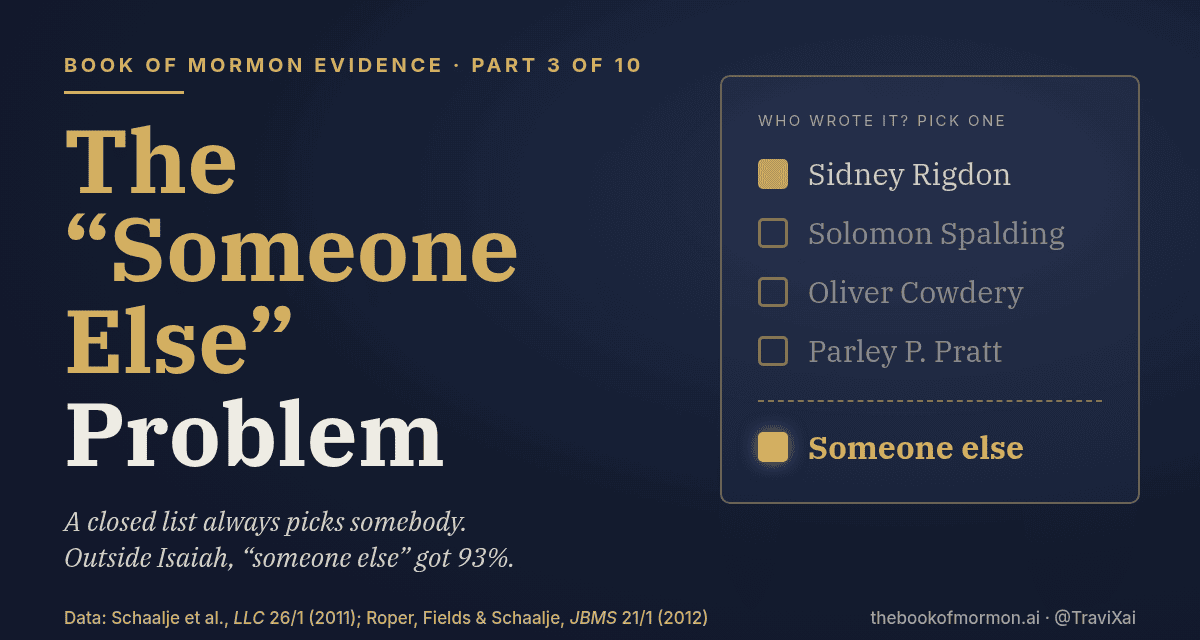

“He that is first in his own cause seemeth just; but his neighbour cometh and searcheth him” (Proverbs 18:17, KJV). In 2008 a Stanford paper went first. It ran the Book of Mormon through a computer and announced that the style pointed to Sidney Rigdon and Solomon Spalding, the old “someone else wrote it” theory with fresh math on top. Then the neighbours came and searched it. What they found is a lesson from every multiple-choice test: without “none of the above,” you always get an answer, even when every choice is wrong.
In this series: Book of Mormon Evidence (10 parts)
- Part 1: 149 Voices
- Part 2: The Berkeley Wordprint Test
- Part 3: The “Someone Else” Problem (you are here)
- Part 4: The Wordprint Track Record (coming soon)
- Part 5: One Draft (coming soon)
- Part 6: Older Than King James (coming soon)
- Part 7: Alma 36, Built as a Mirror (coming soon)
- Part 8: Nahom (coming soon)
- Part 9: Could the Plates Work? (coming soon)
- Part 10: The Witnesses Who Never Recanted (coming soon)
This started as a post on X, Part 3 of my 10-part Book of Mormon Evidence series. This is the longer version. If you missed it, Part 2: The Berkeley Wordprint Test covers the study that came before it.
The 2008 claim
The paper is “Reassessing Authorship of the Book of Mormon Using Delta and Nearest Shrunken Centroid Classification,” by Matthew Jockers, Daniela Witten, and Craig Criddle, published in Literary and Linguistic Computing 23, no. 4 (2008). Their reviewers describe them as “an English lecturer, a statistics graduate student, and a civil engineering professor at Stanford University.”
Their main tool was nearest shrunken centroid classification, or NSC, a method “developed for the classification of tumors in genomics research.” NSC learns the word habits of a few candidate authors, then assigns each test text to whichever candidate sits closest.
Here’s who was on the list:
- Candidates: Solomon Spalding, Sidney Rigdon, Oliver Cowdery, and Parley P. Pratt.
- Positive control: Isaiah and Malachi, combined as one “author,” since the Book of Mormon really does quote them.
- Negative controls: the poets Henry Wadsworth Longfellow and Joel Barlow, who definitely didn’t write any of it.
The test texts were the Book of Mormon’s 239 modern chapters, though chapter designations weren’t added until 1879, when every candidate was dead. The style measure was the relative frequency of 110 common words.
The conclusion, as quoted by the reviewers from page 483 of the paper: “we find strong support for the Spalding-Rigdon theory of authorship. In all the data, we find Rigdon as a unifying force. His signal dominates the book.”
Confident. Now look at the list again. Somebody’s missing.
A multiple-choice test with no “none of the above”
Joseph Smith wasn’t a candidate. He was listed as the “author” on the first printed edition, and he’s the one most critics today think wrote it. As Fields, Schaalje, and Roper note, “A substantial majority of critics favor some version of the Joseph Smith composition theory.”
The Stanford team’s reason for leaving him out, as quoted from page 486 of their paper: “we do not believe that even the small number of letters written in his own hand can be reasonably attributed to him.” The reviewers point out that some of the other candidates’ samples were as small as 114 words, and they list twenty-four letters entirely in Joseph’s handwriting “totaling over 12,039 words.”
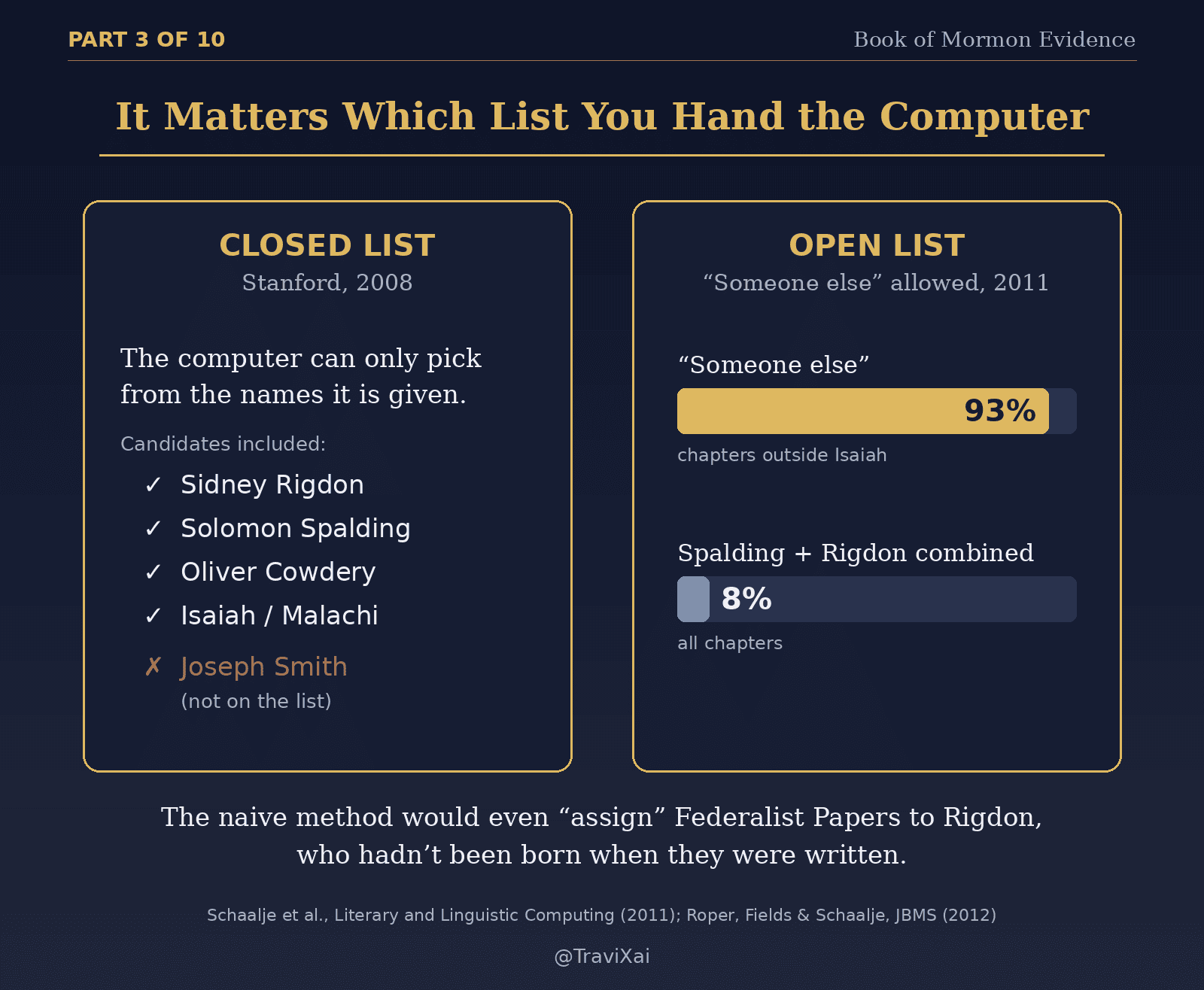
The bigger problem is the method itself. NSC is a closed-set method. In Roper, Fields, and Schaalje’s words, it “assumes the set of candidate authors definitely includes the true author to the exclusion of any other possible candidates.” That works for the Federalist Papers, where the disputed essays were by Hamilton or Madison and nobody else. It doesn’t work for a book whose authorship is the very thing in dispute.
Closest isn’t close
Fields, Schaalje, and Roper compared the Stanford logic to asking, “Choosing among Boston, New York, and Chicago, which city is closest to Los Angeles?” Chicago wins, maybe with 99 percent confidence. But, as they note, “Chicago and Los Angeles are half a continent apart.” Picking the closest of three bad options doesn’t make it close, and it certainly doesn’t make it the same city.
In their words, “‘closest to’ (a relative comparison) does not necessarily mean ‘close to’ (an absolute comparison).”
The control that failed
The 2008 study had a built-in warning light, and it was flashing. NSC correctly put 20 of the 21 Isaiah and Malachi chapters with Isaiah and Malachi. The Stanford team counted that as “evidence for the effectiveness of NSC classification.”
But NSC also assigned 42 other chapters to Isaiah and Malachi, chapters those prophets didn’t write. That’s twice as many wrong answers as right ones for the one author the study could check. Roper, Fields, and Schaalje’s verdict: “The statement Jockers et al. should have made is ‘This is evidence for the ineffectiveness of NSC classification.'”
Same method, stranger results
To show what a closed list does when the real author isn’t on it, Fields, Schaalje, and Roper ran the same naive approach on texts where we already know the answer:
- The Federalist Papers: it found “with 99 percent probability that Sidney Rigdon wrote thirty-four of The Federalist Papers published in 1788, before he was even born (he was born in 1793).”
- The King James Bible: it gave Rigdon “about 30 percent of the Bible.”
- The 2008 paper itself: “Oliver Cowdery (who died in 1850) wrote the Jockers, Witten, and Criddle paper published in 2008.”
Their verdict: this approach “produces absurd results when naively employed unless Criddle and associates are willing to disavow authorship of their own paper!”
The computer isn’t broken. It answered the question it was given: which of these names is least unlike the text? Nobody asked whether any of them actually fit.
Letting “someone else” answer
So the reviewers fixed the question. In “Extended Nearest Shrunken Centroid Classification: A New Method for Open-Set Authorship Attribution of Texts of Varying Sizes,” published in the same journal (Literary and Linguistic Computing 26, no. 1, 2011), G. Bruce Schaalje, Paul J. Fields, Matthew Roper, and Gregory L. Snow added a “someone else” option to NSC. Their extended method, ENSC, also adjusts for wildly different text sizes and for running hundreds of comparisons at once.
For a fair fight, they used the Stanford team’s own 110 words and its own chapter divisions. They added Joseph Smith as a candidate. They also used only Rigdon’s early writings, because his later writings turned out to have a noticeably different style.
The results:
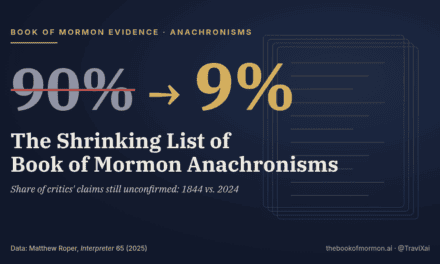
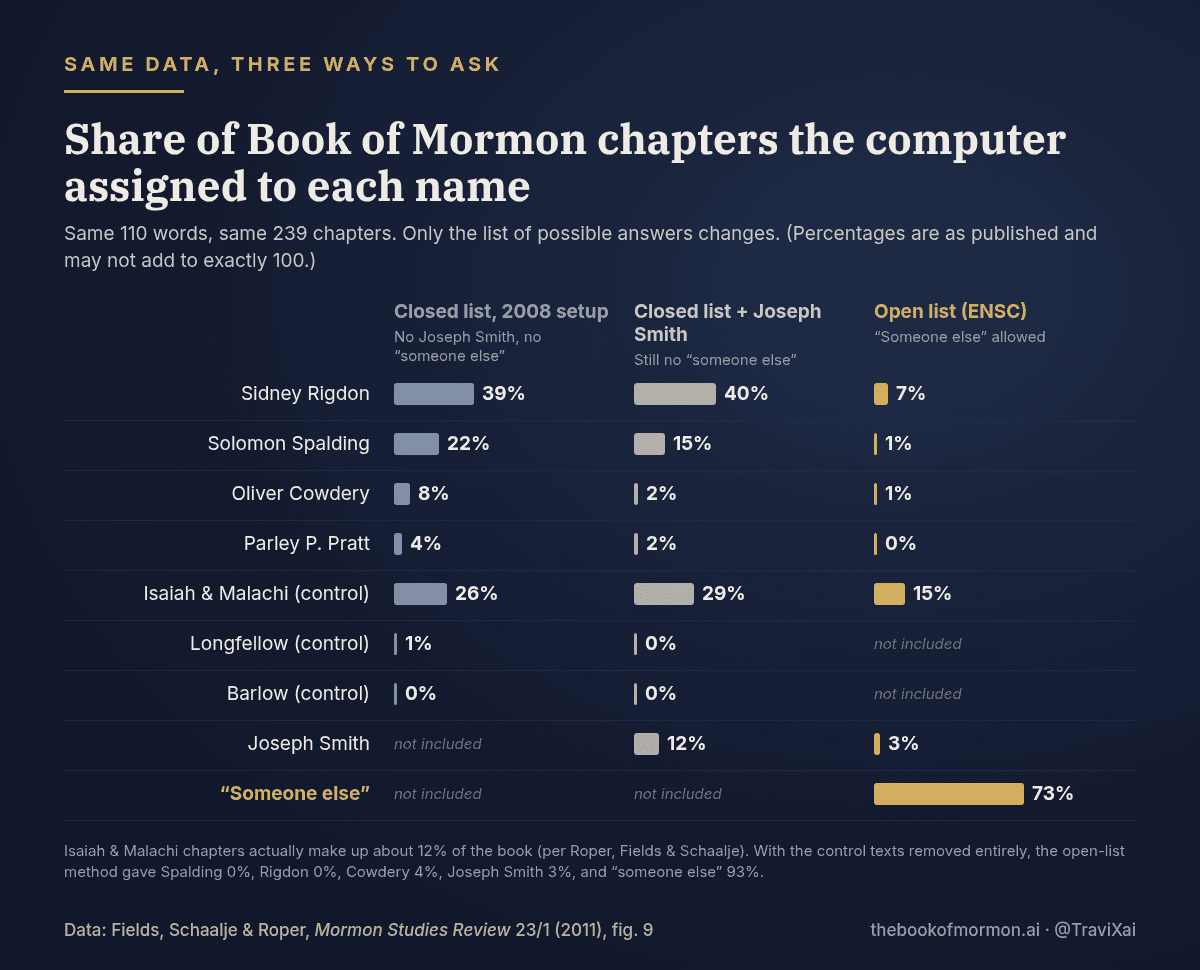
- With “someone else” allowed, Spalding and Rigdon together dropped to 8 percent of chapters, and “someone else” took 73 percent.
- Looking only at the chapters that aren’t Isaiah or Malachi, ENSC “assigned 93% of those chapters to ‘Someone Else.'”
- With the control authors removed, ENSC gave Spalding and Rigdon 0 percent, Cowdery 4 percent, Joseph Smith 3 percent, and “someone else” 93 percent.
One more Rigdon detail. The reviewers found that his writings after 1863 sit closer to the Book of Mormon than his writings before 1846. If he had shaped the book in 1829, it should be the other way around. As they put it, any “signal” the Stanford team found “came into existence over thirty years too late.” That fits the history: the book was printed before Rigdon joined the Church, and an actual Spalding manuscript recovered in 1884 bore “little resemblance to the Book of Mormon.”
The objections, answered up front
You might think this is just BYU people grading their own homework. But the open-set method went through the same journal that published the Stanford paper, an Oxford University Press title, and it used the Stanford team’s own word list and chapter divisions. If the journal was good enough in 2008, it’s good enough in 2011.
You might think Joseph at 3 percent and Cowdery at 4 percent proves Joseph and Oliver wrote it after all. But that’s the translator and his main scribe. The reviewers say a faint trace of them “is not inconsistent with the claim that Joseph translated the entire book with Oliver acting as his scribe.” What matters is the other 93 percent, which didn’t match anyone on the list.
You might think I’m now claiming a computer proved the Book of Mormon true. But I’m not, and neither are the researchers. Roper, Fields, and Schaalje warn that stylometry “can assess the similarity of writing styles among authors, but it cannot prove personal identification of an author.” As Fields, Schaalje, and Roper put it, the math isn’t asking “Who wrote these texts?” It’s asking “Which texts have the most similar patterns?”
What it does and doesn’t prove
Here’s the honest bottom line. Stylometry can’t tell you who the real authors were. It can tell you that the usual nineteenth-century suspects don’t fit well, and that the one study that seemed to say otherwise only got there by leaving out “none of the above.” The reviewers’ conclusion is that “stylometric evidence does not support the Spalding-Rigdon theory of Book of Mormon authorship.”
That leaves the book’s own claim on the table: many writers, abridged, translated by Joseph Smith. The way to settle that was never a computer anyway. It’s the test in Moroni 10:4: “ask God, the Eternal Father, in the name of Christ, if these things are not true.” What studies like this do is clear away a bad answer so the real question can get a hearing.
For the rest of the evidence in one place, see The Best Book of Mormon Evidences, in One Place.
Watch: the Spalding-Rigdon theory in six minutes
Saints Unscripted on where the Spalding-Rigdon theory came from and why few people take it seriously anymore.
Next: The Wordprint Track Record
Three studies so far, three different methods. What does the whole record look like, including the 1992 study that concluded Joseph Smith wrote it? That’s Part 4: The Wordprint Track Record, coming tomorrow.
Credit where it’s due
Thanks to:
- G. Bruce Schaalje, Paul J. Fields, Matthew Roper, and Gregory L. Snow for building the open-set method and publishing it where critics could check it.
- Matthew Jockers, Daniela Witten, and Craig Criddle for posting their data and asking a testable question, which pushed the field to fix a real gap in the method.
- BYU ScholarsArchive for keeping the reviews free online, and Saints Unscripted for the video above.
A note on spelling: you’ll see both “Spalding” and “Spaulding” in the literature. Same man.
For more like this, follow me on X at @TraviXai. And if someone answers all this with Galatians 1:8, the Galatians 1:8 app is ready for that conversation.
Sources
- Matthew L. Jockers, Daniela M. Witten, and Craig S. Criddle, “Reassessing Authorship of the Book of Mormon Using Delta and Nearest Shrunken Centroid Classification,” Literary and Linguistic Computing 23, no. 4 (2008): 465–91: doi:10.1093/llc/fqn040
- G. Bruce Schaalje, Paul J. Fields, Matthew Roper, and Gregory L. Snow, “Extended Nearest Shrunken Centroid Classification: A New Method for Open-Set Authorship Attribution of Texts of Varying Sizes,” Literary and Linguistic Computing 26, no. 1 (2011): 71–88: doi:10.1093/llc/fqq029
- Paul J. Fields, G. Bruce Schaalje, and Matthew Roper, “Examining a Misapplication of Nearest Shrunken Centroid Classification to Investigate Book of Mormon Authorship,” Mormon Studies Review 23, no. 1 (2011): 87–111: scholarsarchive.byu.edu (PDF)
- Matthew Roper, Paul J. Fields, and G. Bruce Schaalje, “Stylometric Analyses of the Book of Mormon: A Short History,” Journal of Book of Mormon Studies 21, no. 1 (2012): 28–45: scholarsarchive.byu.edu (PDF)
- “What Can Stylometry Tell Us about Book of Mormon Authorship?” Scripture Central KnoWhy #389 (2020): scripturecentral.org
- Scriptures: Proverbs 18:17 (KJV); Moroni 10:4
- Previous in the series: Part 2: The Berkeley Wordprint Test
- The original X post: x.com/TraviXai