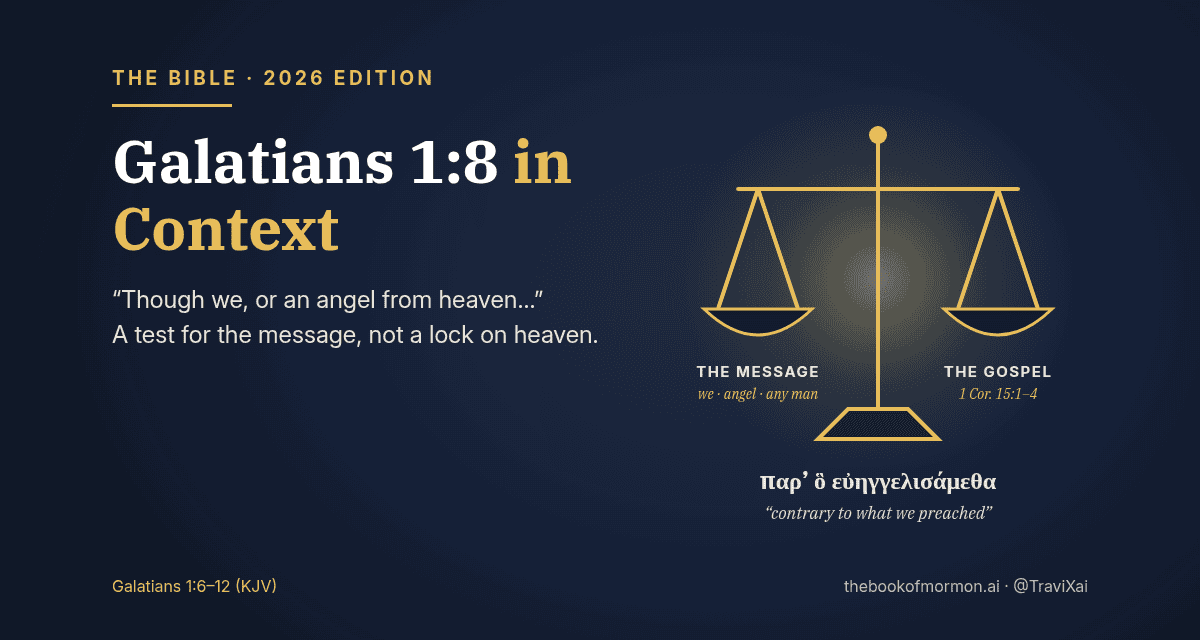

“Though we, or an angel from heaven…” is the verse critics reach for first. Read in its own chapter and its own letter, Galatians 1:8 is a test for the message, and the test is one the Book of Mormon is glad to take.
Joseph Smith said an angel visited him. Galatians 1:8 says an angel preaching another gospel is accursed. Case closed, right?
That’s the most common use of this verse against Latter-day Saints. I answered it in September 2025 in Apologetic Rebuttal to Galatians 1:8: Context Matters. This 2026 Edition digs into the text itself: the Galatian problem, Paul’s Greek, who the curse covers, and what happens when you run Paul’s test on the Book of Mormon. (The verse matters enough to me that I named my apologetics app after it: Galatians18.)
The chargeHow the verse gets used
But though we, or an angel from heaven, preach any other gospel unto you than that which we have preached unto you, let him be accursed.
Galatians 1:8 (KJV)
It usually comes in three forms. First, Moroni was an angel, so the Book of Mormon is the angel’s “other gospel.” Second, anything beyond the Bible is “other” by definition, so new scripture is automatically cursed. Third, Latter-day Saints add works to grace, which is exactly what Paul condemned in Galatia.
All three assume Paul was judging who brings a message, or whether anything new is said, rather than what the message says. Galatians doesn’t support that. (For the short version, see Galatians18’s Galatians 1:8: Another Gospel?)
GalatiaWhat the “other gospel” was
Paul tells us exactly what the trouble was: teachers insisting that Gentile converts be circumcised and keep the law of Moses to be saved. Luke records the same campaign in Antioch:
And certain men which came down from Judæa taught the brethren, and said, Except ye be circumcised after the manner of Moses, ye cannot be saved.
Acts 15:1 (KJV)
Galatians keeps returning to it. Paul refused to have Titus circumcised because of “false brethren unawares brought in” who wanted “to bring us into bondage” (Galatians 2:3–5). The agitators “constrain you to be circumcised” (Galatians 6:12). And Paul’s sharpest line in the letter is about the same thing:
Behold, I Paul say unto you, that if ye be circumcised, Christ shall profit you nothing. … Christ is become of no effect unto you, whosoever of you are justified by the law; ye are fallen from grace.
Galatians 5:2, 4 (KJV)
So the “other gospel” wasn’t a new book or vision. It was the claim that Christ wasn’t enough without the law of Moses. That’s the error Galatians 1:8 was written to stop.
The wording“Which is not another”
Two verses earlier, Paul says something that sounds strange in English:
I marvel that ye are so soon removed from him that called you into the grace of Christ unto another gospel: Which is not another; but there be some that trouble you, and would pervert the gospel of Christ.
Galatians 1:6–7 (KJV)
“Another gospel, which is not another.” In Greek, verse 6 says heteron (“a different”) gospel, and verse 7 says it is not allo (“another”) at all (1:6, 1:7 interlinear). There is only one gospel; the agitators offered a twisted version of it. His verb is “pervert” (metastrepsai, to turn around or distort).
Then verse 8. The KJV’s “any other gospel … than that which we have preached” translates the Greek par’ ho euēngelisametha (interlinear). Modern translations render it as a contradiction: “a gospel contrary to the one we preached” (ESV), “contrary to what we have preached” (NASB), and “contrary to what we proclaimed” (NRSVue). The NIV keeps “other than.”
Paul uses the same construction in Romans, and there the King James translators chose “contrary”:
Now I beseech you, brethren, mark them which cause divisions and offences contrary to the doctrine which ye have learned; and avoid them.
Romans 16:17 (KJV)
That’s para tēn didachēn, “contrary to the teaching” (interlinear). Nobody reads Romans 16:17 as a ban on learning anything new. It warns against contradicting what they had learned. Galatians 1:8 works the same way.
“Though we”Paul put himself under the curse
Read the verse slowly and notice who comes first: “though we.” Paul names himself and his companions before he names the angel. Then he repeats the warning and widens it:
As we said before, so say I now again, If any man preach any other gospel unto you than that ye have received, let him be accursed.
Galatians 1:9 (KJV)
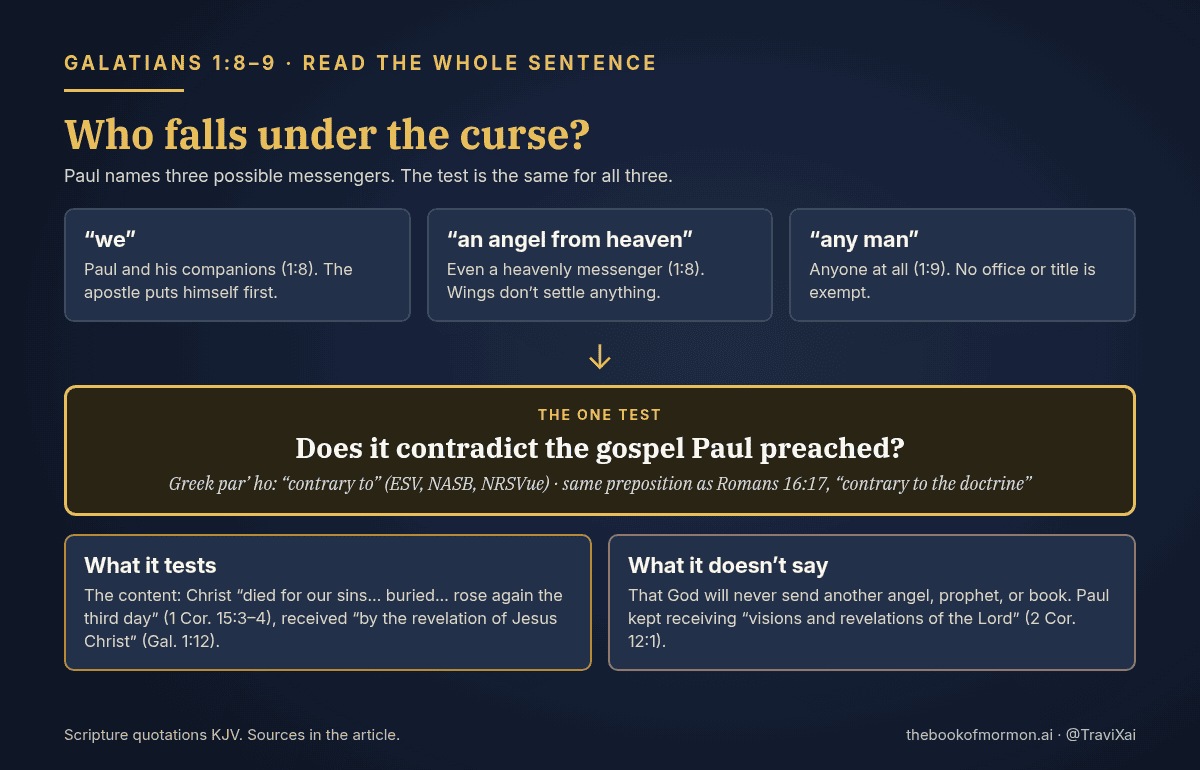
If Galatians 1:8 meant “no more revelation after this letter,” Paul just cursed himself for every letter he wrote afterward. What he built is a content test for apostles, angels, and everyone else alike. The question is never whether the messenger had wings. It’s whether the message contradicts the gospel.
The Bible even expects another angel “having the everlasting gospel to preach” (Revelation 14:6), which I covered in the 2025 post. Galatians18 also has a page on whether Moroni is the accursed angel.
After GalatiansPaul kept receiving revelation
Galatians 1:8 can’t be a rule against new revelation, because Paul’s own gospel came that way:
But I certify you, brethren, that the gospel which was preached of me is not after man. For I neither received it of man, neither was I taught it, but by the revelation of Jesus Christ.
Galatians 1:11–12 (KJV)
He even went to Jerusalem “by revelation” (Galatians 2:2). And it didn’t stop when he sealed this letter. Most scholars date Galatians between the late 40s and early 50s AD (overview), which on that dating puts most of Paul’s letters after it, including 1 and 2 Corinthians and Romans. In one of them he writes, “I will come to visions and revelations of the Lord” (2 Corinthians 12:1). In another:
How that by revelation he made known unto me the mystery; … Which in other ages was not made known unto the sons of men, as it is now revealed unto his holy apostles and prophets by the Spirit.
Ephesians 3:3, 5 (KJV)
Revelation “now revealed” to living apostles and prophets: that’s Paul after Galatians. He also told the Thessalonians, “Despise not prophesyings” (1 Thessalonians 5:20). Revelation and John’s letters came later still. If Galatians 1:8 closed the door, much of the New Testament walked through it afterward. I traced that pattern in The Canon Was Never Meant to Close and looked at the other proof texts in Sola Scriptura: Which Verse Teaches It? (Galatians18 gathers the Bible’s own case for continuing revelation.)
The testPaul’s gospel in Paul’s words
So what was the gospel Paul preached? He defines it plainly:
Moreover, brethren, I declare unto you the gospel which I preached unto you … For I delivered unto you first of all that which I also received, how that Christ died for our sins according to the scriptures; And that he was buried, and that he rose again the third day according to the scriptures.
1 Corinthians 15:1, 3–4 (KJV)
Galatians fills in the rest. We are “justified by the faith of Christ, and not by the works of the law” (Galatians 2:16). We receive “the promise of the Spirit through faith” (Galatians 3:14). “As many of you as have been baptized into Christ have put on Christ” (Galatians 3:27). And what counts is “faith which worketh by love” (Galatians 5:6).
Christ crucified and risen. Faith in Him, not in the law of Moses. Baptism into Him. The Spirit. Faith that shows itself in love. That’s the standard.
AppliedHold the Book of Mormon to it
Now hold the Book of Mormon up to it. When the risen Christ defines “my gospel” in the Book of Mormon, He starts at the cross: “my Father sent me that I might be lifted up upon the cross” (3 Nephi 27:13–14). Then He gives the rest:
Now this is the commandment: Repent, all ye ends of the earth, and come unto me and be baptized in my name, that ye may be sanctified by the reception of the Holy Ghost, that ye may stand spotless before me at the last day. Verily, verily, I say unto you, this is my gospel.
3 Nephi 27:20–21
Faith, repentance, baptism, the Holy Ghost: the same order Nephi teaches as “the doctrine of Christ” (2 Nephi 31:17–21) and Jesus teaches at the temple in Bountiful (3 Nephi 11:32–39). And on the exact question that set off Galatians, the Book of Mormon lands where Paul does: “the law of circumcision is done away in me” (Moroni 8:8), and “the law hath become dead unto us, and we are made alive in Christ because of our faith” (2 Nephi 25:25).
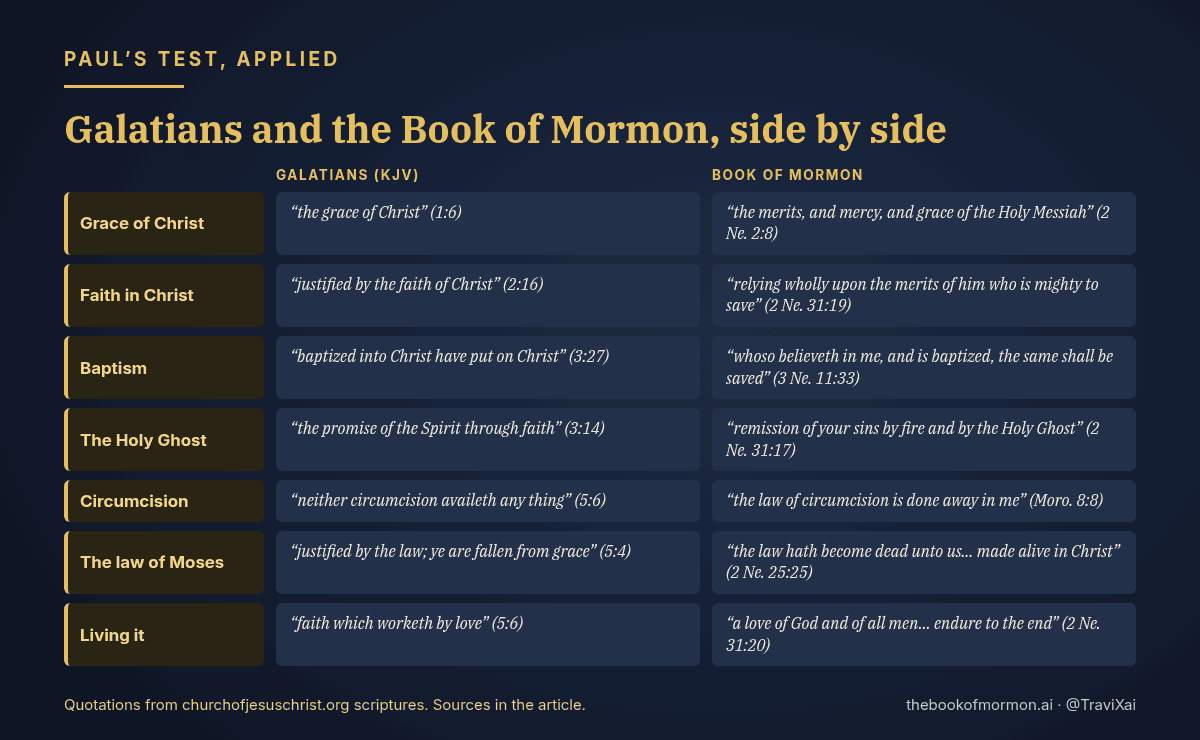
A book contrary to Paul’s gospel would sound like the Judaizers: Christ plus circumcision, Christ plus Moses. The Book of Mormon says the opposite in so many words. Disagree with it on other grounds if you like, but “contrary to the gospel Paul preached” is the one charge its own text refutes.
The works question“Isn’t that what the Judaizers did?”
This is the strongest version of the objection, so here’s a straight answer. Latter-day Saints teach that baptism, obedience, and enduring to the end matter. Isn’t that adding works, like the agitators in Galatia?
Look at what Paul opposed: being “justified by the law” of Moses, with circumcision as the entry rite (Galatians 5:4). He did not oppose obedience to Christ. In the same letter he warns that people who practice the works of the flesh “shall not inherit the kingdom of God” (Galatians 5:19–21), and adds, “whatsoever a man soweth, that shall he also reap” (Galatians 6:7–8).
If teaching baptism (3:27) and faith that works by love (5:6) makes a gospel “other,” Galatians fails its own test. The Book of Mormon puts the credit where Paul does: no one can dwell with God “save it be through the merits, and mercy, and grace of the Holy Messiah” (2 Nephi 2:8), and we press forward “relying wholly upon the merits of him who is mighty to save” (2 Nephi 31:19). Galatians18 walks through the rest of this on its grace and works page.
SummaryKey takeaways
- The “other gospel” in Galatia was circumcision and the law of Moses as requirements for salvation (Acts 15:1; Galatians 2:3–5; 5:2–4).
- Paul says it is “not another” gospel at all, but a perversion of the one gospel (Galatians 1:6–7).
- The Greek par’ ho means “contrary to” Paul’s gospel (ESV, NASB, NRSVue; compare the KJV of Romans 16:17).
- “Though we” puts Paul himself under the test. It judges the message, not the messenger, and Paul kept receiving revelation after writing it (2 Corinthians 12:1; Ephesians 3:3–5).
- The Book of Mormon teaches the gospel Paul defended: Christ crucified and risen, faith, repentance, baptism, the Holy Ghost, and “the law of circumcision is done away in me.”
Next time someone quotes Galatians 1:8 at you, agree with Paul. Then ask kindly: which part of 3 Nephi 27 contradicts 1 Corinthians 15? Read them together. For quick, sourced replies on this verse and dozens of others, use Galatians18, the app named after this very verse. And for more like this every day, follow me on X at @TraviXai.
Sources
- Scriptures (KJV and Book of Mormon, churchofjesuschrist.org): Galatians 1:6–12 · Galatians 2:2–5, 16 · Galatians 3:14, 27 · Galatians 5:2–6, 19–21 · Galatians 6:7–8, 12 · Acts 15:1 · Romans 16:17 · 1 Corinthians 15:1–4 · 2 Corinthians 12:1 · Ephesians 3:3–5 · 1 Thessalonians 5:20 · Revelation 14:6 · 3 Nephi 27:13–21 · 3 Nephi 11:32–39 · 2 Nephi 31:17–21 · 2 Nephi 25:25–26 · 2 Nephi 2:8 · Moroni 8:8
- Galatians 1:8 in modern translations (Bible Gateway): ESV · NASB · NRSVue · NIV
- Greek interlinear (Bible Hub): Galatians 1:6 · Galatians 1:7 · Galatians 1:8 · Romans 16:17
- Dating of Galatians (majority view late 40s to early 50s, citing The New Oxford Annotated Bible; other views to the mid-50s): Wikipedia, “Epistle to the Galatians”
- Related on this site: Apologetic Rebuttal to Galatians 1:8: Context Matters (September 2025) · Sola Scriptura: Which Verse Teaches It? · The Canon Was Never Meant to Close · Books the Bible Quotes That Aren’t in the Bible
- Galatians18: Galatians 1:8: Another Gospel? · Moroni and the accursed angel · Continuing revelation · Grace and works
- Featured image and both charts: original graphics by thebookofmormon.ai (no photographs or likenesses of real people). Greek as printed in the Bible Hub interlinear.