
Critics say gold plates would be too heavy and too small to hold the book. One researcher tested more than 4 billion versions against the witnesses’ descriptions.
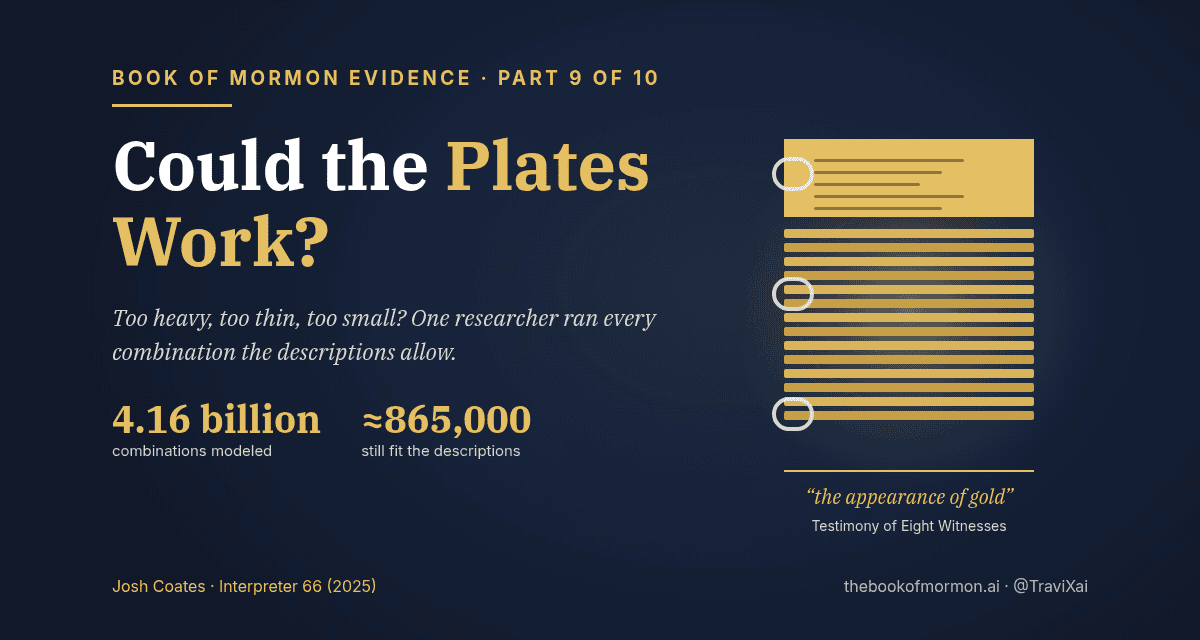
“Gold plates? Do the math. They’d weigh a ton, and you couldn’t fit a 500-page book on them anyway.” It’s one of the oldest jabs at the Book of Mormon, and it sounds like physics. So a researcher actually did the math. He modeled more than four billion versions of the plates and checked which ones fit what the witnesses described.
In this series: Book of Mormon Evidence (10 parts)
- Part 1: 149 Voices
- Part 2: The Berkeley Wordprint Test
- Part 3: The “Someone Else” Problem
- Part 4: The Wordprint Track Record
- Part 5: One Draft
- Part 6: Older Than King James
- Part 7: Alma 36, Built as a Mirror
- Part 8: Nahom
- Part 9: Could the Plates Work? (you are here)
- Part 10: The Witnesses Who Never Recanted (coming soon)
This is Part 9 of my 10-part Book of Mormon Evidence series. If you missed it, Part 8: Nahom looks at three altars in Yemen carrying a name from 1 Nephi.
The objectionToo heavy, too thin, too small
The objection comes in two flavors. Pure gold is heavy, so a stack that size would be impossible to carry. And there isn’t enough surface area to hold the Book of Mormon, plus the lost 116 pages, plus a sealed portion.
The first one is easy to make sound convincing. A solid block of pure gold six by eight by six inches is 288 cubic inches, and at gold’s density of about 19.3 grams per cubic centimeter it would weigh roughly 200 pounds. If that’s what Joseph Smith claimed to carry home through the woods, the critics would have a point.
But that isn’t what anyone described. The way to settle it is to test every combination the actual descriptions allow.
The descriptionsWhat the witnesses actually said
Joseph Smith’s fullest description is in the 1842 Wentworth letter, printed in the Times and Seasons:
These records were engraven on plates which had the appearance of gold, each plate was six inches wide and eight inches long and not quite so thick as common tin. They were filled with engravings, in Egyptian characters and bound together in a volume, as the leaves of a book with three rings running through the whole. The volume was something near six inches in thickness, a part of which was sealed.
Joseph Smith, “Church History,” Times and Seasons, 1 March 1842 (Joseph Smith Papers)
Notice the phrase. Not “made of gold.” “The appearance of gold.” The Eight Witnesses used the same words, and they didn’t just look. They lifted them:
That Joseph Smith, Jun., the translator of this work, has shown unto us the plates of which hath been spoken, which have the appearance of gold; and as many of the leaves as the said Smith has translated we did handle with our hands … for we have seen and hefted, and know of a surety that the said Smith has got the plates of which we have spoken.
The Testimony of Eight Witnesses
Gather the historical reports and you get ranges: weights from about 30 to 60 pounds, and a stack 4 to 8 inches high. William Smith was the only witness to say the plates were an alloy of gold and copper. Galatians18 has the short version of what the gold plates were and who saw them.
The testFour billion plates, run through the filters
In 2025 Josh Coates published “A Combinatorial Approach to Modeling All Possible Golden Plates” in Interpreter. The method is brute force. Take every physical property the reports touch (plate size and thickness, gold content, gaps between plates, the sealed share), set a range for each, and calculate every combination.
That came to 4,164,048,000 possible plate sets. Then the filters started:
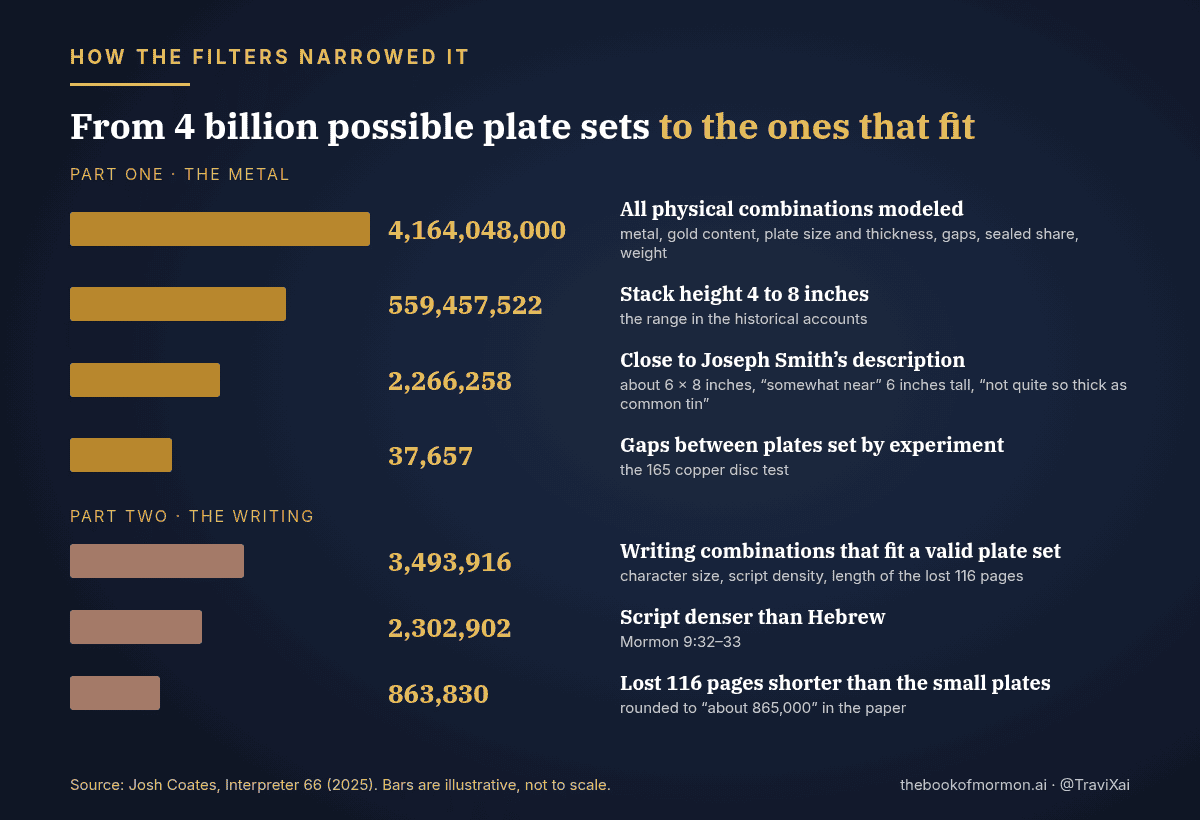
- Stack height of 4 to 8 inches, the range in the accounts. That cut 86.6% and left 559,457,522.
- Close to Joseph’s own description, with a margin for estimating: about 6 by 8 inches, a stack of 5.5 to 6.25 inches, plates 0.015 to 0.019 inches thick. That left 2,266,258.
- Realistic gaps between plates, set by an actual experiment (more on that below). That left 37,657 physical configurations.
Part two did the same for the writing. Coates kept only scripts denser than Hebrew, because Moroni says they’d have used Hebrew if the plates had been big enough, and only versions where the lost 116 pages were shorter than the small plates. The end of the funnel: 863,830 writing configurations, which he rounds to “about 865,000.”
The point isn’t the exact number. It’s that it isn’t zero.
The metalNot solid gold, and not a fantasy alloy
Coates’s conclusions on the survivors: the plates likely contained less than 20% gold, weighed at least 54 pounds, and numbered between 187 and 259 including the sealed portion. Their size comes out slightly smaller than Joseph’s description but within 10% of it.
Less than 20% gold sounds like a problem until you remember the witnesses said “appearance.” Gold and copper alloys are ancient. In the New World it’s called tumbaga, and Coates notes examples back to the second millennium BC in the Americas and the third millennium BC in the Old World, including a dagger from the Royal Cemetery of Ur.
The trick is depletion gilding: corrode away the copper at the surface, burnish the gold that’s left, and the object looks like gold. Coates photographs a test plate of 15% gold, 84% copper and 1% silver that looks the part. A coppery alloy with a golden face is exactly what “the appearance of gold” would describe.
And the weight? At least 54 pounds sits inside the 30-to-60-pound range people reported. Heavy, yes. Nothing near 200 pounds.
The experiment165 copper discs and an honest caveat
No metalwork is perfectly flat, so stacked sheets leave small gaps, and gaps add height. That matters, because height was the hardest test in the whole model.
So Coates made 165 copper discs, each about 4 inches across and averaging 0.020 inches thick, then stacked and measured them. The gaps added about 53% to the stack. Pressed down, that dropped to about 41%.
He is upfront about the limits: compression varied, the discs were smaller than the plates, and larger plates would probably be less uniform. That’s how a real test is reported.
The writingSmall characters, dense script
The text itself tells you space was tight. Jacob complains about it:
I cannot write but a little of my words, because of the difficulty of engraving our words upon plates
Jacob 4:1
Moroni explains the script:
And now, behold, we have written this record according to our knowledge, in the characters which are called among us the reformed Egyptian, being handed down and altered by us, according to our manner of speech. And if our plates had been sufficiently large we should have written in Hebrew.
Mormon 9:32–33
That’s a writer choosing a compact script because engraving is slow. Coates’s results fit. The characters averaged less than 5 millimeters square, and each one likely stood for at least three English characters, about the density of Egyptian Demotic. Joseph said the characters “were small, and beautifully engraved.” For scale, a draft survey by Neal Rappleye of engravings on ancient Near Eastern metal found the most common height was about 2 millimeters. Galatians18 covers reformed Egyptian and the question of whether the plates could hold the book.
William Hamblin offers a real-world check. The bronze Iguvine Tables from Italy, from the third century BC, are seven plates, five written on both sides, with about 4,000 words of Umbrian ritual. Hamblin works out about 1,350 English words per plate there, with letters over half an inch high, compared with about 1,000 per plate for the 24 plates of Ether.
The practiceSacred writing on metal, right on schedule
Writing scripture on metal was a real practice, and some of the best examples come from Lehi’s own era.
The Bible itself has one. The high priest wore a gold plate on his forehead:
And thou shalt make a plate of pure gold, and grave upon it, like the engravings of a signet, Holiness to the Lord.
Exodus 28:36
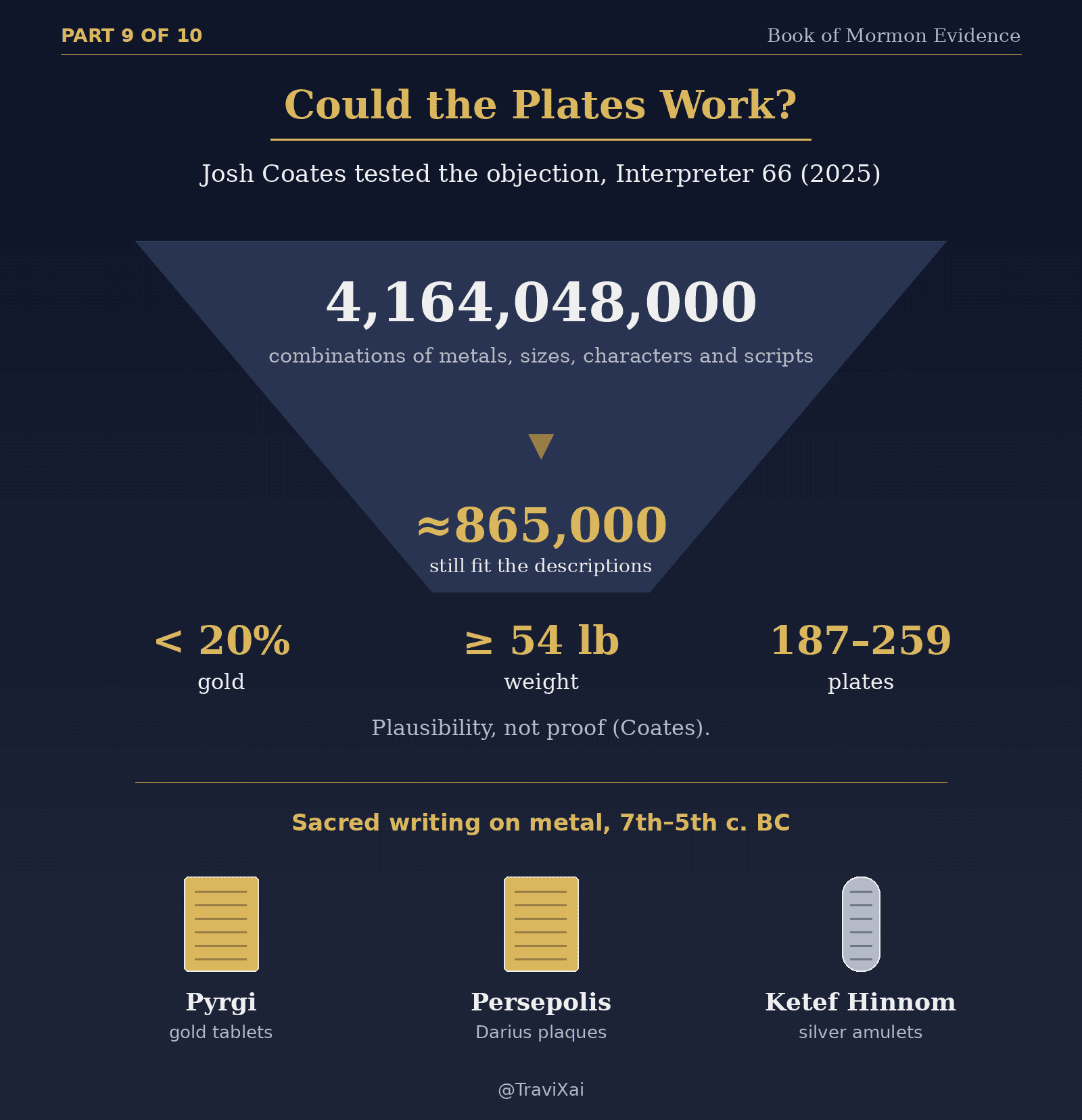
- Ketef Hinnom, near Jerusalem. Excavations in the late 1970s turned up two small silver plates from the seventh century BC, inscribed with the priestly blessing of Numbers 6:24–26: “The Lord bless thee, and keep thee.” Hamblin quotes the description of them as the “earliest fragments of the biblical text known up to the present.”
- Pyrgi, Italy. Three gold tablets, two in Etruscan and one in Phoenician, dated by the Etruscan museum to the end of the sixth century BC. They record King Thefarie Velianas dedicating a sacred place to the goddess Astarte, and they survived because they “were rolled up and buried with great care.”
- Persepolis, Persia. Darius the Great placed stone boxes in the corners of his audience hall. Two were recovered in 1933, each holding gold and silver plaques, about 33 centimeters square, carrying a foundation inscription in three languages.
See the pattern? Important records, engraved on metal, put away on purpose so they would last. Jacob says the same: “whatsoever things we write upon anything save it be upon plates must perish and vanish away” (Jacob 4:2). Hamblin’s conclusion:
The Book of Mormon describes sacred writing on bronze and gold plates in the early sixth century BC at precisely the time when we find the earliest evidence of the spread of this practice from Phoenicia to Carthage, Italy, and Greece.
William J. Hamblin, FARMS Review 19/1 (2007)
Hamblin also catches the critics shifting position. They “have for the most part dropped the argument that the idea of ancient writing on metal plates is absurd; some ironically now claim instead that knowledge of ancient writing on metal plates was readily available in Joseph Smith’s day.” That’s moving the goalposts. Did the idea go from absurd to common knowledge? It can’t be both.
Fair framingWhat this does and doesn’t prove
Coates is careful, and I will be too:
This study does not prove the existence or authenticity of the plates but, rather, demonstrates their mathematical plausibility within the framework of historical descriptions.
Josh Coates, Interpreter 66 (2025)
He also admits that weighing the historical reports involves judgment, and his Hieratic and Demotic samples are small.
But the objection was “impossible.” The answer is hundreds of thousands of ways it works, in an alloy people actually used, in a format spreading around the Mediterranean in Lehi’s day. As Coates puts it, the results contradict “the claims of critics who have argued otherwise.”
SummaryKey takeaways
- The witnesses described plates with “the appearance of gold,” about 6 by 8 inches, a stack near 6 inches, and weights reported from about 30 to 60 pounds.
- Josh Coates modeled 4,164,048,000 physical combinations. After filters for Joseph’s description, real stacking gaps and the writing, about 865,000 configurations remain.
- The likely profile: under 20% gold, at least 54 pounds, 187 to 259 plates, characters under 5 mm in a script about as dense as Demotic.
- Sacred writing on metal is documented around Lehi’s time, from Ketef Hinnom to Pyrgi to Persepolis.
- Fair caveat: this shows plausibility, not proof, and the exact numbers depend on assumptions.
Coming upNext: The Witnesses Who Never Recanted
Next: Part 10: The Witnesses Who Never Recanted (coming soon). In the finale: the men who said they saw the plates, and what happened when some of them left the Church.
Read Jacob 4 and Mormon 9 and listen for how often the writers mention their plates. Then catch up on Part 8: Nahom. For the rest of the series, follow me on X at @TraviXai. And when someone answers all this with Galatians 1:8, the Galatians 1:8 app is ready for that conversation.
Sources
- Josh Coates, “A Combinatorial Approach to Modeling All Possible Golden Plates,” Interpreter: A Journal of Latter-day Saint Faith and Scholarship 66 (2025): 1–70: interpreterfoundation.org (the combinations, filters, copper disc experiment, likely profile, alloy and depletion gilding, report ranges, the Rappleye engraving survey, and the conclusion quote)
- William J. Hamblin, “Sacred Writing on Metal Plates in the Ancient Mediterranean,” FARMS Review 19, no. 1 (2007): 37–54: scripturecentral.org (Ketef Hinnom, the Iguvine Tables, the sixth-century spread of the practice, the critics’ shift)
- Joseph Smith, “Church History,” Times and Seasons, 1 March 1842 (the Wentworth letter): josephsmithpapers.org
- Etruscan National Museum of Villa Giulia, “Pyrgi Tablets”: museoetru.it
- Encyclopaedia Iranica, “Persepolis”: iranicaonline.org (Darius’s foundation deposit and the 1933 recovery)
- Scriptures: Jacob 4:1–2 · Mormon 9:32–33 · Testimony of Eight Witnesses · Exodus 28:36 · Numbers 6:24–26
- Previous in the series: Part 8: Nahom
- Featured image, chart and X graphic: original graphics by thebookofmormon.ai (no photographs or likenesses of real people).