
Paul stood on Mars’ Hill in front of the sharpest pagan audience in the world and quoted one of their own poets back to them: “For we are also his offspring.” Then he built an argument on it. Not an illustration. An argument, with a “therefore.”
That “therefore” deserves a closer look. Paul’s whole case in Athens rests on one Greek word, and it’s a family word.
This is the third article in today’s Godhead set. The first, God Has a Body: The Verses vs. John 4:24, looked at what “God is a Spirit” actually says. The second, Made in His Image: Genesis 1:26 and 5:3 Mean What They Say, ended by pointing here.
The speech on Mars’ Hill
Paul is in Athens, a city “wholly given to idolatry” (Acts 17:16). He has found an altar “TO THE UNKNOWN GOD,” and he tells the council he will declare that God to them. Here is the heart of the speech:
God that made the world and all things therein, seeing that he is Lord of heaven and earth, dwelleth not in temples made with hands… For in him we live, and move, and have our being; as certain also of your own poets have said, For we are also his offspring. Forasmuch then as we are the offspring of God, we ought not to think that the Godhead is like unto gold, or silver, or stone, graven by art and man’s device.
Acts 17:24, 28–29
“Certain of your own poets” is not a vague wave at Greek culture. The line is word for word from Aratus of Soli, a third-century BC poet whose Phaenomena, a poem about the stars, opens with Zeus. Line 5 reads tou gar kai genos esmen. In G. R. Mair’s 1921 Loeb translation: “For we are also his offspring.” A few lines later Aratus addresses Zeus directly: “Hail, O Father, mighty marvel, mighty blessing unto men.”
The Stoic Cleanthes said nearly the same thing in his Hymn to Zeus: ek sou gar genos esmen. The text of that line is disputed, so hold it loosely, but in E. H. Blakeney’s 1921 translation it runs: “For we Thine offspring are, and sole of all / Created things that live and move on earth / Receive from Thee the image of the One.” Note what even a pagan philosopher heard in “offspring”: likeness. Image.
Paul didn’t borrow Zeus. He borrowed a true sentence the Greeks already knew, applied it to the true God, and drew a conclusion.
What “genos” means
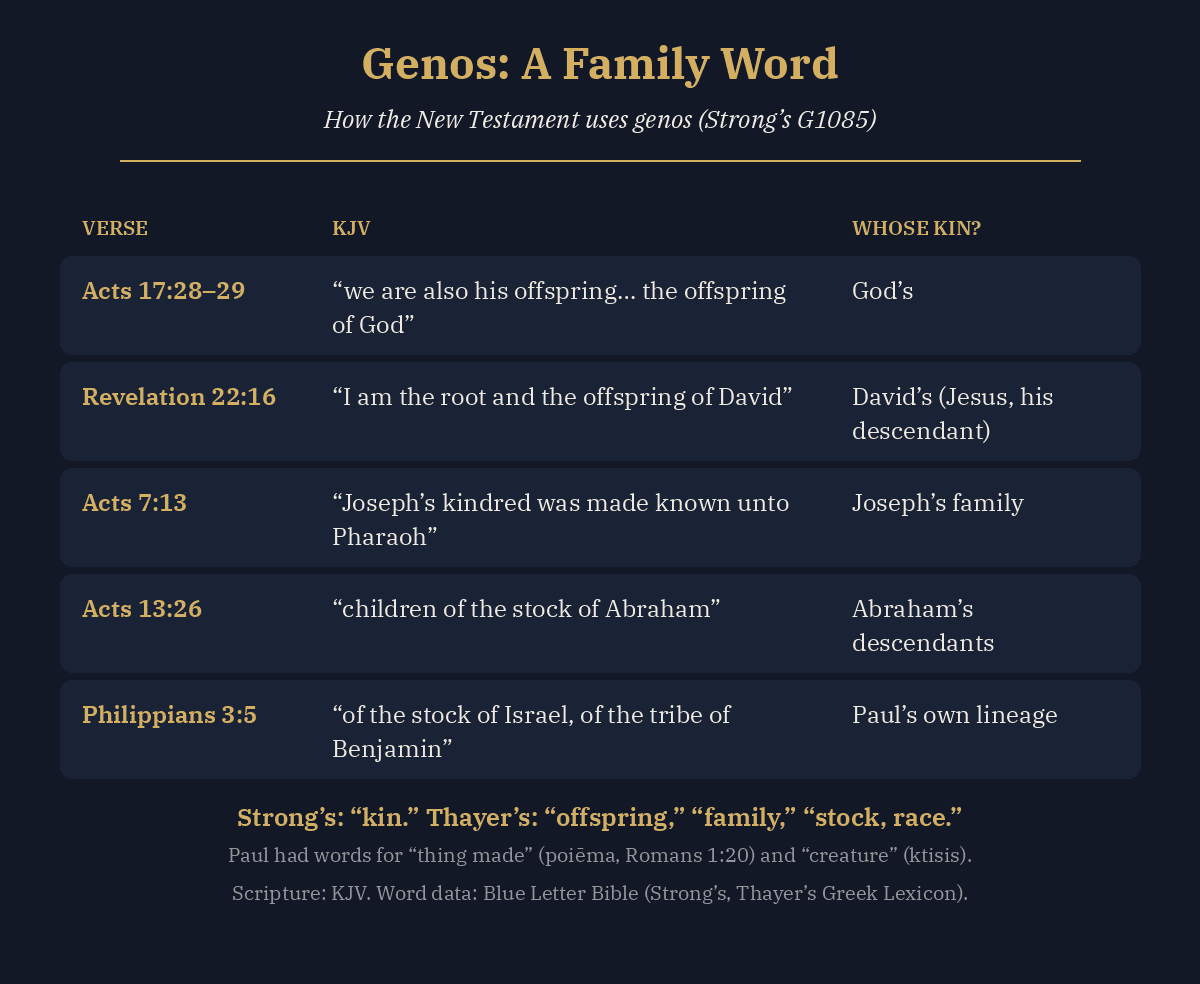
The Greek word behind “offspring” in both verse 28 and verse 29 is genos (Strong’s G1085), from the verb ginomai, “to become” or “to be born.” Strong’s gives its root sense in one word: “kin.” Thayer’s Greek Lexicon lists the meanings as “offspring,” “family,” “stock, race,” and “nation,” and cites Acts 17:28 under “offspring.” Watch it work elsewhere in the New Testament:
- “I am the root and the offspring of David” (Revelation 22:16). Jesus, David’s descendant.
- “Joseph’s kindred was made known unto Pharaoh” (Acts 7:13). Joseph’s family.
- “Children of the stock of Abraham” (Acts 13:26). Abraham’s descendants.
- “Of the stock of Israel, of the tribe of Benjamin” (Philippians 3:5). Paul’s own pedigree.
Every one is about a bloodline. Nobody reads Revelation 22:16 and concludes Jesus is merely something David manufactured.
How Paul’s argument works
Lay the logic out step by step:
- We are God’s genos, His offspring.
- Offspring resemble their parent.
- We are living, thinking, personal beings, not metal or rock.
- Therefore God is not like gold, silver, or stone shaped by a sculptor.
The word “like” in verse 29 is homoios, which Strong’s defines as “similar (in appearance or character).” Paul is reasoning about resemblance. The child tells you something about the Father. If you want to know what God is like, a statue is the wrong place to look. Look at His children.
John Calvin, no friend of the Latter-day Saint reading, saw this clearly. In his commentary on the verse he grants that Paul retained “a true maxim… that men are the generation of God, because by the excellency of nature they resemble some divine thing,” and on verse 29 he says Paul “gathereth that God cannot be figured or resembled by any graven image forasmuch as he would have his image extant in us.” Calvin went on to use the verse against any bodily idea of God, and he and I part ways there. But he agreed on the mechanics: the argument runs on resemblance between parent and child.
“Offspring just means creatures”
The usual reply is that “offspring” here is a loose way of saying “creatures.” God made us, so in a poetic sense we’re His offspring, and that’s all.
Three problems.
First, Paul had other words and used them when he meant “made.” In Romans 1:20 the creation is “the things that are made,” poiēma. In Ephesians 2:10, “we are his workmanship,” the same word. “Creature” is ktisis, as in “nor any other creature” (Romans 8:39). In Athens he chose none of them. He chose the kinship word, and he quoted a poet who used it.
Second, the “creatures” reading breaks the argument. Gold, silver, and stone are God’s creatures too. If “offspring” meant only “things God made,” then the idol’s raw material has exactly the same claim to that title as we do, and Paul’s “therefore” falls flat. The conclusion only follows if we stand in a relationship to God that gold does not. That relationship is kinship.
Third, Paul isn’t alone. Luke traces Jesus’ genealogy back through “Seth, which was the son of Adam, which was the son of God” (Luke 3:38). Same genealogical chain, same kind of link, all the way up. Psalm 82:6 says “Ye are gods; and all of you are children of the most High,” and Jesus quotes it in John 10:34–35 and adds that “the scripture cannot be broken.” More on that in The Gods of the Bible (2026 Edition).
The Father of spirits
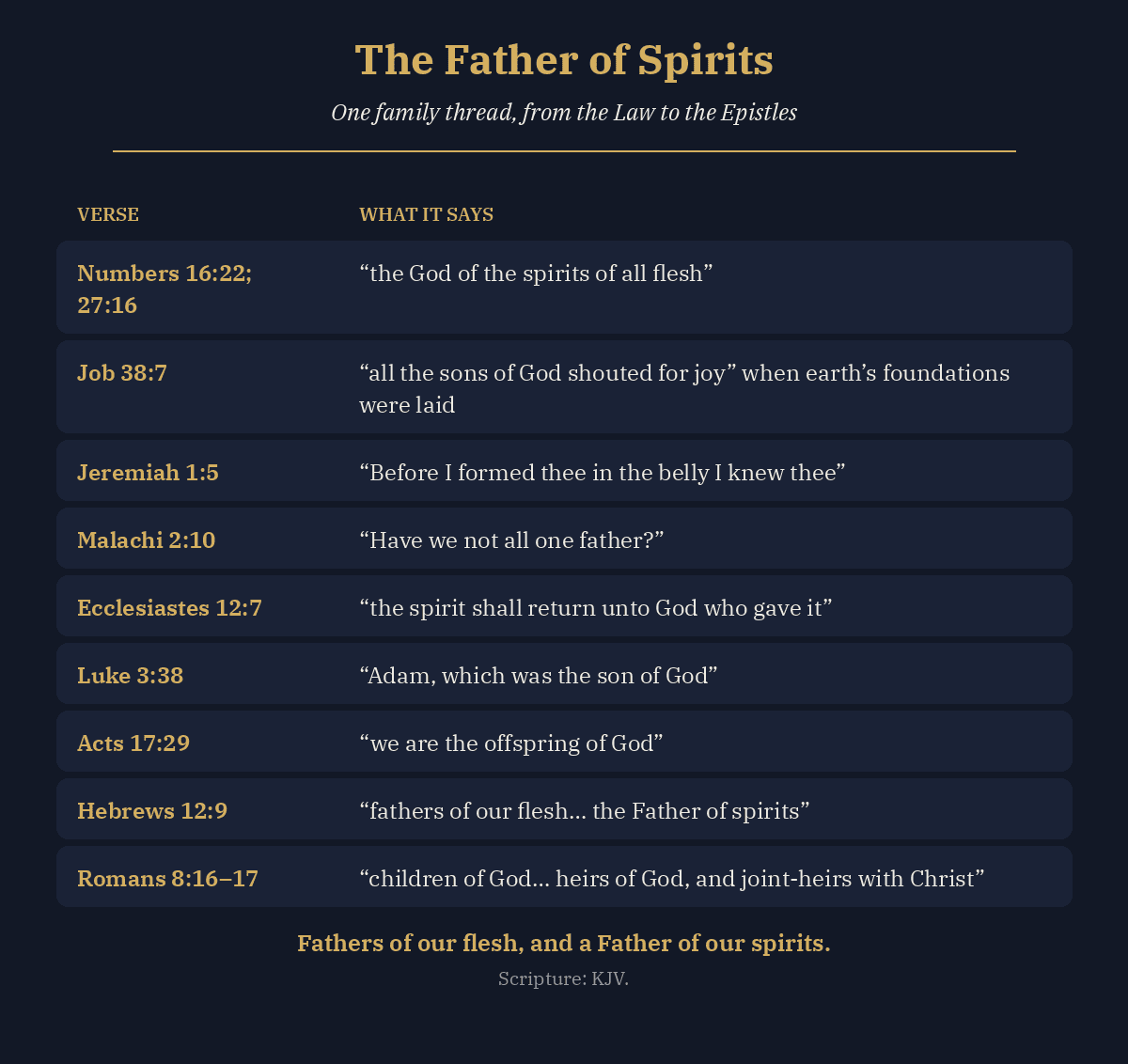
Paul’s line in Athens is not a one-off. The Bible keeps calling God the Father of something in us that came from Him:
Furthermore we have had fathers of our flesh which corrected us, and we gave them reverence: shall we not much rather be in subjection unto the Father of spirits, and live?
Hebrews 12:9
The comparison is exact: fathers of our flesh, and the Father of our spirits. Same word, father, for both. Numbers twice calls Him “the God of the spirits of all flesh” (Numbers 16:22; 27:16). Malachi asks, “Have we not all one father? hath not one God created us?” (Malachi 2:10). Notice Malachi puts “father” and “created” side by side; they aren’t rivals.
And the spirit had somewhere to come from. “Then shall the dust return to the earth as it was: and the spirit shall return unto God who gave it” (Ecclesiastes 12:7). You can only return to a place you’ve been. God tells Jeremiah, “Before I formed thee in the belly I knew thee” (Jeremiah 1:5). When the foundations of the earth were laid, “the morning stars sang together, and all the sons of God shouted for joy” (Job 38:7). That’s a family gathered before the world was finished.
I’ve been asked on X whether the Father of spirits has only one Son. Fair question to put back: which verse says the Father of spirits has only one child? Christ is “the only begotten of the Father” (John 1:14), and He is also “the firstborn among many brethren” (Romans 8:29). Hebrews 2:11 says He “is not ashamed to call them brethren.” Firstborn implies younger siblings.
Children, then heirs
Children inherit. Paul says so in Romans:
The Spirit itself beareth witness with our spirit, that we are the children of God: And if children, then heirs; heirs of God, and joint-heirs with Christ; if so be that we suffer with him, that we may be also glorified together.
Romans 8:16–17
Being God’s offspring by nature and becoming His heirs through Christ are not the same thing, and the scriptures keep both. We are His children from the start; we receive the inheritance by following His Son. A joint-heir shares the estate. That is where the Bible’s language about partaking of the divine nature points, and I wrote about why “same divine nature” is not the same as the creedal word “consubstantial” in Same Divine Nature Isn’t Consubstantial.
What Latter-day Saints teach
The Church of Jesus Christ of Latter-day Saints reads these verses at face value. The Family proclamation says each human being “is a beloved spirit son or daughter of heavenly parents, and, as such, each has a divine nature and destiny,” and that “in the premortal realm, spirit sons and daughters knew and worshipped God as their Eternal Father.”
Restoration scripture fills in the picture. “Man was also in the beginning with God” (D&C 93:29). Abraham saw “the intelligences that were organized before the world was,” and the Lord told him, “Abraham, thou art one of them; thou wast chosen before thou wast born” (Abraham 3:22–23). Read that next to Jeremiah 1:5 and Job 38:7 and it sounds familiar.
To be careful: Paul in Acts 17 doesn’t lay out a doctrine of premortal life, and I won’t claim the Athenians heard one. What Paul does do is call us God’s kin and reason from it. The Restoration didn’t invent that idea. It took Paul at his word and told us more about where the family began.
This video from the Church’s Bible Videos series shows the Mars’ Hill sermon in full, in KJV wording:
The bottom line
Paul had a word for “things God made,” and he didn’t use it. He used the word for kin, quoted a poet who called God “Father,” and reasoned that a Father with living, thinking children cannot be like a carved rock. That only works if the family resemblance is real. Hebrews calls Him the Father of spirits, Malachi asks whether we have not all one father, and Romans says His children are heirs. Take the word seriously and the conclusion follows: you are not a product God shelved. You are family.
Credit where it’s due
- G. R. Mair, whose Loeb translation of Aratus is still the standard English version, and Theoi.com for putting it online.
- E. H. Blakeney for his 1921 edition of Cleanthes’ Hymn, and Wikisource volunteers for transcribing it.
- John Calvin, whose commentary on Acts makes the resemblance point plainly even while disagreeing with where I take it, and the Christian Classics Ethereal Library for hosting it.
- Blue Letter Bible for free access to Strong’s and Thayer’s lexicons.
- Perseus Digital Library (Tufts) for the Greek text of Aratus.
I make these arguments every day on X. Follow me at @TraviXai. And if someone answers all this with Galatians 1:8, the Galatians 1:8 app was built for that conversation.
Sources
- Bible quotations from the King James Version.
- Strong’s G1085 (genos), with Thayer’s Greek Lexicon and KJV usage: Blue Letter Bible
- Strong’s G4161 (poiēma): Blue Letter Bible; Strong’s G2937 (ktisis): Blue Letter Bible; Strong’s G3664 (homoios): Blue Letter Bible
- Acts 17:29 with Strong’s numbers: Blue Letter Bible
- Aratus, Phaenomena 1–18, trans. G. R. Mair, Loeb Classical Library 129 (1921): Theoi Classical Texts Library; Greek text: Perseus Catalog
- Cleanthes, Hymn to Zeus, Greek text and trans. E. H. Blakeney (1921): Wikisource
- John Calvin, Commentary on Acts, vol. 2, on Acts 17:26–29: Christian Classics Ethereal Library
- “The Family: A Proclamation to the World”: churchofjesuschrist.org
- Doctrine and Covenants 93:29: churchofjesuschrist.org
- Abraham 3:22–23: churchofjesuschrist.org
- Video: “Acts 17 | We Are the Offspring of God | The Bible,” The Church of Jesus Christ of Latter-day Saints: YouTube