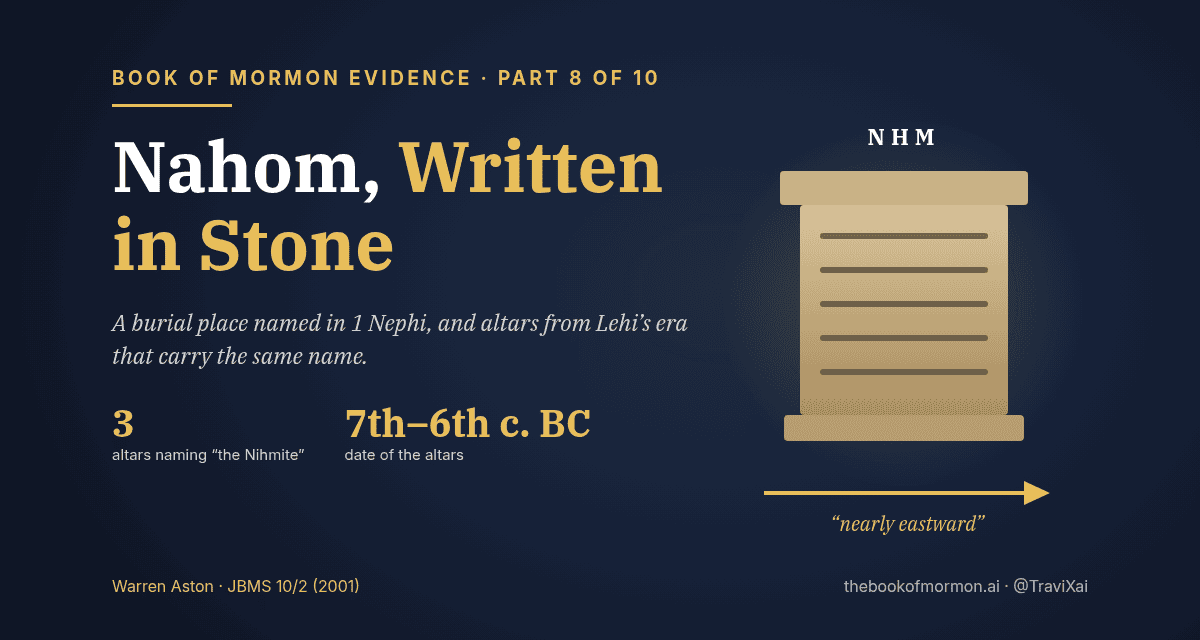

Nephi buried Ishmael at a place “called Nahom,” then turned east. Altars from a temple in Yemen carry the same name, carved around Lehi’s time.
“There’s no archaeology for the Book of Mormon.” You hear it constantly. No dig, no inscription, nothing in stone with a name from the book on it. Then a German team excavated a temple in Yemen, and three limestone altars turned up carrying a name from 1 Nephi, in the right region, from roughly the right century.
In this series: Book of Mormon Evidence (10 parts)
- Part 1: 149 Voices
- Part 2: The Berkeley Wordprint Test
- Part 3: The “Someone Else” Problem
- Part 4: The Wordprint Track Record
- Part 5: One Draft
- Part 6: Older Than King James
- Part 7: Alma 36, Built as a Mirror
- Part 8: Nahom (you are here)
- Part 9: Could the Plates Work? (coming soon)
- Part 10: The Witnesses Who Never Recanted (coming soon)
This is Part 8 of my 10-part Book of Mormon Evidence series. If you missed it, Part 7: Alma 36, Built as a Mirror looks at a chapter that runs forward, then backward, with Christ at the center.
The verseA place that already had a name
Somewhere in the Arabian desert, Lehi’s family buries one of their own. Nephi gives it one sentence:
And it came to pass that Ishmael died, and was buried in the place which was called Nahom.
1 Nephi 16:34
Read that wording closely. When Lehi’s group names a place, Nephi says so: “we did call the name of the place Shazer” (1 Nephi 16:13), and later “the land which we called Bountiful” (1 Nephi 17:5). Nahom is different. It “was called” Nahom. As Warren Aston puts it, “the wording makes it clear that Nahom was not named by Lehi’s party but was already known by that name to local people.”
So the text makes a testable claim. Somewhere along a south-southeast route through Arabia, there should have been a place with that name before 600 BC. And it should sit roughly west of a fertile coast, because of what Nephi says next.
And it came to pass that we did again take our journey in the wilderness; and we did travel nearly eastward from that time forth.
1 Nephi 17:1
In 1830, the inscriptions that would test that claim were still under the sand.
The findThree altars in a temple near Marib
The Bar’an temple sits near Marib in Yemen, once the capital of the Sabaean (Sheban) kingdom. The German Archaeological Institute (DAI) in Berlin excavated it from 1988 to 1997, and the site opened to the public in November 2000. Among the finds were altars of solid local limestone, each about 26 inches high, with a dedication carved around all four sides in three-inch letters.
One altar left Yemen in October 1997 for a touring exhibit on ancient Yemen in Europe. Its catalog caption gave the translation, and S. Kent Brown wrote it up in 1999 as “dramatic new evidence.” In September 2000 Aston and fellow researchers examined a second altar at the site, and in May 2001 BYU archaeologist David Johnson identified the name on a third. The inscription, essentially the same on all three, reads:
Bi’athar son of Sawdum, son of Naw’um, the Nihmite, has dedi[cated] (to) Ilmaqah (the person) Fari’at.
Translation in Warren P. Aston, Journal of Book of Mormon Studies 10/2 (2001)
“The Nihmite” means a member of the Nihm tribe. Written South Arabian, like Hebrew, records consonants and not vowels, so the name is NHM, the same three consonants as Nahom. The Nihm tribe still lives in that part of Yemen, northeast of Sana‘a.
The dateOld enough to matter
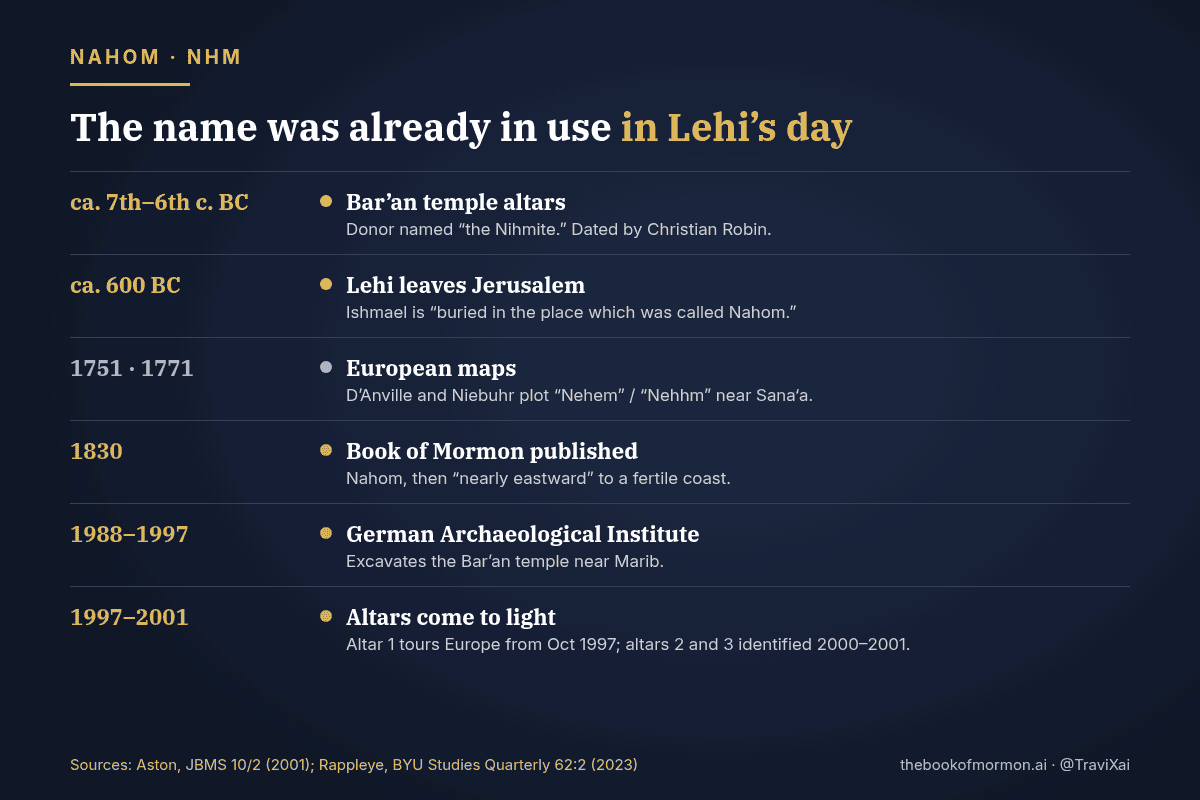
A name on a medieval map would be interesting. A name carved before Lehi’s day is something else. French scholar Christian Robin, an authority on this region, dates the altars to the seventh to sixth centuries BC. The inscription also invokes a ruler named Yada’-il, possibly one of two kings who reigned roughly 630 BC or 580 BC.
Then there’s the family tree. Bi’athar is the grandson of Naw’um, the Nihmite. If the grandfather already carried the name, Aston notes, “the Nihm name must be at least two generations—perhaps another century—older still, certainly predating the arrival of the Lehites to the area.” Before these altars, the earliest known references to NHM came from Arabic writings that may go back to the first century AD. The altars pushed the name back about seven centuries.
That’s why Latter-day Saint scholar Terryl Givens, writing for Oxford University Press, called the altars “the first actual archaeological evidence for the historicity of the Book of Mormon.” He added that they were “the most impressive find to date corroborating Book of Mormon historicity.”
The turn“Nearly eastward” to Bountiful
A name alone could be luck. But Nephi gives a direction, too, and a destination you can test:
And we did come to the land which we called Bountiful, because of its much fruit and also wild honey; and all these things were prepared of the Lord that we might not perish. And we beheld the sea, which we called Irreantum, which, being interpreted, is many waters.
1 Nephi 17:5
And it came to pass that we did pitch our tents by the seashore; and notwithstanding we had suffered many afflictions and much difficulty, yea, even so much that we cannot write them all, we were exceedingly rejoiced when we came to the seashore; and we called the place Bountiful, because of its much fruit.
1 Nephi 17:6
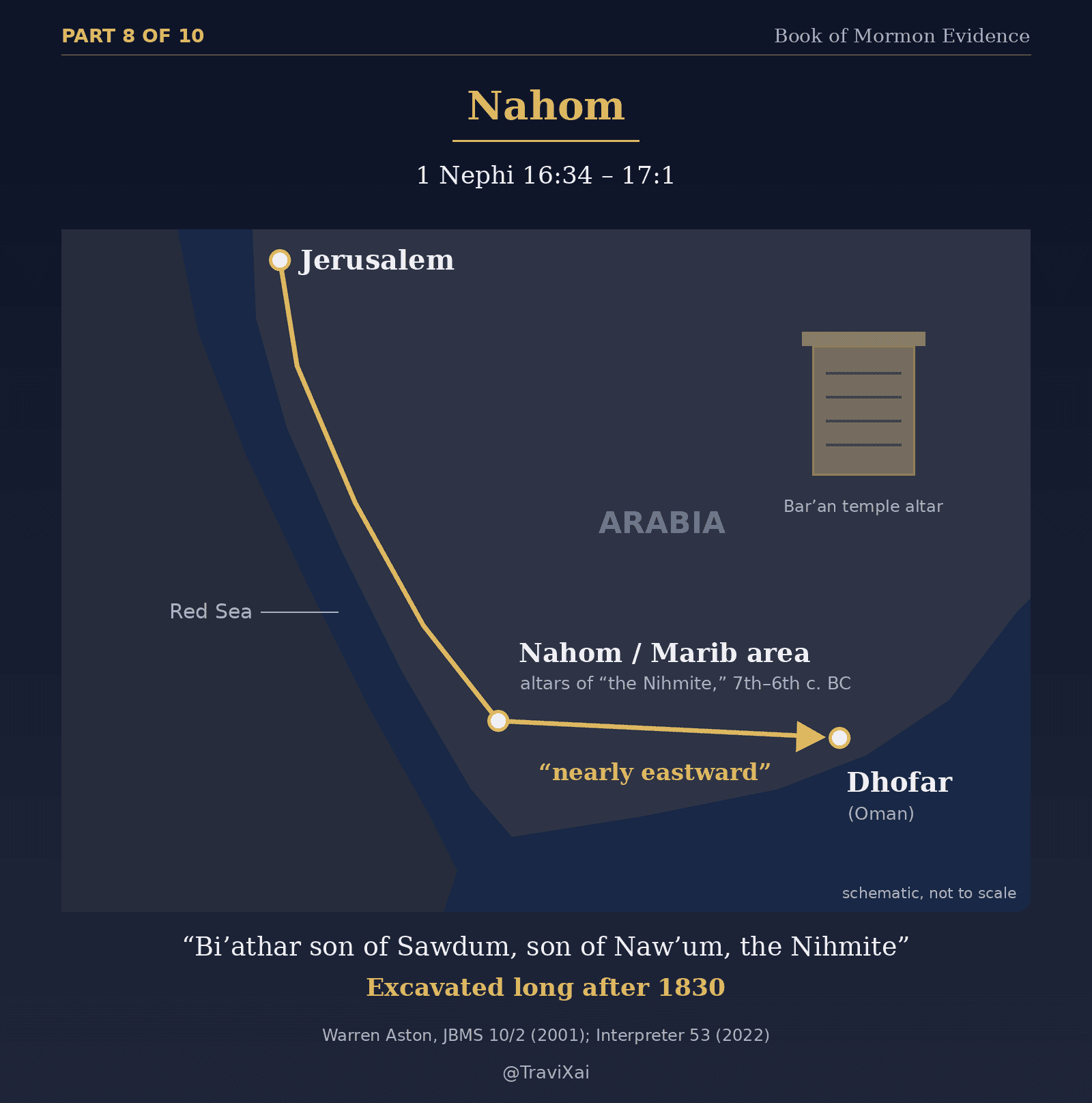
Fruit, timber for a ship, fresh water, and a mountain nearby (1 Nephi 17:7) is a tall order on a desert coast. Aston spent 1988 to 1992 exploring the coast of Oman and Yemen, from Aden northward, on the ground. He describes the Dhofar region of southern Oman as “the only section of the Arabian coast containing the feature Nephi describes.” And Dhofar, he notes, lies “within one degree of being due east of the Nahom region.” Galatians18 has a short version of this route through Arabia.
Think about what that requires of a guess. Pick an Arabian place name, put a burial there, then turn your characters east across a desert and land them on the one stretch of coast that fits. All dictated in 1829.
The siteKhor Kharfot, and a tower that’s too young
Aston’s leading candidate for Bountiful is Khor Kharfot, a small, fertile inlet on the Dhofar coast reached mostly by sea. Oman has taken notice. On August 23, 2021, Sultan Haitham bin Tarik decreed that the whole of Khor Kharfot and Wadi Sayq be designated an “Archaeological Reserve.” Preliminary excavations at Khor Kharfot ran from 2016 to 2018, and they resumed in February 2022.
Now the fair part, and it comes from Aston himself. The largest ruin at Khor Kharfot is a collapsed tower that some had hoped was a link to Lehi’s family. In 2022 Aston studied a similar standing tower on the al Hauta coast and concluded it “was built more than a thousand years too late to have any possible direct connection with the Lehite clan’s stay at Bountiful,” adding that “it now seems likely that the same is also true” of the Khor Kharfot structure.
That’s how real research behaves. The evidence for Bountiful rests on the place itself, its water, trees, fruit, mountain and harbor, not on one ruin. When a hoped-for link fails, you say so and keep digging.
Fair framingWhat the critics get right
Critics make two fair points, and both deserve a straight answer.
First, the name was on maps before 1830. It was. Jean Baptiste D’Anville’s 1751 map of Asia shows “Nehem,” and Carsten Niebuhr’s 1771 map of Yemen shows “Nehhm,” both north or northeast of Sana‘a. Neal Rappleye documents these in BYU Studies Quarterly. So the name alone isn’t the whole case. What the altars add is a date: the name existed in Lehi’s era, not just in the 1700s, and these altars were excavated long after 1830.
Second, NHM on the altars is a tribe, not necessarily a place. Rappleye takes this on directly, showing that in Yemen tribe and territory have been tied together since pre-Islamic times, and that Nihm’s use as a place name is documented back to the early Islamic period. His conclusion: the inscriptions “can reasonably be understood as evidence for both a tribe and place called NHM going back to the early first millennium BC.”
The real strength is the convergence. Rappleye and Stephen Smoot list the pieces: a place named with the Semitic root NHM, a name that predates 600 BC, a place of burial, the south end of a south-southeast route that turns east, and a fertile “bountiful” coast to the east. Aston adds that the largest burial area known anywhere in Arabia, many thousands of tombs, lies about 25 miles north of Marib. Any one of those is a coincidence you could live with. Stacked together, “lucky guess” starts working very hard. Galatians18 sums it up in Nahom and NHM, and if someone tells you there’s no archaeology at all, this is the first stone to hand them.
Frauds get exposed over time, not vindicated over time. With every new discovery, something in the Book of Mormon that was “impossible” becomes probable.
Travi𝕏 on X
SummaryKey takeaways
- Nephi says Ishmael was buried in a place that “was called Nahom,” a name that already existed, then the family turned “nearly eastward” (1 Nephi 16:34; 17:1).
- Three limestone altars from the Bar’an temple near Marib, excavated by the German Archaeological Institute, name a donor as “the Nihmite.”
- The altars are dated to the seventh to sixth centuries BC, and the donor’s grandfather already carried the name.
- Nearly due east sits Dhofar, which Aston calls the only section of the Arabian coast that fits Nephi’s Bountiful.
- Fair caveats: the name appears on 18th-century European maps, and the Khor Kharfot tower is likely about a thousand years too late for Lehi. The case rests on the convergence, not any one piece.
Coming upNext: Could the Plates Work?
Next: Part 9: Could the Plates Work? (coming soon). Nahom put a name in stone. Next we look at the record itself, and whether metal plates could really hold it.
Read 1 Nephi 16 and 17 in one sitting and watch the route unfold. Then catch up on Part 7: Alma 36, Built as a Mirror. For the rest of the series, follow me on X at @TraviXai. And when someone answers all this with Galatians 1:8, the Galatians 1:8 app is ready for that conversation.
Sources
- Warren P. Aston, “Newly Found Altars from Nahom,” Journal of Book of Mormon Studies 10, no. 2 (2001): 56–61, 71: scripturecentral.org (excavation, altar size and inscription, Robin’s dating, the grandfather argument, “nearly eastward,” the Givens and Brown quotes)
- Warren P. Aston, “A Research Note: Continuing Exploration and Research in Oman,” Interpreter 53 (2022): 255–264: interpreterfoundation.org (coastal exploration, Dhofar, the 2021 decree, the tower caveat, resumed excavations)
- Neal Rappleye, “The Place—or the Tribe—Called Nahom? NHM as Both a Tribal and Geographic Name in Modern and Ancient Yemen,” BYU Studies Quarterly 62, no. 2 (2023): 49–72: byustudies.byu.edu (the 1751 and 1771 maps, tribe and place)
- Neal Rappleye and Stephen O. Smoot, “Book of Mormon Minimalists and the NHM Inscriptions: A Response to Dan Vogel,” Interpreter 8 (2014): 157–185: interpreterfoundation.org (the convergence list)
- Terryl L. Givens, By the Hand of Mormon: The American Scripture that Launched a New World Religion (Oxford University Press, 2002), 120–121, as quoted by Aston and Rappleye
- Scripture Central, “Remarkable Archaeological Evidence for Ishmael’s Burial at Nahom in the Book of Mormon”: YouTube
- Scriptures: 1 Nephi 16:13 · 1 Nephi 16:34 · 1 Nephi 17:1 · 1 Nephi 17:5–7
- Previous in the series: Part 7: Alma 36, Built as a Mirror
- Featured image, map and timeline: original graphics by thebookofmormon.ai (no photographs or likenesses of real people).