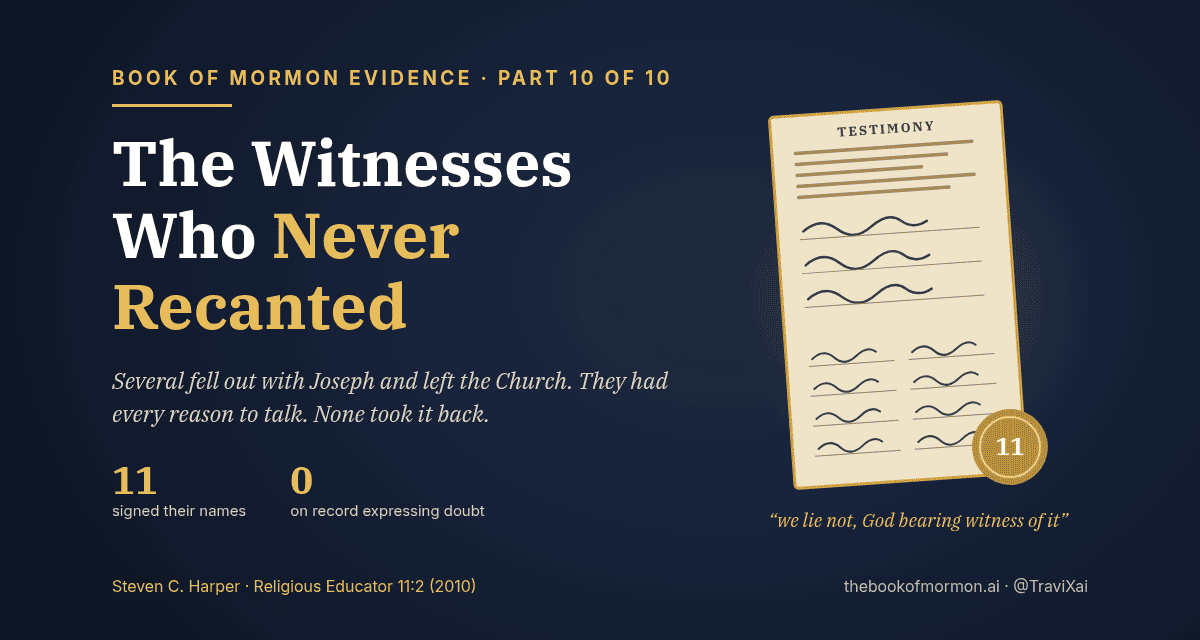

Several of the eleven men who signed the Book of Mormon testimonies later fell out with Joseph Smith and left the Church. They had every reason to recant. None of them did.
If the Book of Mormon witnesses were in on a con, it was a con with a terrible exit plan. Within nine years, all of the Three Witnesses had fallen out with Joseph Smith and left the Church. They were angry, they were public about it, and they had every reason to say, “It was all made up.” Not one of them ever did.
In this series: Book of Mormon Evidence (10 parts)
- Part 1: 149 Voices
- Part 2: The Berkeley Wordprint Test
- Part 3: The “Someone Else” Problem
- Part 4: The Wordprint Track Record
- Part 5: One Draft
- Part 6: Older Than King James
- Part 7: Alma 36, Built as a Mirror
- Part 8: Nahom
- Part 9: Could the Plates Work?
- Part 10: The Witnesses Who Never Recanted (you are here)
This is Part 10, the finale of my 10-part Book of Mormon Evidence series. If you missed it, Part 9: Could the Plates Work? runs the math on the plates these men said they saw.
The claimEleven names, two statements
Every copy of the Book of Mormon opens with two signed statements. Three men say an angel showed them the plates. Eight more say Joseph Smith showed them the plates and they handled them. The Three wrote:
And we declare with words of soberness, that an angel of God came down from heaven, and he brought and laid before our eyes, that we beheld and saw the plates, and the engravings thereon …
The Testimony of Three Witnesses
The Eight were blunter. No angel, no vision, just a heavy object and their hands:
And this we bear record with words of soberness, that the said Smith has shown unto us, for we have seen and hefted, and know of a surety that the said Smith has got the plates of which we have spoken. And we give our names unto the world, to witness unto the world that which we have seen. And we lie not, God bearing witness of it.
The Testimony of Eight Witnesses
The book predicted them: “in the mouth of three witnesses shall these things be established” (Ether 5:4; see also 2 Nephi 27:12). That’s the Bible’s own standard: “In the mouth of two or three witnesses shall every word be established” (2 Corinthians 13:1). Galatians18 has a full rundown of the Three and Eight Witnesses.
The stress testWhy leaving matters
Friends sign things. The real test comes when the friendship sours.
And it soured. The Church’s own history notes that Martin Harris was excommunicated in 1837, and Oliver Cowdery and David Whitmer were out by 1838. Hiram Page and John Whitmer of the Eight went with them. These weren’t quiet exits. Cowdery, for one, accused Joseph of serious wrongdoing on the way out.
That’s the moment a fraud falls apart. A partner who feels cheated has the motive to expose it, the inside knowledge to make it stick, and critics ready to print every word. So what did they say?
Three WitnessesDavid Whitmer: fifty years out, still testifying
David Whitmer is the hardest case for critics, because he never came back. He spent his last half century running a livery stable in Richmond, Missouri, openly critical of the Church in Utah until he died in 1888.
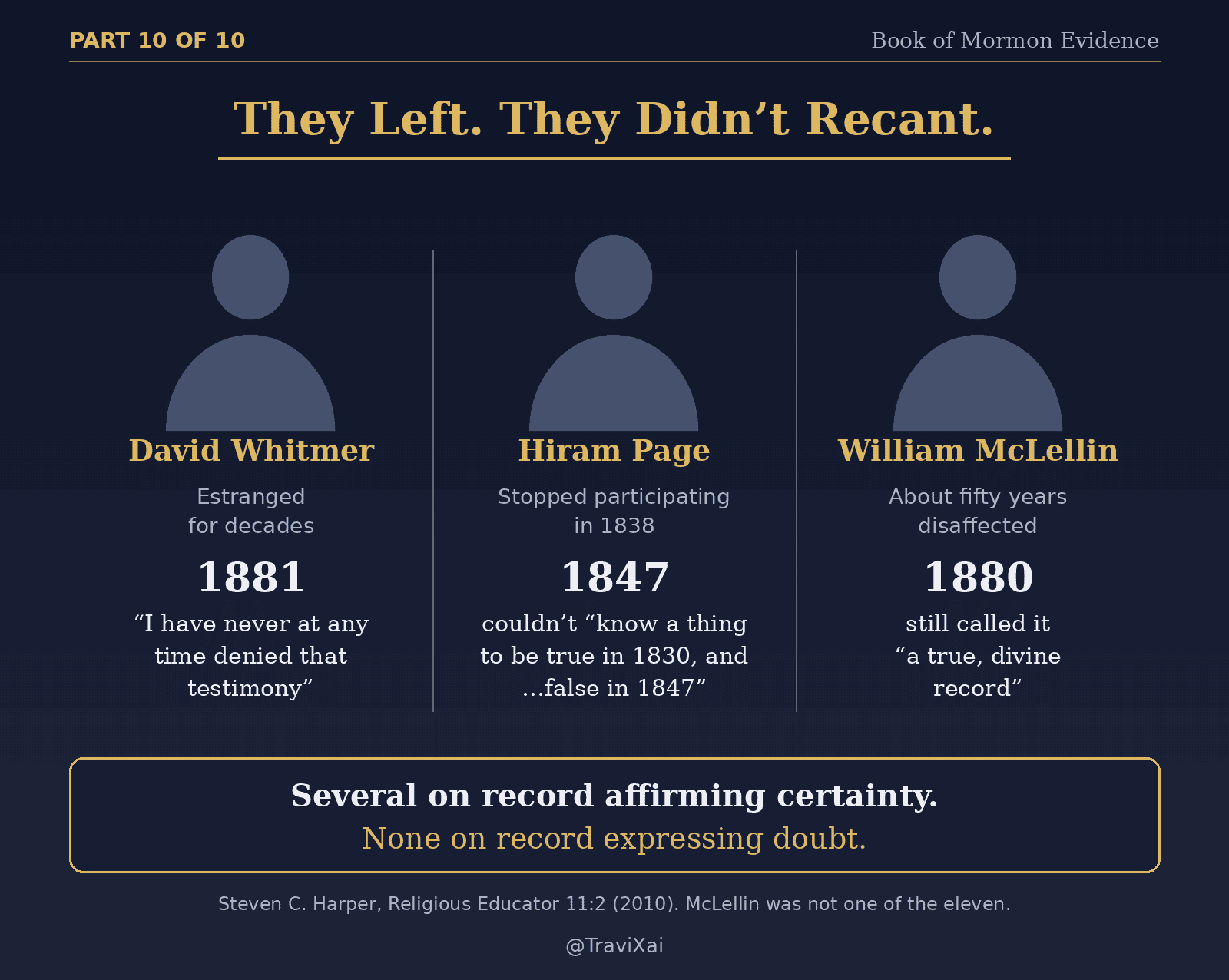
In 1880 a man named John Murphy interviewed him, then published a claim that Whitmer had admitted his vision was just an impression. Whitmer’s answer, dated March 19, 1881, and printed in the Richmond paper, left no wiggle room:
That I have never at any time denied that testimony or any part thereof, which has so long since been published with that Book, as one of the three witnesses. Those who know me best, well know that I have always adhered to that testimony.
David Whitmer, “A Proclamation,” March 19, 1881 (quoted in Harper; full text at Wikisource)
He added, “it was no delusion!” About two dozen Richmond community leaders vouched for his honesty, according to Richard Lloyd Anderson. And the same proclamation distances him from polygamy and the Church in Utah. He was defending the one thing he refused to give up.
Critics sometimes answer that the witnesses only saw with “spiritual eyes.” Whitmer addressed that too, in an 1887 letter:
Of course we were in the spirit when we had the view, for no man can behold the face of an angel, except in a spiritual view, but we were in the body also, and everything was as natural to us, as it is at any time.
David Whitmer to Anthony Metcalf, March 1887 (quoted in “Witnesses of the Book of Mormon,” Church History Topics)
Three WitnessesOliver Cowdery and Martin Harris: they came back
Oliver Cowdery was Joseph’s main scribe and the Church’s second elder. He was excommunicated in 1838 and practiced law for about a decade. Then he did something no one does once he’s free of a con: he came back. He was rebaptized in Kanesville, Iowa, in 1848. He died in 1850 before he could go west.
Martin Harris financed the first printing, and Anderson notes it cost him his prosperity and his first marriage. After his excommunication he ran with dissenters trying to build a reformed church without the Book of Mormon, and he still wouldn’t budge. A letter from that time records: “Martin Harris then bore testimony of its truth and said all would be damned that rejected it.”
In 1838 an ex-member named Stephen Burnett claimed Harris had admitted seeing the plates only “in vision.” Burnett’s own letter records what Harris did next: he “arose & said he was sorry for any man who rejected the Book of Mormon for he knew it was true.”
In 1870, at 87, Harris moved to Utah and was rebaptized. That November he wrote:
Concerning the plates, I do say that the angel did show to me the plates containing the Book of Mormon. … I do firmly believe and do know that Joseph Smith was a prophet of God …
Martin Harris to Hannah Emerson, November 23, 1870 (in Harper and Anderson)
David Whitmer, the last of the three alive, summed up all three in 1887: “neither Oliver Cowdery or Martin Harris ever at any time denied their testimony. They both died reaffirming the truth of the divine authenticity of the Book of Mormon.”
Eight WitnessesHiram Page, John Whitmer, and Hyrum Smith
Hiram Page was whipped in Jackson County in 1833 for his faith and stopped participating in 1838. In 1847, still outside the Church, he wrote:
it would be doing injustice to myself and to the work of God of the last days, to say that I could know a thing to be true in 1830, and know the same thing to be false in 1847. To say my mind was so treacherous that I had forgotten what I saw. To say that a man of Joseph’s ability, who at that time did not know how to pronounce the word Nephi, could write a book of six hundred pages, as correct as the Book of Mormon, without supernatural power.
Hiram Page to William McLellin, May 30, 1847 (quoted in Harper)
John Whitmer wrote in 1836: “I have most assuredly seen the plates from whence the book of Mormon is translated, and that I have handled these plates.” He was excommunicated two years later. In 1876, two years before his death, he wrote: “I have never heard that any one of the three or eight witnesses ever denied the testimony that they have borne to the Book.”
Hyrum Smith never left. After escaping Liberty Jail he wrote in 1839 that he “felt a determination to die, rather than deny the things which my eyes had seen, which my hands had handled.” Five years later he was killed beside his brother at Carthage (see Galatians18 on the martyrdom).
The outsiderWilliam McLellin checked their stories
William McLellin wasn’t one of the eleven, which makes him useful. In August 1831 he met David Whitmer, Martin Harris, and Hyrum Smith, and spent about four hours in the woods questioning Hyrum. He joined, served as an apostle, became disaffected in the late 1830s, and stayed that way for half a century.
In 1880 an anti-Mormon named James Cobb wrote him, expecting an ally. McLellin replied: “I have set to my seal that the Book of Mormon is a true, divine record and it will require more evidence than I have ever seen to ever shake me relative to its purity.”
Fair framingDirect statements vs. hearsay
Critics do have quotes. They’re secondhand. BYU historian Steven Harper separates the witnesses’ own words from what others said they heard. Hearsay cuts both ways and is “both the most plentiful and the most problematic.” The direct statements point one way:
Some of them are on record expressing certainty in the reality of the plates and their divine translation. None of them is on record expressing doubt in those things.
Steven C. Harper, Religious Educator 11:2 (2010)
To be fair about the gaps: Christian and Peter Whitmer Jr. died in 1835 and 1836, Joseph Smith Sr. and Samuel Smith in 1840 and 1844, and Jacob Whitmer wrote little, so none left a personal statement. Silence isn’t testimony. It isn’t a recantation either.
Now apply that standard to the Bible. When Moses went up for the tablets, the Lord said, “no man shall come up with thee” (Exodus 34:3). No co-signers. Nobody hefting the stone. I believe Moses. I’m just asking the same courtesy for eleven named men who kept their word for life.
SummaryKey takeaways
- All Three Witnesses left the Church. None denied seeing the angel and the plates.
- David Whitmer stayed out for fifty years and still published “I have never at any time denied that testimony.”
- Oliver Cowdery came back in 1848 and Martin Harris in 1870, both reaffirming their testimony.
- Hiram Page and John Whitmer left in 1838 and later reaffirmed what they handled.
- Harper’s finding: several witnesses are on record expressing certainty. None is on record expressing doubt.
Series wrap-upThat’s the series. Now ask Him yourself.
Ten parts. 149 distinct voices, wordprints that don’t match the usual suspects, one draft, grammar older than King James, a chapter built like a mirror, a place called Nahom, plates that pass the math, and eleven men who never took it back. Every part is linked in the series box at the top, starting with Part 1: 149 Voices.
But none of this replaces the invitation in the book itself:
And when ye shall receive these things, I would exhort you that ye would ask God, the Eternal Father, in the name of Christ, if these things are not true; and if ye shall ask with a sincere heart, with real intent, having faith in Christ, he will manifest the truth of it unto you, by the power of the Holy Ghost.
Moroni 10:4
It’s the promise of James 1:5 too: “If any of you lack wisdom, let him ask of God.” The witnesses gave their word. You don’t have to take it. Read the book and ask Him.
Read the two testimonies at the front of the Book of Mormon, then Moroni 10. Then revisit the earlier parts, starting with Part 9: Could the Plates Work? Follow me on X at @TraviXai for what comes next. And when someone answers the witnesses with Galatians 1:8, the Galatians 1:8 app is ready for that conversation.
Sources
- Steven C. Harper, “Evaluating the Book of Mormon Witnesses,” Religious Educator 11, no. 2 (2010): 37–49: rsc.byu.edu (Whitmer’s 1881 and 1887 statements, Harris’s 1870 and 1871 letters, the Burnett letter, Hiram Page 1847, John Whitmer 1836 and 1876, Hyrum Smith 1839, McLellin 1880, and the direct-vs-hearsay finding)
- Richard Lloyd Anderson, “Personal Writings of the Book of Mormon Witnesses,” in Book of Mormon Authorship Revisited, ed. Noel B. Reynolds (FARMS, 1997), 39–60: Book of Mormon Central archive (PDF) (Cowdery’s 1848 rebaptism, Harris among the dissenters and his 1870 return, the Murphy episode and the Richmond character statement, the witnesses who left no statements)
- Daniel C. Peterson, “Variety and Complexity in the Witnesses to the Book of Mormon,” Interpreter 43 (2021): vii–xxxii: interpreterfoundation.org
- “Witnesses of the Book of Mormon” and “Oliver Cowdery,” Church History Topics: churchofjesuschrist.org · churchofjesuschrist.org (excommunication and rebaptism dates; Whitmer’s 1887 letter to Metcalf)
- David Whitmer, “A Proclamation” (Richmond, Missouri, March 19, 1881): Wikisource
- Scriptures: Testimony of Three Witnesses · Testimony of Eight Witnesses · 2 Nephi 27:12–14 · Ether 5:2–4 · Moroni 10:4–5 · 2 Corinthians 13:1 · Exodus 34:3 · James 1:5
- Previous in the series: Part 9: Could the Plates Work?
- Featured image and X graphic: original graphics by thebookofmormon.ai (no photographs or likenesses of real people; the X graphic uses generic silhouettes).