
Is every minute of a prophet’s life written down? Every year? Every century? The Bible itself answers, and the answer is no. Here are the silent centuries, the books it cites but doesn’t contain, the slain prophets nobody can name, and the records that keep coming out of the ground.
“The Bible is ALL of God’s words.” You hear it every time someone mentions the Book of Mormon. It sounds pious. It sounds safe. It also falls apart the moment you ask the Bible whether it agrees.
So let’s ask it. Not with theology, not with church history, just with the Bible’s own pages: its own time spans, its own footnotes, its own list of murdered prophets. This is the long version of a post I put up on X. Every Bible verse below is quoted from the King James Version and linked so you can check it yourself. I’d encourage you to.
No. The Bible never claims to hold all of God’s words, and it tells you plainly that it doesn’t. It skips centuries at a time, covers about eighteen years of Jesus’ life in two verses (Luke 2:51–52), says Jesus did “many other things” that were never written (John 21:25), and cites about twenty writings by prophets and seers that it doesn’t contain, from the book of Jasher (Joshua 10:13) to the epistle from Laodicea (Colossians 4:16). Jesus said all the prophets testified of Him, yet the Bible admits many prophets were killed whose names and words we don’t have. Since the 1890s, the Dead Sea Scrolls and other finds have kept turning up records nobody knew existed. The Bible is God’s word. It was never all of it.
Run the test
Start with a simple question, then keep making the unit of time bigger.
- Is every minute of a prophet’s life written down? Did he speak in any of the minutes we don’t have? Were those words from God?
- Every hour? Every day?
- Every week? Every month?
- Every year? Every decade?
- Every century?
Nobody actually believes the first one. Nobody thinks the Gospels recorded every minute Jesus was awake. So the person saying “the Bible is all of God’s words” has already conceded the point. He’s only arguing about how big the gaps are. Let’s measure them.
The claim rests on a few assumptions, and it helps to say them out loud:
- That God said nothing important outside what was written down. The Bible contradicts this repeatedly, as you’re about to see.
- That everything prophets wrote survived. The Bible names their books and then can’t produce them.
- That the prophets we can name are all the prophets there were. Jesus said otherwise.
- That God stopped speaking when the canon closed. No verse says that. Not one. (For the full case, see Sola Scriptura: 8 Problems With “Bible Only”.)
Part I: The gaps of time
The Bible covers thousands of years. It does it the way a highlight reel covers a season: a few great plays, and long stretches where the camera is simply off. That isn’t a flaw. It’s what a selective record looks like. The problem is only with people who insist the highlight reel is the whole game.
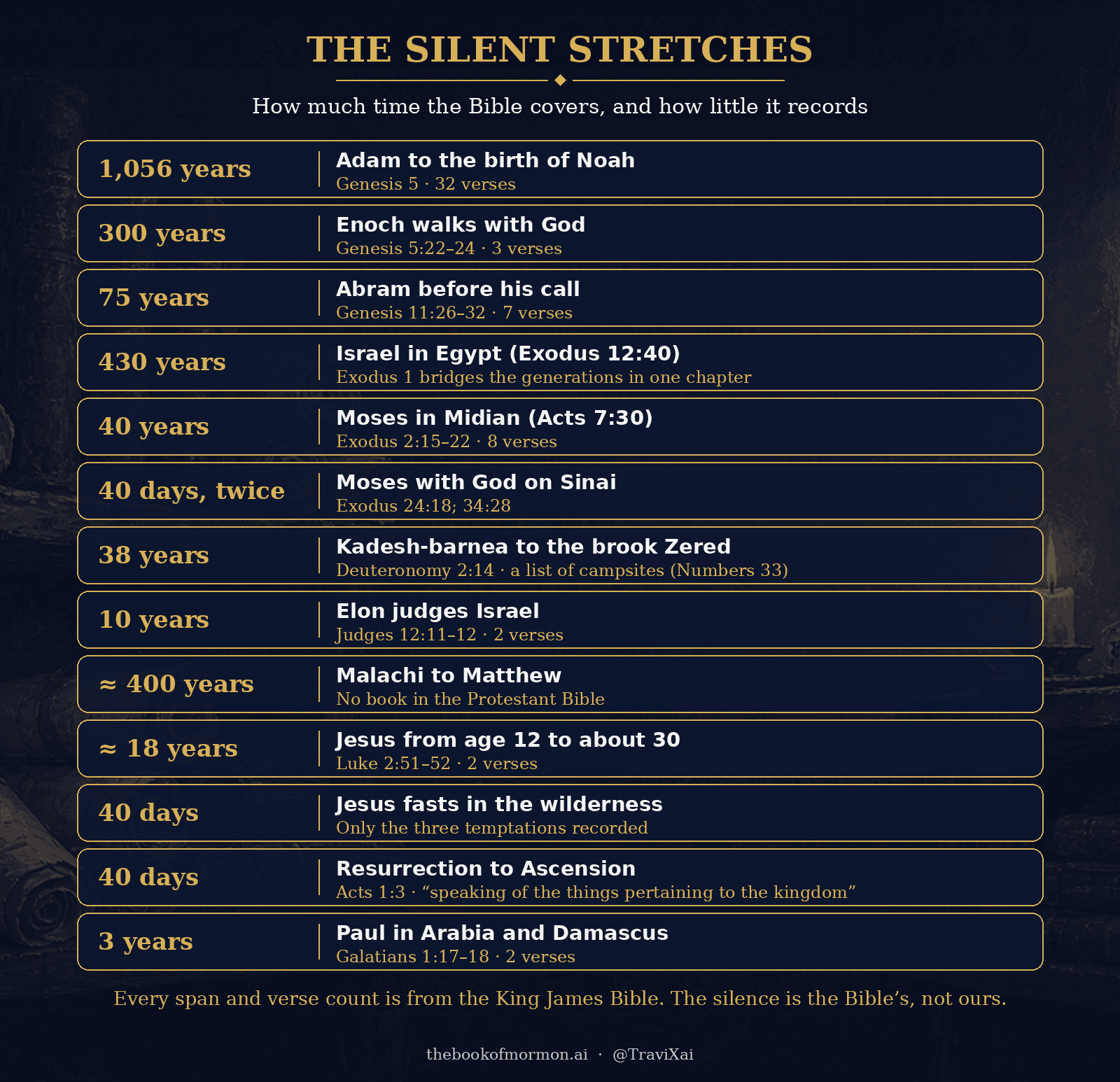
Adam to the Flood: about 1,656 years in a few chapters
Add up the ages in Genesis 5 and you get 1,056 years from Adam’s creation to the birth of Noah. Noah was “six hundred years old when the flood of waters was upon the earth” (Genesis 7:6). That’s about 1,656 years from Adam to the Flood by the Bible’s own numbers, and Genesis covers it in chapters 1 through 7.
Genesis 5, the chapter that carries those ten generations, is 32 verses long. Most of it is a formula: he lived, he begat, he died. Adam lived “nine hundred and thirty years” (Genesis 5:5). Methuselah lived “nine hundred sixty and nine years” (Genesis 5:27). Not one word Methuselah ever said is recorded. Nearly a thousand years of a righteous patriarch’s life, and the Bible gives us his age and his son.
Did Adam teach his children for 930 years? Did God speak to him again after Eden? The Bible doesn’t say. It isn’t trying to.
Enoch: 300 years with God, a handful of verses
And Enoch walked with God after he begat Methuselah three hundred years, and begat sons and daughters:
Genesis 5:22 (KJV)
Three hundred years of walking with God. Then “he was not; for God took him” (Genesis 5:24). That’s it. Genesis gives Enoch seven verses (5:18–24), and you can read every one of them in under a minute.
Then the New Testament quietly blows up the idea that Genesis told us everything. Jude says Enoch “prophesied” and quotes him: “Behold, the Lord cometh with ten thousands of his saints” (Jude 1:14). That prophecy isn’t in the Old Testament. Jude got it from a record of Enoch that isn’t in your Bible, and fragments of that Enoch literature turned up in Aramaic among the Dead Sea Scrolls (more in Part V). I cover this in Jude Says Enoch “Prophesied” and Joseph Smith’s Enoch and the Dead Sea Scrolls.
Abraham’s first 75 years
Abram “was seventy and five years old when he departed out of Haran” (Genesis 12:4). Everything before that is covered in Genesis 11:26–32: his birth, his brothers, a marriage, a move. Seven verses for seventy-five years. He lived to “an hundred threescore and fifteen years” (Genesis 25:7), and even the part of his life Genesis does cover has years-long jumps between chapters.
How did Abram come to know the true God in a family that served others? Genesis doesn’t say. Latter-day Saints have an account of his early life, his priesthood, and his visions in the Book of Abraham, and some of its details have since been found in ancient sources Joseph Smith couldn’t have read (The Book of Abraham: Ancient Details Discovered After 1842).
Israel in Egypt: 430 years
Now the sojourning of the children of Israel, who dwelt in Egypt, was four hundred and thirty years.
Exodus 12:40 (KJV)
Genesis ends with Joseph in a coffin in Egypt (Genesis 50:26). Exodus opens: “And Joseph died, and all his brethren, and all that generation,” and two verses later, “there arose up a new king over Egypt, which knew not Joseph” (Exodus 1:6–8). Generations pass in the space of a paragraph.
Did God speak to anyone in Israel for those centuries? Were there prophets among the slaves? Did fathers teach sons the covenant of Abraham? They must have, or nobody would have remembered it. None of it is recorded.
Moses: 40 years in Midian and 40 days on the mount, twice
Stephen tells us Moses was “full forty years old” when he went out to visit his brethren, and that “when forty years were expired,” the angel appeared in the bush (Acts 7:23, 30). Exodus covers those forty years in Midian in eight verses (Exodus 2:15–22), then says simply, “it came to pass in process of time” (Exodus 2:23).
And Moses went into the midst of the cloud, and gat him up into the mount: and Moses was in the mount forty days and forty nights.
Exodus 24:18 (KJV)
Forty days and nights in the presence of God. Then he did it again: “he was there with the LORD forty days and forty nights” (Exodus 34:28). What we have from those weeks is mostly the tabernacle instructions in Exodus 25–31 and the covenant renewal in Exodus 34. And even there, God tells Moses to build “after their pattern, which was shewed thee in the mount” (Exodus 25:40). Moses was shown things the text only points to. Eighty days face to face with God. Do you really think every sentence made it into Exodus?
38 years in the wilderness
And the space in which we came from Kadesh-barnea, until we were come over the brook Zered, was thirty and eight years; until all the generation of the men of war were wasted out from among the host, as the LORD sware unto them.
Deuteronomy 2:14 (KJV)
Thirty-eight years, and the Bible gives you a handful of episodes and a list of campsites (Numbers 33). An entire generation was born, raised, and buried in that desert under a living prophet. Moses spoke to them for decades. Most of what he said is gone.
The Judges: centuries in summary
Paul says God gave Israel judges “about the space of four hundred and fifty years, until Samuel the prophet” (Acts 13:20). Look at how the book of Judges handles some of them:
- Shamgar delivered Israel. One verse (Judges 3:31).
- Tola “judged Israel twenty and three years.” Two verses (Judges 10:1–2).
- Jair judged twenty-two years. Three verses, mostly about his thirty sons on thirty donkeys (Judges 10:3–5).
- Elon “judged Israel ten years.” Two verses, and the second one is his burial (Judges 12:11–12).
By the time Samuel was a boy, “the word of the LORD was precious in those days; there was no open vision” (1 Samuel 3:1). And when Samuel did receive revelation, he “told the people the manner of the kingdom, and wrote it in a book, and laid it up before the LORD” (1 Samuel 10:25). A prophet wrote a book and laid it before the Lord. Where is it?
About 400 years between Malachi and Matthew
Turn the page from Malachi to Matthew and you skip roughly four centuries. Malachi ends promising “Elijah the prophet before the coming of the great and dreadful day of the LORD” (Malachi 4:5). Matthew opens with a genealogy. In between, empires rose and fell, the temple was profaned and rededicated, and the Jews produced a whole library of religious writing. Catholic and Orthodox Bibles include some of it, like the books of Maccabees. Protestant Bibles include none of it.
So the person who says “the Bible is all of God’s words” is also saying God had nothing to say to His covenant people for about four hundred years. Maybe. But that’s a claim about God, and he can’t prove it from a blank page.
Jesus from 12 to 30: two verses
Luke tells us that “when he was twelve years old,” Jesus went up to Jerusalem (Luke 2:42), where the teachers in the temple “were astonished at his understanding and answers” (Luke 2:47). The next thing we know, “Jesus himself began to be about thirty years of age” (Luke 3:23). Between them:
And Jesus increased in wisdom and stature, and in favour with God and man.
Luke 2:52 (KJV)
That, plus verse 51, is about eighteen years of the life of the Son of God. Two verses. He grew up in a home with Mary, Joseph, and brothers and sisters. He worked. He worshiped in a synagogue. He prayed. Did He say nothing worth hearing between the ages of twelve and thirty? Did the Father say nothing to Him? The boy in the temple was already astonishing the teachers. Then the record goes silent for nearly two decades.
Forty days in the wilderness
After His baptism, Jesus “fasted forty days and forty nights” (Matthew 4:2), and “the angels ministered unto him” (Mark 1:13). The Gospels record the three temptations at the end. What did the angels say? What did He pray for six weeks? We don’t know.
The ministry itself
John mentions at least three Passovers during Jesus’ public ministry (John 2:13; 6:4; 11:55), which is why it’s usually reckoned at about three years. Three years of teaching crowds, villages, synagogues, and His own disciples privately. Mark says outright that what we have is a sample: “with many such parables spake he the word unto them,” and “when they were alone, he expounded all things to his disciples” (Mark 4:33–34). All things, explained privately. Where’s that record?
And when the crowds came, “he began to teach them many things” (Mark 6:34). Many things, unrecorded. Jesus even told His apostles, “I have yet many things to say unto you, but ye cannot bear them now” (John 16:12). That is not a man who was finished talking.
The sermon on the road to Emmaus
On the day He rose, Jesus walked with two disciples to Emmaus, “about threescore furlongs” from Jerusalem (Luke 24:13), roughly seven miles. On the way:
And beginning at Moses and all the prophets, he expounded unto them in all the scriptures the things concerning himself.
Luke 24:27 (KJV)
The resurrected Lord gave a guided tour of every prophecy about Himself, from Moses forward. Their hearts burned while “he opened to us the scriptures” (Luke 24:32). Then He did the same for the apostles and “opened he their understanding” (Luke 24:45). If there were ever a sermon a Bible-only Christian should want, it’s that one. Not one sentence of it is recorded.
The 40 days after the Resurrection
To whom also he shewed himself alive after his passion by many infallible proofs, being seen of them forty days, and speaking of the things pertaining to the kingdom of God:
Acts 1:3 (KJV)
Forty days of the risen Christ teaching the apostles about His kingdom, after He had “given commandments unto the apostles” through the Holy Ghost (Acts 1:2). The Gospels and Acts give us a handful of appearances. Paul adds one the Gospels don’t mention at all: “he was seen of above five hundred brethren at once” (1 Corinthians 15:6). Forty days of instruction on how to run His Church, and we have a few scenes.
The apostles who vanish
Acts 1:13 lists the eleven. Then watch what happens. Andrew, Thomas, Bartholomew, Matthew, Simon Zelotes, and Judas the brother of James are never named in Acts again. Matthias is chosen to replace Judas Iscariot (Acts 1:26) and never appears again either. Herod kills James “the brother of John with the sword” in one verse (Acts 12:2). Peter drops out of the story after Acts 15.
These were men ordained by Christ, who spent decades preaching. Did they receive revelation? Write letters? Nearly all of it is gone. Even Paul’s life has holes: after his conversion he “went into Arabia,” and only “after three years” went up to Jerusalem (Galatians 1:17–18). Later he was “caught up into paradise, and heard unspeakable words, which it is not lawful for a man to utter” (2 Corinthians 12:4). Words from heaven that Paul was forbidden to write. Acts ends with Paul two years in a rented house, “preaching the kingdom of God” (Acts 28:30–31). Then nothing. Paul’s death, the later years of the apostles, the decades after: none of it is in the New Testament.
Part II: Do the math on Jesus’ words
You can read every red-letter word in an afternoon. You can read all four Gospels, narration and all, in a long day. Now compare that to how long Jesus actually taught.
Here’s a simple illustration. It is not a statistic, and I’m keeping every assumption deliberately low so nobody can say I padded it:
- Suppose Jesus taught just one hour a day. (Luke says that near the end “in the day time he was teaching in the temple,” with people coming “early in the morning” to hear Him (Luke 21:37–38). So this is low.)
- Suppose He did it 365 days a year for three years.
- Suppose He spoke at a slow 100 words a minute. (Ordinary conversation runs faster.)
- That’s 100 × 60 × 365 × 3 = 6,570,000 words.
The four Gospels in the King James Version come to roughly 84,000 words. That counts everything: the genealogies, the narration, the Pharisees’ lines, Pilate’s lines. Even if every one of those words came out of Jesus’ mouth, the Gospels would hold about 1.3 percent of what one hour a day would produce. The actual red-letter portion is smaller still.
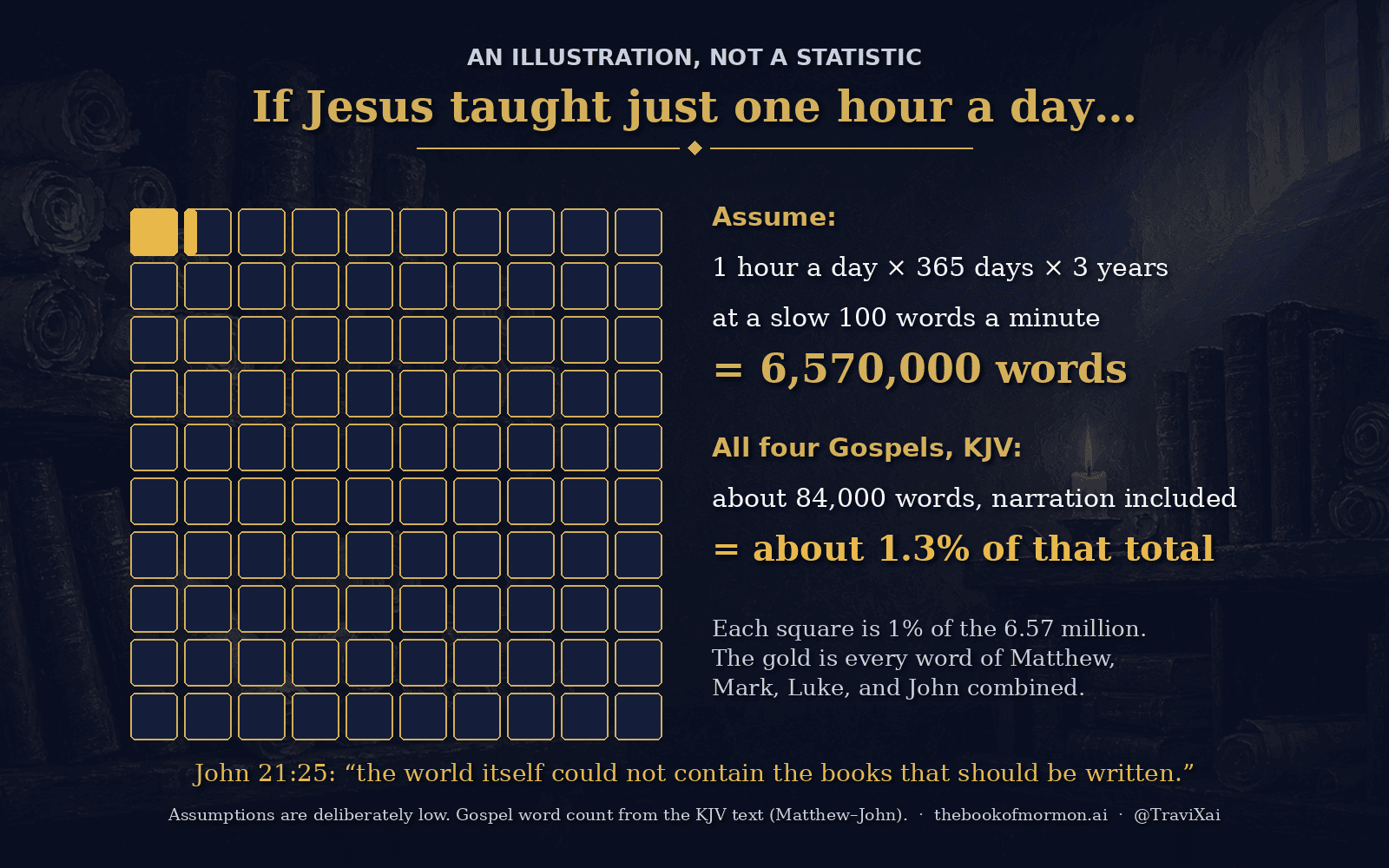
Play with the numbers however you like. Make it half an hour a day. Make it two years. You still can’t get the Gospels anywhere close to everything He said. And that’s just Jesus. It doesn’t count Adam, Enoch, Noah, Abraham, Moses, or any of the apostles.
The Gospel writers knew this. John said so twice:
And many other signs truly did Jesus in the presence of his disciples, which are not written in this book:
John 20:30 (KJV)
And there are also many other things which Jesus did, the which, if they should be written every one, I suppose that even the world itself could not contain the books that should be written. Amen.
John 21:25 (KJV)
The last verse of the fourth Gospel is an admission that the Gospels are incomplete. And the New Testament proves it right away. Paul quotes Jesus saying something that appears in none of the four Gospels: “remember the words of the Lord Jesus, how he said, It is more blessed to give than to receive” (Acts 20:35). A real saying of Jesus, preserved outside the Gospels. So much for the idea that the Gospels hold every word He said.
Part III: The books the Bible cites and doesn’t have
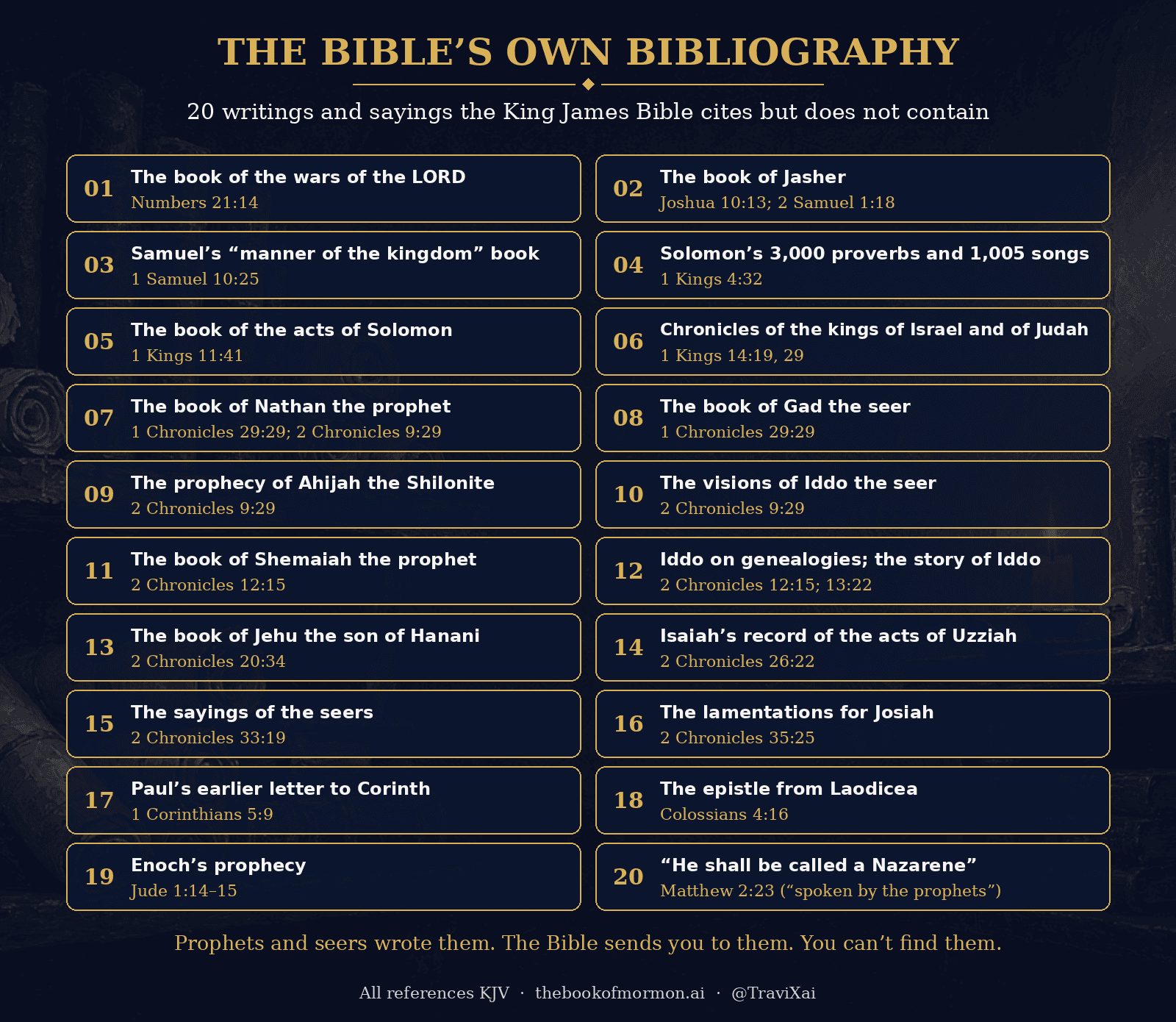
A book that cites its sources is telling you there’s more. The Bible does it constantly. The authors of Kings and Chronicles send you to the books of prophets and seers for “the rest of the acts” of a king, as if you could walk down to the library and look them up. You can’t. Here are the ones the King James Bible names, with every reference checked:
The early books
- The book of the wars of the LORD. “Wherefore it is said in the book of the wars of the LORD” (Numbers 21:14).
- The book of Jasher. At the sun standing still: “Is not this written in the book of Jasher?” (Joshua 10:13). Again at David’s lament for Saul: “behold, it is written in the book of Jasher” (2 Samuel 1:18). The “Book of Jasher” sold online today is a much later work, not the one Joshua cites.
- Samuel’s book on the kingdom. Samuel “wrote it in a book, and laid it up before the LORD” (1 Samuel 10:25).
The prophets’ and seers’ books
- The books of Nathan the prophet and Gad the seer. David’s acts “are written in the book of Samuel the seer, and in the book of Nathan the prophet, and in the book of Gad the seer” (1 Chronicles 29:29).
- The prophecy of Ahijah and the visions of Iddo. Solomon’s acts are in “the book of Nathan the prophet, and in the prophecy of Ahijah the Shilonite, and in the visions of Iddo the seer” (2 Chronicles 9:29).
- The book of Shemaiah the prophet, and Iddo “concerning genealogies” (2 Chronicles 12:15), plus “the story of the prophet Iddo” (2 Chronicles 13:22).
- The book of Jehu the son of Hanani (2 Chronicles 20:34).
- Isaiah’s account of Uzziah. “Now the rest of the acts of Uzziah, first and last, did Isaiah the prophet, the son of Amoz, write” (2 Chronicles 26:22). Our book of Isaiah doesn’t contain it.
- The sayings of the seers. Manasseh’s prayer of repentance is “written among the sayings of the seers” (2 Chronicles 33:19).
- The lamentations for Josiah. “Jeremiah lamented for Josiah,” and the laments “are written in the lamentations” (2 Chronicles 35:25). Our book of Lamentations mourns the fall of Jerusalem, not Josiah.
Look at the titles: prophet, seer, prophet, seer. These weren’t court clerks. They were men God spoke to, and the Bible itself treats their writings as the place to go for the rest of the story.
There were royal records too, “the book of the acts of Solomon” (1 Kings 11:41) and “the book of the chronicles of the kings of Israel” and “of Judah” (1 Kings 14:19, 29). And Solomon himself “spake three thousand proverbs: and his songs were a thousand and five” (1 Kings 4:32). Our whole book of Proverbs is 915 verses, and not all of them are his (chapters 30 and 31 are credited to Agur and Lemuel). Of his 1,005 songs, the Bible keeps the Song of Solomon and two psalms with his name in the title (Psalms 72 and 127). Most of the wisest king’s words are lost.
The New Testament’s missing mail
- Paul’s earlier letter to Corinth. “I wrote unto you in an epistle not to company with fornicators” (1 Corinthians 5:9). That letter came before our 1 Corinthians, and it’s gone.
- The epistle from Laodicea. “Cause that it be read also in the church of the Laodiceans; and that ye likewise read the epistle from Laodicea” (Colossians 4:16). Paul told a church to read it. We can’t.
- Enoch’s prophecy. Quoted as prophecy in Jude 1:14–15.
- What “the prophets” said about Nazareth. Jesus lived in Nazareth “that it might be fulfilled which was spoken by the prophets, He shall be called a Nazarene” (Matthew 2:23). No Old Testament verse says that. Matthew is quoting prophets whose words we don’t have, or at least not in that form.
The New Testament also leans on stories the Old Testament never tells: Michael the archangel disputing with the devil “about the body of Moses” (Jude 1:9), and “Jannes and Jambres” who “withstood Moses” (2 Timothy 3:8). The apostles clearly knew sources we don’t.
God rewrote a burned book, with more in it
One story should end the “closed and complete” idea by itself. King Jehoiakim cut Jeremiah’s scroll apart with a penknife and burned it, “until all the roll was consumed in the fire” (Jeremiah 36:23). So God had Jeremiah dictate it again:
Then took Jeremiah another roll, and gave it to Baruch the scribe, the son of Neriah; who wrote therein from the mouth of Jeremiah all the words of the book which Jehoiakim king of Judah had burned in the fire: and there were added besides unto them many like words.
Jeremiah 36:32 (KJV)
“There were added besides unto them many like words.” God restored a lost record and added more revelation to it. Keep that verse in your pocket. It describes the Restoration better than most of us do.
For a fuller treatment of these citations, see Books the Bible Quotes That Aren’t in the Bible. The Latter-day Saint Bible Dictionary also keeps a list under “Lost books.” And for what the brass plates may have held that our Bible doesn’t, see my review of The Key to the Keystone.
Part IV: “All the prophets” and the ones we can’t name
Here’s where the “Bible is everything” position gets genuinely hard to hold. Jesus and His apostles didn’t say some of the prophets testified of Christ. They said all of them did.
These are the words which I spake unto you, while I was yet with you, that all things must be fulfilled, which were written in the law of Moses, and in the prophets, and in the psalms, concerning me.
Luke 24:44 (KJV)
- “To him give all the prophets witness” (Acts 10:43).
- “All the prophets from Samuel and those that follow after, as many as have spoken, have likewise foretold of these days” (Acts 3:24).
- God spoke “by the mouth of all his holy prophets since the world began” (Acts 3:21; see also Luke 1:70).
- The prophets “testified beforehand the sufferings of Christ, and the glory that should follow” (1 Peter 1:11).
- “Search the scriptures… they are they which testify of me” (John 5:39). And of Moses: “he wrote of me” (John 5:46).
Now do the honest exercise. Open the Old Testament and find where all the prophets plainly testify of the suffering and glory of the Messiah. Find where Moses plainly writes of Jesus. You’ll find types, shadows, and some powerful prophecies, especially in Isaiah and the Psalms. You will not find every prophet saying it plainly, and you won’t find most of the prophets at all. I made this argument at length in The Old Testament Was Christian. So Who Took Christ Out? The short version: either “all the prophets” means something, or it doesn’t.
The prophets they killed
The Bible gives you the reason so many prophets are missing. Their own people killed them.
O Jerusalem, Jerusalem, thou that killest the prophets, and stonest them which are sent unto thee, how often would I have gathered thy children together, even as a hen gathereth her chickens under her wings, and ye would not!
Matthew 23:37 (KJV)
That the blood of all the prophets, which was shed from the foundation of the world, may be required of this generation; From the blood of Abel unto the blood of Zacharias, which perished between the altar and the temple: verily I say unto you, It shall be required of this generation.
Luke 11:50–51 (KJV)
“The blood of all the prophets, which was shed from the foundation of the world.” Not a few. A long line of murdered prophets reaching back to Abel. How many of them does the Old Testament name? How many of their sermons does it preserve?
- Stephen: “Which of the prophets have not your fathers persecuted? and they have slain them which shewed before of the coming of the Just One” (Acts 7:52). They killed prophets who foretold Christ. Where are those prophecies?
- Nehemiah: Israel “slew thy prophets which testified against them to turn them to thee” (Nehemiah 9:26).
- When Jezebel “cut off the prophets of the LORD,” Obadiah “took an hundred prophets, and hid them by fifty in a cave” (1 Kings 18:4). A hundred prophets alive at one time, in one kingdom. Name five of them.
- Elijah: “the children of Israel have… slain thy prophets with the sword; and I, even I only, am left” (1 Kings 19:10).
- Urijah “prophesied in the name of the LORD” and Jehoiakim “slew him with the sword” (Jeremiah 26:20–23). We get a summary of his message and his death. Not his words.
- Zechariah son of Jehoiada spoke by the Spirit, and “they… stoned him with stones at the commandment of the king” (2 Chronicles 24:20–21).
- Hebrews: “of the prophets… They were stoned, they were sawn asunder… slain with the sword: they wandered about in sheepskins and goatskins… in dens and caves of the earth” (Hebrews 11:32, 37–38).
- And Jesus to the scribes and Pharisees: “ye be witnesses unto yourselves, that ye are the children of them which killed the prophets” (Matthew 23:31).
So the Bible tells you, in Jesus’ own words, that a long line of prophets testified of Christ, were killed for it, and left us nothing we can name. You can’t believe Jesus on that and also believe the Old Testament preserves every prophet God ever sent.
Three of those lost prophets have names again
This is one of the quiet wonders of the Book of Mormon. Lehi’s family carried the brass plates out of Jerusalem around 600 BC. Those plates held “the prophecies of the holy prophets, from the beginning, even down to the commencement of the reign of Zedekiah” (1 Nephi 5:13). Among them were prophets the Bible never mentions, and their testimonies are exactly the kind Jesus said all the prophets gave.
…to be lifted up, according to the words of Zenock, and to be crucified, according to the words of Neum, and to be buried in a sepulchre, according to the words of Zenos, which he spake concerning the three days of darkness, which should be a sign given of his death unto those who should inhabit the isles of the sea, more especially given unto those who are of the house of Israel.
1 Nephi 19:10
Zenos, Zenock, and Neum: three Israelite prophets who testified plainly of the Messiah being lifted up, crucified, and buried. And they died the way Jesus said the prophets died.
And now, my brethren, ye see that a second prophet of old has testified of the Son of God, and because the people would not understand his words they stoned him to death.
Alma 33:17
And now I would that ye should know, that even since the days of Abraham there have been many prophets that have testified these things; yea, behold, the prophet Zenos did testify boldly; for the which he was slain.
Helaman 8:19
Helaman 8:20 adds Ezias, another name the Bible doesn’t have. Zenos’ words fill a whole chapter: the allegory of the olive tree in Jacob 5, at 77 verses the longest chapter in the Book of Mormon. His teaching on prayer is quoted in Alma 33:3–11.
Think about what that means. The Bible tells you prophets who foretold Christ were killed and lost. The Book of Mormon names some of them, quotes them, and says they were killed for testifying of the Son of God. That isn’t competing with the Bible. It’s answering a question the Bible itself raises.
Part V: What the ground has given back since the 1890s
If God’s dealings with men really ended at the last page of the Bible, you wouldn’t expect the ground to keep handing back sacred records nobody knew existed. It does. Here’s what has turned up since the 1890s, with an honest label on each. Not all of it is scripture, and I’m not going to pretend it is. The point is simpler: the ancient world had far more religious writing than our Bible holds, and it keeps surfacing.
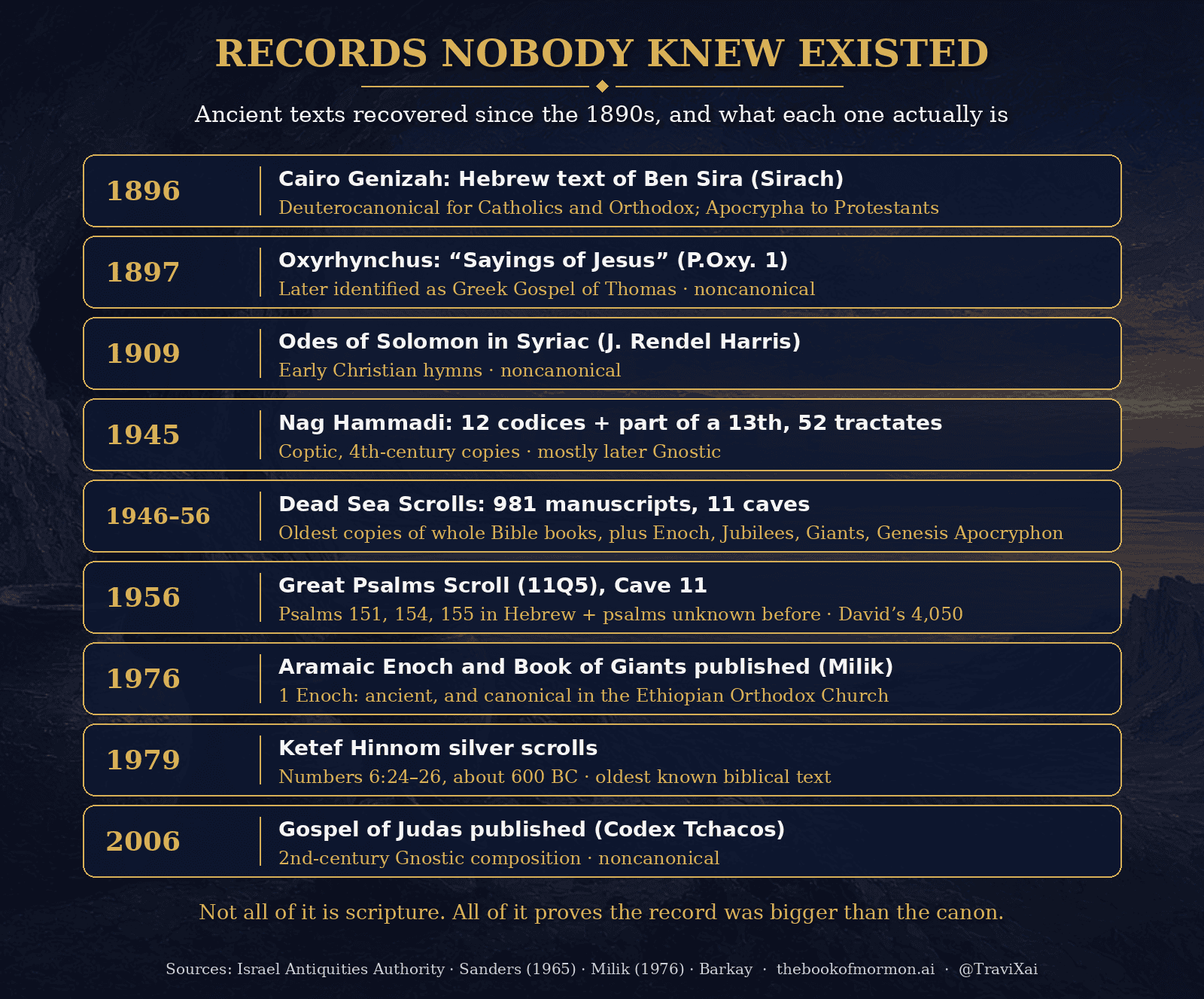
1896: the Cairo Genizah
A storeroom for worn-out sacred texts in Cairo’s Ben Ezra Synagogue held roughly 400,000 manuscript fragments. In 1896 scholars recognized among them the Hebrew text of Ben Sira (Sirach, also called Ecclesiasticus), a book until then known mainly in Greek. Solomon Schechter also found there fragments of a sectarian work later called the Damascus Document, which turned up again decades later among the Dead Sea Scrolls (overview). Status: Sirach is deuterocanonical scripture for Catholics and Orthodox, Apocrypha to Protestants.
1897: the Oxyrhynchus papyri
Bernard Grenfell and Arthur Hunt began digging an ancient rubbish dump at Oxyrhynchus, Egypt, in the 1890s. Over 5,000 documents have been published since, and scholars estimate far more remain (overview). One of the first, P.Oxy. 1, was a page of “sayings of Jesus,” published in 1897. Decades later it was identified as part of the Greek Gospel of Thomas (overview). Status: noncanonical. The sayings collection is usually dated to the second century and has a mix of familiar sayings and later ideas.
1909: the Odes of Solomon
In 1909 J. Rendel Harris identified a Syriac manuscript of the Odes of Solomon, a collection of early Christian hymns previously known only from scraps quoted elsewhere (overview). Status: early Christian, noncanonical. A reminder that the first Christians were singing and writing far more than the New Testament preserves.
1945: Nag Hammadi
Near Nag Hammadi, Egypt, a farmer named Muhammad ‘Ali al-Samman dug up a sealed jar holding twelve leather-bound papyrus codices and part of a thirteenth: 52 tractates in Coptic, copied in the third and fourth centuries. It includes the only complete text of the Gospel of Thomas (overview). Status: mostly Gnostic and later than the New Testament. Latter-day Saints don’t treat these as scripture, and neither should anyone else. But they show how crowded the field of “Christian” writing was before the canon settled, and how much was argued over and set aside.
1946–1956: the Dead Sea Scrolls
Between late 1946 and early 1947, Bedouin shepherds found jars of scrolls in a cave near Qumran. By 1956, eleven caves had produced the remains of 981 different manuscripts, copied between the third century BC and the first century AD (overview; Leon Levy Dead Sea Scrolls Digital Library). About 40 percent are copies of books in the Hebrew Bible, including the oldest surviving copies of whole biblical books. About 30 percent are religious texts that never made it into the Hebrew canon. The rest are writings of the community itself. Among the finds:
- Aramaic fragments of 1 Enoch from Cave 4, published by J. T. Milik in 1976 (Milik, The Books of Enoch). The book Jude quotes was being copied by Jews before Christ. Status: ancient Jewish text; canonical in the Ethiopian Orthodox Tewahedo Church (overview).
- Jubilees, a retelling of Genesis and early Exodus. About fifteen copies were found in five caves, more than for any biblical book except Psalms, Deuteronomy, Isaiah, Exodus, and Genesis (overview). Status: ancient; canonical in the Ethiopian Orthodox Church.
- The Book of Giants, an Enoch-related work about the giants of Genesis 6, in which a figure named Mahaway goes to Enoch. Its connection to Joseph Smith’s Mahijah in Moses 6 is covered in Joseph Smith’s Enoch and the Dead Sea Scrolls. Status: ancient, noncanonical.
- The Genesis Apocryphon, one of the original seven Cave 1 scrolls, an Aramaic retelling of stories of Lamech, Noah, and Abraham (overview). Status: ancient, noncanonical.
- The Great Psalms Scroll (11Q5), found in Cave 11 in February 1956, unrolled in 1961, and published by James Sanders in 1965 (overview; digital library). It arranges the biblical psalms in a different order and mixes in psalms that aren’t in the Hebrew Bible: Psalm 151 (previously known from the Greek Septuagint), Psalms 154 and 155, and compositions nobody had seen before, like the “Plea for Deliverance” and the “Apostrophe to Zion.” Status: Psalm 151 is in Orthodox Bibles; the others are noncanonical.
That psalms scroll also contains a short prose piece called “David’s Compositions.” It credits David with 3,600 psalms, plus 446 songs for the altar, Sabbaths, and festivals, plus 4 more, a total of 4,050. And it says he composed them all through prophecy given him by the Most High. Our Bible has 150 psalms, only some of them attributed to David. Whatever you make of that number, the Jews who copied this scroll before Christ believed David had left far more inspired songs than survived. Sound familiar? It’s Solomon’s 1,005 songs all over again (1 Kings 4:32).
The scrolls have also corrected our Bible in places. A Dead Sea Scroll of Deuteronomy 32:8 reads “sons of God” where later Hebrew manuscripts read “children of Israel,” which I cover in Deuteronomy 32:8–9 and the Dead Sea Scrolls. Psalm 145 is missing a verse in the Masoretic text that the scroll preserves (Psalm 145 and the Missing Verse). The text we have didn’t come down perfectly, either (“As Far As It Is Translated Correctly”).
1979: the Ketef Hinnom silver scrolls
In 1979, in a burial cave outside Jerusalem’s Old City, archaeologist Gabriel Barkay’s team found two tiny rolled silver amulets. Unrolling them safely took three years. They carry the priestly blessing of Numbers 6:24–26, “The LORD bless thee, and keep thee,” and date to around 600 BC, the time of Jeremiah and of Lehi (overview). Status: a canonical text, and widely regarded as the oldest surviving copy of any passage from the Hebrew Bible. Scripture inscribed on metal, from Lehi’s Jerusalem. Critics used to mock the very idea of sacred writing on metal plates.
2006: the Gospel of Judas
A Coptic codex (Codex Tchacos) that surfaced in Egypt in the 1970s was authenticated and published in 2006. The papyrus was carbon-dated to roughly AD 220–340, and the text is a translation of a Greek work from before about AD 180 (overview). Status: Gnostic, noncanonical, and theologically far from the Gospels. I mention it only because it’s famous, and because it shows the same thing again: there were many books, and the record of the early Church is bigger and messier than one bound volume.
Ethiopia never closed the door the same way
One more fact for anyone who thinks the canon is obvious. The Ethiopian Orthodox Tewahedo Church, one of the oldest Christian churches on earth, has long included 1 Enoch and Jubilees in its Bible. In fact, the only complete text of 1 Enoch that survives is in Ge’ez, Ethiopia’s ancient church language (overview). The book Jude quoted as prophecy has been scripture for millions of Christians for centuries. So which canon is “all of God’s words”? The Protestant 66? The Catholic 73? The Ethiopian one? They can’t all be complete.
Step back and look at the pattern. In about 130 years we’ve recovered Hebrew Ben Sira, the Odes of Solomon, the Nag Hammadi codices, nearly a thousand manuscripts from the Dead Sea caves, extra psalms, Aramaic Enoch, and the oldest scripture text on silver. Every generation, more of God’s dealings with men, and men’s reactions to Him, come out of the ground. The record was always bigger than the canon.
Part VI: “But Revelation 22:18…”
Somebody always pastes this one:
For I testify unto every man that heareth the words of the prophecy of this book, If any man shall add unto these things, God shall add unto him the plagues that are written in this book:
Revelation 22:18 (KJV)
Three problems. First, “this book” is John’s prophecy, the book of Revelation, which he was told to “write in a book, and send it unto the seven churches” (Revelation 1:11). There was no bound Bible yet for him to be closing. Second, Revelation is last in the binding, not necessarily last in time. Third, Moses said almost the same thing:
Ye shall not add unto the word which I command you, neither shall ye diminish ought from it, that ye may keep the commandments of the LORD your God which I command you.
Deuteronomy 4:2 (KJV)
If Deuteronomy 4:2 closed the canon, throw out everything from Joshua to Revelation. Nobody does, because everybody understands the warning is against men tampering with God’s word, not against God speaking again. Proverbs says it too: “Add thou not unto his words, lest he reprove thee” (Proverbs 30:6). Notice whose words: His. The warning protects revelation; it doesn’t forbid it. I go through this in detail in Revelation 22:18 and “This Book”.
Part VII: A God who still speaks
Surely the Lord GOD will do nothing, but he revealeth his secret unto his servants the prophets.
Amos 3:7 (KJV)
That’s the pattern from Genesis to Revelation. God works through prophets. When there are no prophets, it’s not because God ran out of things to say. It’s because people killed them or stopped listening. Paul said Christ gave “apostles; and… prophets” to the Church “till we all come in the unity of the faith” (Ephesians 4:11–13). Look around at the state of Christianity and tell me we’ve arrived at the unity of the faith. (On what happened when the apostles were gone, see The Great Apostasy in the New Testament’s Own Words.)
The Book of Mormon saw this exact argument coming, nearly word for word:
And because my words shall hiss forth—many of the Gentiles shall say: A Bible! A Bible! We have got a Bible, and there cannot be any more Bible.
2 Nephi 29:3
Wherefore, because that ye have a Bible ye need not suppose that it contains all my words; neither need ye suppose that I have not caused more to be written.
2 Nephi 29:10
That isn’t an attack on the Bible. Latter-day Saints love the Bible, read it, and teach from it every week. It’s a refusal to put a limit on God that the Bible never puts on Him. The same God who had Jeremiah rewrite a burned scroll “and there were added besides unto them many like words” brought forth the Book of Mormon, restored lost writings of Moses and Enoch in the Pearl of Great Price, and kept speaking through living prophets in the Doctrine and Covenants (What Is the Doctrine and Covenants?). That’s what the Restoration is: not a new God, but the same God doing what He has always done (What Is the Restoration of the Gospel?; The Canon Was Never Meant to Close).
The bottom line
Ask the Bible whether it holds all of God’s words and it answers for itself. It skips Adam’s nine centuries, Enoch’s three hundred years with God, four hundred years in Egypt, four hundred more between the testaments, and eighteen years of Jesus’ own life. It records none of the Emmaus sermon and almost none of the forty days. It sends you to the books of Nathan, Gad, Iddo, Shemaiah, Jehu, and Isaiah that it doesn’t contain. It tells you a long line of prophets testified of Christ and were murdered, and it can’t tell you their names.
Then the caves started talking. Enoch in Aramaic. Jubilees in Hebrew. Psalms nobody had read for two thousand years. The priestly blessing on silver from Lehi’s Jerusalem.
So when someone tells me the Bible is all of God’s words, I don’t have to argue with him. I just hand him his Bible and ask him to read John 21:25 out loud. Then I ask him what Jesus said on the road to Emmaus.
He doesn’t know. Neither do I. But I know a God who keeps His promises, raises up prophets, and brings lost records out of the ground in His own time. He did it in 1947 at Qumran. He did it in 1827 at Cumorah. And He isn’t finished.
Key takeaways
- The Bible never claims to contain all of God’s words. John 20:30 and 21:25 say plainly that most of what Jesus did was never written.
- It skips long stretches: about 1,656 years from Adam to the Flood in seven chapters, 430 years in Egypt, about 400 years between Malachi and Matthew, and about 18 years of Jesus’ life (Luke 2:51–52).
- The Emmaus sermon (Luke 24:27) and the 40 days of teaching after the Resurrection (Acts 1:3) are almost entirely unrecorded.
- The KJV cites about 20 writings and sayings it doesn’t contain, including Jasher, the books of Nathan, Gad, Iddo, Shemaiah and Jehu, Paul’s epistle from Laodicea, and Enoch’s prophecy.
- Jesus said all the prophets testified of Him (Luke 24:27, 44; Acts 3:24; 10:43), and that the blood of prophets slain since the foundation of the world would be required (Luke 11:50). Many are unnamed. The Book of Mormon names Zenos, Zenock, and Neum.
- Since the 1890s, the Cairo Genizah, Oxyrhynchus, Nag Hammadi, the Dead Sea Scrolls, and Ketef Hinnom have recovered ancient religious texts nobody knew existed. Some are scripture, some are not, and all show the record was bigger than the canon.
- Revelation 22:18 and Deuteronomy 4:2 forbid men from tampering with God’s words. They don’t stop God from speaking. Amos 3:7 says He speaks through prophets.
Is the Bible all of God’s words? Quick answers
Does the Bible contain all of God’s words?
No, and it says so. John 21:25 says that if everything Jesus did were written, “the world itself could not contain the books.” The Bible also cites about twenty prophetic and historical writings it doesn’t contain, such as the book of Jasher (Joshua 10:13) and the epistle from Laodicea (Colossians 4:16).
What books are mentioned in the Bible but missing from it?
Among others: the book of the wars of the LORD (Numbers 21:14), the book of Jasher (Joshua 10:13; 2 Samuel 1:18), the books of Nathan the prophet and Gad the seer (1 Chronicles 29:29), the prophecy of Ahijah and the visions of Iddo (2 Chronicles 9:29), the book of Shemaiah (2 Chronicles 12:15), the book of Jehu (2 Chronicles 20:34), Paul’s earlier letter to Corinth (1 Corinthians 5:9), and the epistle from Laodicea (Colossians 4:16).
What did Jesus do between ages 12 and 30?
The Bible doesn’t say. Luke covers those roughly eighteen years in two verses: He went home to Nazareth, “was subject unto them,” and “increased in wisdom and stature, and in favour with God and man” (Luke 2:51–52).
What did Jesus teach during the 40 days after His resurrection?
Acts 1:3 says He was “seen of them forty days, and speaking of the things pertaining to the kingdom of God.” Only a few of those appearances are described, and the content of that teaching is almost entirely unrecorded.
How many years are there between the Old and New Testaments?
Roughly four hundred years separate Malachi from the events of the Gospels. Protestant Bibles have no books from that period; Catholic and Orthodox Bibles include some, such as 1 and 2 Maccabees.
Who were the prophets killed in the Bible whose words we don’t have?
Jesus spoke of “the blood of all the prophets, which was shed from the foundation of the world” (Luke 11:50). Obadiah hid a hundred prophets from Jezebel (1 Kings 18:4), and Elijah said Israel had slain God’s prophets with the sword (1 Kings 19:10). Most are unnamed. The Book of Mormon names Zenos, Zenock, and Neum, who testified of Christ (1 Nephi 19:10), and says Zenos and Zenock were killed for it (Helaman 8:19; Alma 33:17).
Were new psalms found in the Dead Sea Scrolls?
Yes. The Great Psalms Scroll (11Q5), found in Qumran Cave 11 in 1956, includes Psalm 151, Psalms 154 and 155, and compositions unknown before, such as the “Plea for Deliverance” and the “Apostrophe to Zion.” It also credits David with 4,050 compositions.
Doesn’t Revelation 22:18 say nothing can be added to the Bible?
It warns against adding to “the prophecy of this book,” meaning John’s Revelation, written before the Bible was compiled. Deuteronomy 4:2 gives the same warning, and God kept revealing scripture for centuries afterward. The warning binds men who tamper with God’s words, not God.
This post expands a post on X. Follow @TraviXai for daily answers to critics, and dig deeper into any topic at galatians18.app.
Sources
- Scripture quotations: King James Version and the Book of Mormon, churchofjesuschrist.org. Gospel word count (about 84,000 words, Matthew through John) computed from the KJV text; spans from Genesis 5 and 7:6, Exodus 12:40, Acts 7:23, 30, Deuteronomy 2:14, and Acts 13:20.
- “Lost books,” Bible Dictionary, churchofjesuschrist.org.
- Leon Levy Dead Sea Scrolls Digital Library, Israel Antiquities Authority, deadseascrolls.org.il; Great Psalms Scroll, 11Q5.
- J. A. Sanders, The Psalms Scroll of Qumrân Cave 11 (11QPsa), Discoveries in the Judaean Desert 4 (Oxford: Clarendon, 1965).
- J. T. Milik with Matthew Black, The Books of Enoch: Aramaic Fragments of Qumrân Cave 4 (Oxford, 1976).
- Background and dates: “Dead Sea Scrolls,” “Great Psalms Scroll,” “Book of Enoch,” “Book of Jubilees,” “Genesis Apocryphon,” “Nag Hammadi library,” “Oxyrhynchus Papyri,” “Gospel of Thomas,” “Cairo Geniza,” “Odes of Solomon,” “Ketef Hinnom,” and “Gospel of Judas,” Wikipedia (accessed November 13, 2026), with their cited scholarship (Sanders 1965; Schiffman 2000; Barkay; Kasser, Meyer and Wurst 2006).
- Related on this blog: Books the Bible Quotes, Revelation 22:18 and “This Book”, The Canon Was Never Meant to Close, Joseph Smith’s Enoch and the Dead Sea Scrolls, Deuteronomy 32:8–9 and the Dead Sea Scrolls.
- Featured image and in-post graphics: original graphics by thebookofmormon.ai (painted backgrounds with no photographs or likenesses of real people).
- Scripture quotations from the Holy Bible (KJV) and the Book of Mormon via churchofjesuschrist.org.
Follow @TraviXai and explore more at https://galatians18.app.