
The second most-searched question about the Book of Mormon. Here’s the strongest evidence, the honest caveats, and the test the book itself gives.
Latter-day Saints believe the Book of Mormon is true: an ancient record of prophets in the Americas, translated by Joseph Smith by the gift and power of God. The evidence is worth weighing: eleven witnesses who never recanted, about 269,500 words dictated in roughly three months without notes, wordprint studies pointing to many authors, Alma 36’s chiasmus, and Nahom in Yemen. Some questions remain open, and no evidence can prove a spiritual claim. So the book gives its own test: read, ponder, and “ask God … and he will manifest the truth of it unto you, by the power of the Holy Ghost” (Moroni 10:4).
The short answerYes, and you don’t have to take our word for it
Latter-day Saints believe the Book of Mormon is exactly what it claims to be: a true record of ancient prophets in the Americas, translated by Joseph Smith “by the gift and power of God,” and “another testament of Jesus Christ.” Its writers said why they wrote: “we talk of Christ, we rejoice in Christ, we preach of Christ, we prophesy of Christ … that our children may know to what source they may look for a remission of their sins” (2 Nephi 25:26).
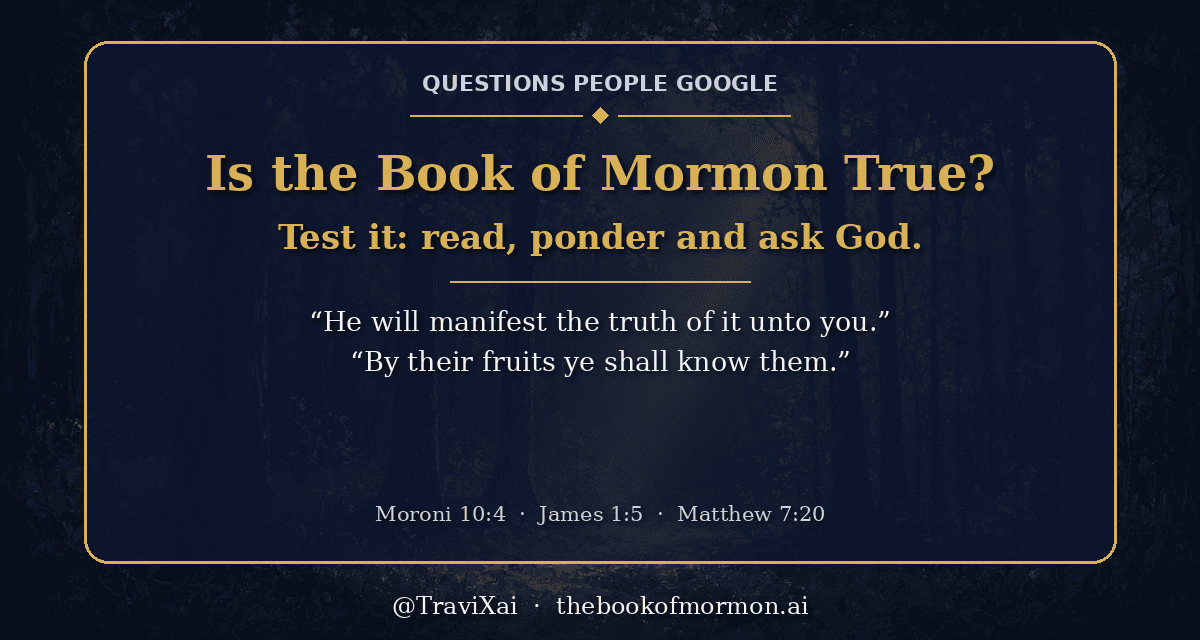
There is real evidence worth weighing, and there are fair caveats. But the book itself says the final answer comes another way: “ask God, the Eternal Father, in the name of Christ, if these things are not true; and if ye shall ask with a sincere heart, with real intent, having faith in Christ, he will manifest the truth of it unto you, by the power of the Holy Ghost. And by the power of the Holy Ghost ye may know the truth of all things” (Moroni 10:3–5).
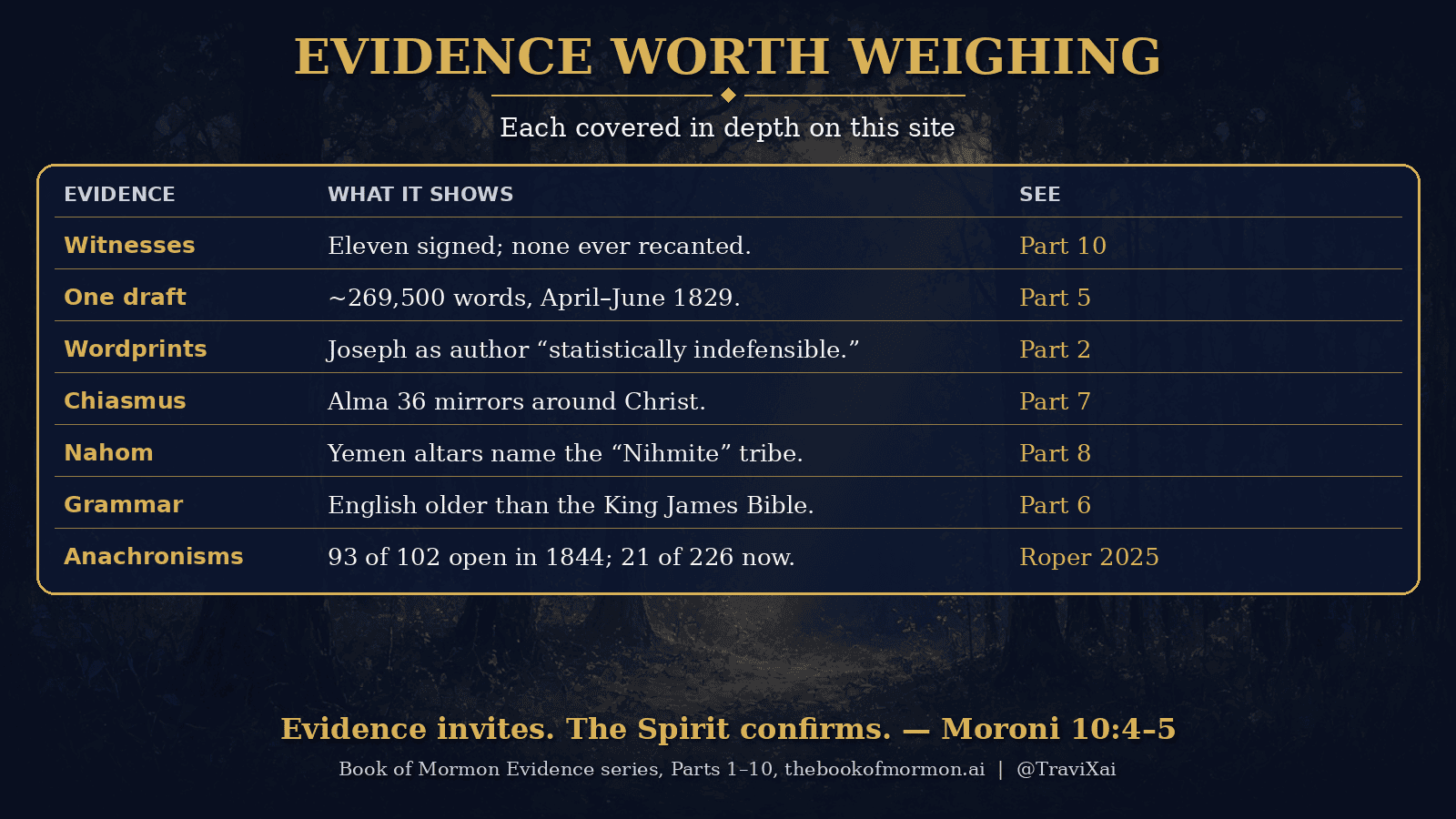
The evidenceWhat critics have to explain
Eleven witnesses. Three said an angel showed them the plates; eight said they “did handle [them] with our hands” (Testimony of Eight Witnesses). All three of the Three Witnesses later left the Church after falling out with Joseph Smith, and none ever denied what he saw (Part 10).
One draft in about three months. Between April and about June 1829, Joseph dictated roughly 269,500 words with no notes and no rewrite, according to his scribes (Part 5; see Who Wrote the Book of Mormon?). For the flashbacks and prophecies that one draft had to keep straight, see How Complex Is the Book of Mormon?
Many authors, not one. A Berkeley team spent about 10,000 hours on wordprint tests and called Joseph Smith, Oliver Cowdery or Solomon Spaulding as author of Nephi and Alma “statistically indefensible” (Part 2). BYU researchers counted 149 distinct voices with consistent verbal fingerprints (Part 1). For the studies that disagree and their weaknesses, see Part 3 and Part 4.
Ancient fingerprints. Alma 36 is built as a mirror with Jesus Christ at its center (Part 7). Nephi buried Ishmael at “the place which was called Nahom” and then traveled “nearly eastward,” and three altars from Yemen name a “Nihmite” tribe from about Lehi’s time (Part 8). Much of the book’s odd grammar is Early Modern English older than the King James Bible (Part 6). In 1844, 93 of 102 claimed anachronisms were unconfirmed; by a 2025 count, 21 of 226 remain (the shrinking list). Everything in one place: The Best Book of Mormon Evidences.
The fair caveatsWhat evidence can’t do
Honesty matters here. There are still open questions, such as specific Book of Mormon locations (the Church takes no position; see Book of Mormon geography), DNA (see Does DNA Disprove the Book of Mormon?), and the remaining unconfirmed items on the anachronism list. The Bible has open questions too; scholars still debate the Exodus route (see “No Archaeology”?).
Evidence can remove reasons to dismiss the book, but it can’t prove that angels appeared or that Christ visited the Americas, any more than archaeology can prove the Resurrection. That’s why the book points beyond evidence to God.
The testHow to know for yourself
Joseph Smith’s own story began with one verse: “If any of you lack wisdom, let him ask of God, that giveth to all men liberally, and upbraideth not; and it shall be given him” (James 1:5). He wrote, “Never did any passage of scripture come with more power to the heart of man than this did at this time to mine” (Joseph Smith—History 1:11–13).
Jesus gave a test for any prophet or book: “Ye shall know them by their fruits … every good tree bringeth forth good fruit” (Matthew 7:16–20), and “If any man will do his will, he shall know of the doctrine, whether it be of God” (John 7:17). Alma invited readers to “an experiment upon my words”: plant the seed, and “if it be a true seed … it will begin to swell within your breasts … it beginneth to enlighten my understanding” (Alma 32:27–28).
The Lord told Oliver Cowdery how revelation works: “you must study it out in your mind; then you must ask me if it be right, and if it is right I will cause that your bosom shall burn within you” (D&C 9:8–9). Modern revelation says the book exists for this purpose: “Proving to the world that the holy scriptures are true, and that God does inspire men and call them to his holy work in this age” (D&C 20:11–12). See also Read It and Ask: Moroni 10:4–5 and James 1:5.
Check the premiseThe presuppositions baked into the question
Before this question can be answered fairly, the person asking has to justify a few assumptions packed inside it:
- That the Book of Mormon has no evidence at all. Witnesses, wordprint studies, Nahom, Alma 36 and Early Modern English grammar all call for an explanation (Evidence series, Parts 1–10).
- That one unanswered question disproves it. The Bible has unanswered archaeological questions too, and the list of Book of Mormon “anachronisms” has shrunk from 91% unconfirmed in 1844 to about 9% today.
- That evidence alone should settle it. No evidence can prove a spiritual claim. Moroni 10:4–5 and James 1:5 invite readers to ask God.
- That asking God is just emotion. D&C 9:8 requires study first: “study it out in your mind; then you must ask me.” Jesus said to judge by fruits (Matthew 7:20).
FAQQuick answers
Is the Book of Mormon true?
Latter-day Saints believe it is a true ancient record of prophets in the Americas, translated by Joseph Smith by the power of God. The book invites every reader to ask God and promises an answer by the Holy Ghost (Moroni 10:4–5).
Is there evidence for the Book of Mormon?
Yes: eleven witnesses who never recanted, a three-month single-draft dictation, wordprint studies showing many authors, Alma 36’s chiasmus, the Nahom altars in Yemen, and Early Modern English grammar. See our ten-part evidence series.
Is the Book of Mormon historically accurate?
Many details once mocked now have support, and the number of open “anachronisms” has dropped sharply. Some questions remain open, and the Church takes no position on exact locations.
Can the Book of Mormon be disproven?
Critics have tried since 1830, and the list of claimed errors keeps shrinking. A single unanswered question isn’t proof against it, just as it isn’t for the Bible.
How can I know if the Book of Mormon is true?
Read it, ponder it, and ask God sincerely in the name of Christ (Moroni 10:3–5; James 1:5). Alma 32 describes the process as planting a seed and watching it grow.
What is Moroni’s promise?
That anyone who reads the Book of Mormon and asks God “with a sincere heart, with real intent, having faith in Christ” will learn the truth: “he will manifest the truth of it unto you, by the power of the Holy Ghost” (Moroni 10:4).
Who were the witnesses of the Book of Mormon?
The Three Witnesses (Oliver Cowdery, David Whitmer and Martin Harris) said an angel showed them the plates. The Eight Witnesses said they handled them. None of the eleven ever denied his testimony, even those who left the Church.
Does the Book of Mormon say it can contain mistakes?
Yes. Its title page says, “if there are faults they are the mistakes of men; wherefore, condemn not the things of God.”
SummaryKey takeaways
- Latter-day Saints believe the Book of Mormon is a true ancient record and another testament of Christ.
- The evidence is serious: witnesses, one draft, wordprints, Nahom, chiasmus, ancient grammar.
- Some questions are still open, and evidence can’t prove spiritual claims.
- Anyone can test it by reading, pondering and asking God (Moroni 10:3–5; James 1:5).
Read 3 Nephi 11 tonight and ask God about it. For quick, sourced answers, open Galatians18, and follow me on X at @TraviXai.
Sources
- King James Bible (churchofjesuschrist.org): Matthew 7:16–20 · John 7:17 · James 1:5
- Book of Mormon: Testimony of Eight Witnesses · 2 Nephi 25:26 · Alma 32:27–28 · Moroni 10:3–5
- Doctrine and Covenants: D&C 9:8–9 · D&C 20:11–12
- Pearl of Great Price: Joseph Smith—History 1:11–13
- Book of Mormon Evidence series, Parts 1–10, thebookofmormon.ai (each part lists its primary sources)
- Featured image and in-article graphic: original graphics by thebookofmormon.ai (painterly backgrounds; no photographs or likenesses of real people).