
The CES Letter has shaken a lot of people. Here’s a calm, sourced response to each of its chapters, with links to full answers.
The CES Letter is a 2013 list of concerns about the Church’s history by Jeremy Runnells, and every major chapter has a published, sourced answer. Most of its objections (anachronisms, archaeology, multiple accounts, textual changes) can also be raised against the Bible. The Church addresses the main topics in its Gospel Topics essays. Below is a faithful response to each chapter, with links to full posts.
What it isWhat the CES Letter is
The CES Letter is a long document by Jeremy Runnells. According to its own website, he wrote it in 2013, after what the site calls a “faith transition,” after a Church Educational System director invited him to share his concerns, and it was originally titled Letter to a CES Director (cesletter.org). It’s now organized into chapters on the Book of Mormon, its translation, the First Vision, the Book of Abraham, polygamy, prophets, the Kinderhook plates, testimony, priesthood restoration, witnesses, temples, science and “other” concerns (read.cesletter.org).
Many people who read it are sincere, and many come away shaken. This page is for them, and for the friends and family who want to help. It points to a faithful, sourced response for each chapter. We don’t question anyone’s motives. We look at the evidence.
How to read itThree principles before the chapters
1. Apply the same standard to the Bible
Almost every kind of objection in the CES Letter (anachronisms, missing archaeology, textual changes, multiple accounts of a vision) can be raised against the Bible too. Christians don’t abandon the Bible over these, and they shouldn’t apply a stricter standard to the Book of Mormon. See Bible Anachronisms and the Double Standard, No Archaeology? Exodus, Jericho and the Double Standard, and Bible Textual Variants.
2. Check the sources, both ways
Paul wrote, “Prove all things; hold fast that which is good” (1 Thessalonians 5:21). The Lord told the Saints to “seek ye out of the best books words of wisdom; seek learning, even by study and also by faith” (D&C 88:118). That includes reading the Church’s own Gospel Topics essays, which address most of these subjects directly.
3. Don’t leave God out of the question
Joseph Smith found that the religious teachers of his day “understood the same passages of scripture so differently as to destroy all confidence in settling the question by an appeal to the Bible” (JS-H 1:12), so he followed James 1:5 and asked God. Moroni promises that anyone who asks “with a sincere heart, with real intent, having faith in Christ” will receive an answer “by the power of the Holy Ghost” (Moroni 10:4–5). The Lord’s pattern includes both: “you must study it out in your mind; then you must ask me if it be right” (D&C 9:8).
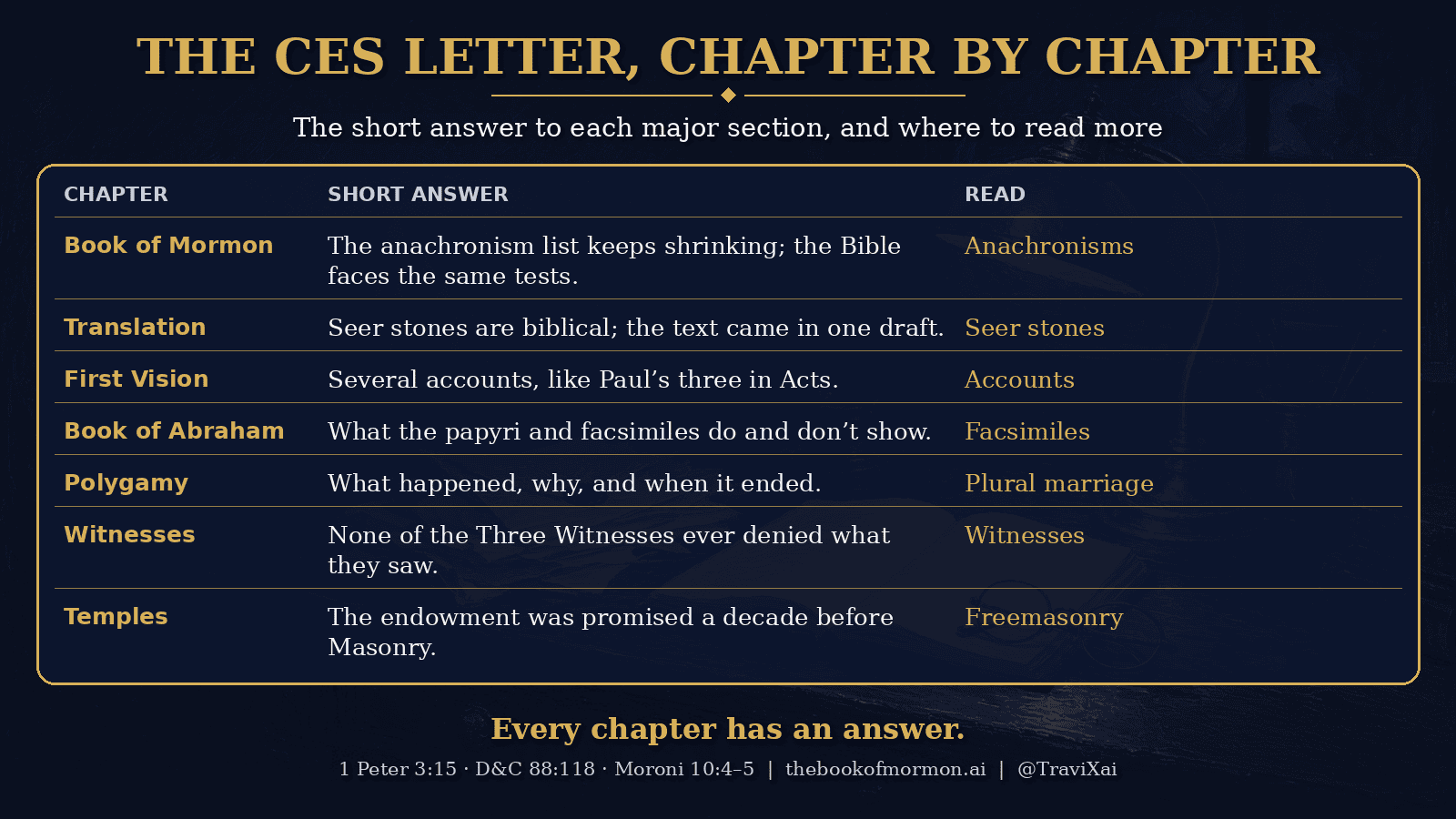
Chapter by chapterThe responses, chapter by chapter
Book of Mormon
The CES Letter lists King James Bible passages in the Book of Mormon, DNA, anachronisms, archaeology, geography and alleged sources like View of the Hebrews.
- Book of Mormon Anachronisms: The Shrinking List
- Does DNA Disprove the Book of Mormon?
- No Archaeology? The Double Standard
- Older Than King James
- The “Someone Else” Problem
- The Best Book of Mormon Evidences
- Gospel Topics essay: Book of Mormon and DNA Studies
Translation
Seer stones, the hat, and Joseph’s 1820s treasure seeking.
- How the Book of Mormon Was Translated
- Seer Stones in the Bible
- One Draft
- Joseph Smith the “Money Digger”
- The 1826 Hearing and the 1830 Acquittals
- Gospel Topics essay: Book of Mormon Translation
First Vision
Multiple accounts and alleged contradictions.
Book of Abraham
The papyri, the facsimiles and Egyptology.
- The Book of Abraham Facsimiles
- The Book of Abraham’s Ancient Roots
- Gospel Topics essay: Translation and Historicity of the Book of Abraham
Polygamy
Joseph Smith’s plural marriages and their history.
- Does the Church Practice Polygamy?
- LDS vs. FLDS
- Gospel Topics essay: Plural Marriage in Kirtland and Nauvoo
Prophets and Kinderhook
Statements by past leaders (including the priesthood restriction), the Kinderhook plates, and whether Joseph was a fraud.
- The Kinderhook Plates: What the Record Shows
- A Con Man Who Never Used His Best Evidence?
- Was Joseph Smith a Con Man?
- “Your Church Changes”: The Double Standard
- Joseph Smith’s Fulfilled Prophecies
- Race and the Priesthood: The Honest History and the 1978 Revelation
- Gospel Topics essay: Race and the Priesthood
Testimony and priesthood
Whether spiritual witness is reliable, and when priesthood restoration was recorded.
Witnesses
The witnesses’ worldview, “second sight” and family ties.
Temples
Freemasonry and the endowment.
Other
Church finances, the name of the Church and more.
The CES Letter’s science chapter (evolution and Adam) doesn’t have a dedicated post here yet. We’ll add it to this page when it does.
1 Peter 3:15Answering with meekness
Peter told Christians to “be ready always to give an answer to every man that asketh you a reason of the hope that is in you with meekness and fear” (1 Peter 3:15). If someone you love has read the CES Letter, start by listening. Their questions deserve real answers, not shame.
Jesus gave a test anyone can try: “If any man will do his will, he shall know of the doctrine, whether it be of God, or whether I speak of myself” (John 7:17). Read the critics, read the responses, read the Book of Mormon, and ask God.
Check the premiseThe presuppositions baked into the question
Before this question can be answered fairly, the person asking has to justify a few assumptions packed inside it:
- That the Church hides these topics. The Church publishes Gospel Topics essays on DNA, Book of Mormon translation, the First Vision accounts, the Book of Abraham, plural marriage and race and the priesthood, linked above.
- That an unanswered letter means there are no answers. Every major chapter has published, sourced responses, including the ones on this page.
- That a stricter standard should apply to Latter-day Saint scripture than to the Bible. The Bible faces the same kinds of objections: anachronisms, missing archaeology, textual variants and multiple accounts.
- That historical questions can be settled without God. Scripture invites both study and prayer (D&C 9:8; D&C 88:118; James 1:5; Moroni 10:4–5).
FAQQuick answers
What is the CES Letter?
A document by Jeremy Runnells, written in 2013 and originally titled Letter to a CES Director, listing his concerns about the Church’s origins and history. It’s organized into chapters on the Book of Mormon, translation, the First Vision, the Book of Abraham, polygamy, witnesses, temples and more.
Has the CES Letter been answered?
Yes. Each major chapter has published, sourced responses. This page links a faithful response for each chapter, along with the Church’s Gospel Topics essays.
Does the Church address the issues in the CES Letter?
Yes. The Church’s Gospel Topics essays cover DNA and the Book of Mormon, Book of Mormon translation, First Vision accounts, the Book of Abraham and plural marriage, among other topics.
What should I do if the CES Letter shook my faith?
Read the responses as carefully as you read the letter, apply the same standard you’d apply to the Bible, and pray about the Book of Mormon (Moroni 10:4–5; James 1:5). Talk with someone you trust.
How should I talk to a family member who read the CES Letter?
Listen first, take their questions seriously, and answer “with meekness and fear” (1 Peter 3:15). Share sourced responses instead of pressure.
Who wrote the CES Letter?
Jeremy Runnells, a former Latter-day Saint, wrote it in 2013 as a letter of questions to a Church Educational System director, then expanded it.
What are the Gospel Topics essays?
Articles the Church published from 2013 to 2015, with footnoted sources, on hard history topics such as plural marriage, Book of Mormon translation, the First Vision accounts and the priesthood restriction.
What does the Bible say to do with honest questions?
Ask God: “If any of you lack wisdom, let him ask of God, that giveth to all men liberally, and upbraideth not” (James 1:5). That verse is what sent Joseph Smith to the grove.
SummaryKey takeaways
- Every major chapter of the CES Letter has a published, sourced response.
- Apply the same standard to the Book of Mormon that Christians apply to the Bible.
- The Church’s Gospel Topics essays address most of these subjects directly.
- Study and prayer go together (D&C 9:8; Moroni 10:4–5).
Bookmark this page; it’ll grow as new responses are published. For quick, sourced answers, open Galatians18, and follow me on X at @TraviXai.
Sources
- King James Bible (churchofjesuschrist.org): John 7:17 · 1 Thessalonians 5:21 · James 1:5 · 1 Peter 3:15
- Book of Mormon: Moroni 10:4–5
- Doctrine and Covenants and Pearl of Great Price: D&C 9:8 · D&C 88:118 · JS-H 1:11–12
- cesletter.org and read.cesletter.org (description, history and chapter list of the CES Letter)
- Gospel Topics essays, churchofjesuschrist.org: Book of Mormon and DNA Studies · Book of Mormon Translation · First Vision Accounts · Translation and Historicity of the Book of Abraham · Plural Marriage in Kirtland and Nauvoo
- Featured image and in-article graphic: original graphics by thebookofmormon.ai (painterly backgrounds; no photographs or likenesses of real people).